When the United States and Israel launched the war on Iran in February, their plan was simple: bomb Iran until either the Iranian public rose up and overthrew the government, or the existing government capitulated to American demands. It rapidly became apparent that neither was going to happen. The Iranian people didn’t revolt against their oppressors. The Iranian government hunkered down, closed the strait, and gambled that the U.S. would be unwilling to invade or strike at crucial infrastructure.
So it seems U.S. planners made an obvious, if common, mistake: They assumed that a war could be won via aerial bombing alone.
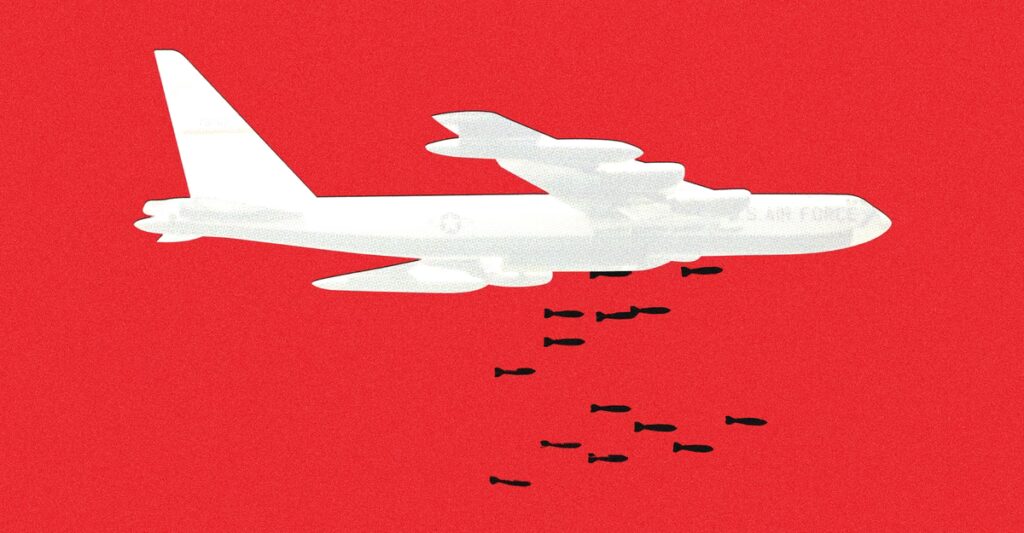
Starting right after World War I, military theorists in the United States, Italy, and the United Kingdom rallied around the idea that airpower lessened or eliminated the need for armies and navies. Their central thesis was that wars could be won almost exclusively with bombers and bombing campaigns.
In his 1921 book, Il dominio dell’aria (“The Command of the Air”), Italian General Giulio Douhet argued that whichever nation claimed air superiority first would be able to bomb their enemies’ cities to ash, forcing capitulation. Marshal Hugh Trenchard, the so-called father of the Royal Air Force who pioneered strategic-bombing theory during World War I, thought that airpower could break an enemy’s will to fight rather than merely provide tactical support for ground troops. And General Curtis LeMay, an American champion of strategic bombing, believed that overwhelming, concentrated force was the best way to win a war. He favored the use of incendiary weapons against urban centers and of immediate, devastating strikes instead of gradual escalation.
[Read: The price of defeat in Iran]
When these theories of total war through bombing were put to the test in World War II and beyond, however, they failed miserably. The German Blitz on London did not induce the British public to give in. Allied bombing of Germany did not break the Nazis’ will to fight; the German collapse at the end had much more to do with the (justified) fear of being captured by the Red Army, and the opportunity to surrender to the Americans.
In the case of Japan, the combination of the naval blockade and firebombing of cities left millions of Japanese people likely to die if the war went on into 1946. However, it was not until the atomic bombings of Hiroshima and Nagasaki, plus the Soviet invasion of Manchuria, that Japan sought a nearly unconditional surrender.
Strategic bombing failed in Vietnam as well. In that war, the U.S. dropped approximately 7.6 million tons of bombs, compared with the roughly 2.7 million tons dropped by the U.S. military across the European and Pacific theaters in World War II. The “Christmas bombings” of 1972 were not enough to persuade North Vietnam to offer favorable terms; rather, the Paris Peace Accords of 1973 were a result of U.S. exhaustion with the war. They paved the way for North Vietnam to conquer the south in 1974–75.
The advent of “true” mass precision bombing in the 1990s led some analysts to conclude that the rules of war had changed, and that airpower alone was at last sufficient. But the supposed examples of victory through aerial bombing aren’t what they seem. The first Gulf War ended only after U.S. troops went into Kuwait in a 100-hour-long charge. In Serbia in 1999, Slobodan Milošević’s capitulation to a united NATO’s demands was based on fears of regime survival and the credible threat of ground invasion. The air campaign in Afghanistan succeeded because the U.S. had allies on the ground willing to fight for, take, and hold territory in the form of the Northern Alliance. In each case, there were troops on the ground, or a credible threat thereof. A study by the RAND Corporation in 1996 on the capabilities and limitations of the psychological effects of U.S. air operations cautioned leaders that airpower alone was unlikely to coerce an enemy to offer favorable terms, unless there were other factors at play. Those external influences include the enemy’s belief that they would be defeated on the battlefield, that continued fighting would not improve their position, that damage from air attacks would likely be worse than concessions, and that there would be no hope of mounting a defense or effective counterattack.
The U.S. plan for attacking Iran was doomed from the start because it relied on airpower without the benefit of external factors that would have made an air campaign successful. There was no credible threat of mass ground invasion to overthrow the Iranian regime. It was either internal revolution or nothing.
The U.S. was also unwilling to inflict the sort of mass casualties and suffering that might have caused Iran to decide that capitulation was less damaging than continued resistance. The administration generally avoided targeting crucial infrastructure such as water and electrical plants and ground lines of communication (bridges and rail). And it was unwilling to resort to something drastic, such as setting off a nuclear electromagnetic-pulse weapon to permanently disable the majority of Iranian infrastructure.
[Karim Sadjadpour: Trump’s second gamble on Iran]
Unlike Serbia or Afghanistan, Iran had the ability to fight back and inflict significant pain on the United States. Iran fully grasped, from the beginning, that the outcome of the war would be determined by who could withstand the closure of the Strait of Hormuz. The regime always had a plausible theory of victory and pursued it logically and consistently throughout the conflict.
Senior U.S. military leaders have spent decades studying warfare from every angle and must have understood the possibility of a prolonged regional conflict. In fact, General Dan Caine reportedly cautioned the Trump administration against attacking Iran.
But President Trump and Secretary of Defense Pete Hegseth did not appreciate the need for caution. Hegseth gained his experience at the tactical level, as a junior officer in the field. He seems to believe that technological might and physical strength, rather than carefully thought-out strategy, win wars. An Army captain in the field might see dropping a 2,000-pound munition on a house as a self-contained solution to his troops taking fire; a flag officer understands the risk of it creating 100 more enemies next week.
The consequences of the botched war effort are nothing short of catastrophic. The U.S.’s munitions stockpiles are depleted, its military reputation is in tatters, its foreign relations are strained to the breaking, and Iranian leadership is in the best strategic position it has ever been in. It’s a hard way to relearn the old lesson that airpower alone doesn’t win wars.
The post America’s Big Mistake in Iran appeared first on The Atlantic.