Ariel Kalil is a professor and Susan Mayer is a professor emerita of public policy at the University of Chicago Harris School of Public Policy.
National and district-level data confirm an alarming decline in student test scores over the past decade and a half. Lower-performing students have fallen furthest, widening the gap between the highest and lowest achievers. About 40 percent of fourth-graders now read below the NAEP basic level, the largest share since 2002.
A popular explanation is the proliferation of digital devices in schools. The timing seems right: Test scores began to drop around 2013, just as smartphones and tablets became ubiquitous. The argument goes that banning screens in schools will restore scores. But the argument is wrong, and so is the solution, because school is where children spend the least time on screens.
In fact, between birth and age 18, children spend roughly 15 percent of their waking hours in school. The rest of their lives happen at home. And home is where the teens are on their screens, according to a 2025 study that gathered data from tracking apps. On average, teenagers in that study spent about 5½ hours a day on their smartphones, only about 90 minutes of it during school hours.
The argument that banning phones in schools will reverse the test score decline also misses a bigger point. Disadvantaged children arrive to kindergarten already far behind their more affluent peers in reading and math skill development, long before they have set foot in a classroom or spent their days with a Chromebook. Expanding preschool is one response, but the research on its effects is unsettled, and achievement gains from preschool typically fade by third grade. The gap is built at home, in the years before school — and that is where any solution must reach.
A better solution than banning screens in schools is to focus on helping parents support their children’s skill development in the years before formal schooling begins, so that all children can enter kindergarten on an equal footing. Our research using the American Time Use Survey finds that mothers with a bachelor’s degree spent an average of 2½ times as long as mothers with only a high school diploma participating in learning activities, such as reading and talking, with their preschool-age children — roughly eight more minutes per weekend day. Eight minutes sounds trivial. But over the course of a year, it adds up to many additional hours of shared reading and talking. Shared reading, play and daily conversation are essential to building children’s language and literacy skills. The policy question is how to reach parents during the hours that schools never will.
The good news is that the technology that is blamed for the skills crisis can also be part of the solution — not in school, but at home, where the hours that matter are spent. Research from our lab shows that text-delivered conversation prompts nearly doubled the frequency of open-ended parent-child language interactions among low-income families. A preloaded digital library used for an average of just seven minutes a week moved children’s language scores from the 40th to the 50th national percentile. Math apps used by parents without college degrees closed roughly one-third of the initial skills gap. Less-educated parents are also less likely to limit the time of day or length of time children can use screens. Low-cost text message interventions could be developed to modify this parental behavior. These are not complex solutions. What is missing is a policy infrastructure to deliver them at scale.
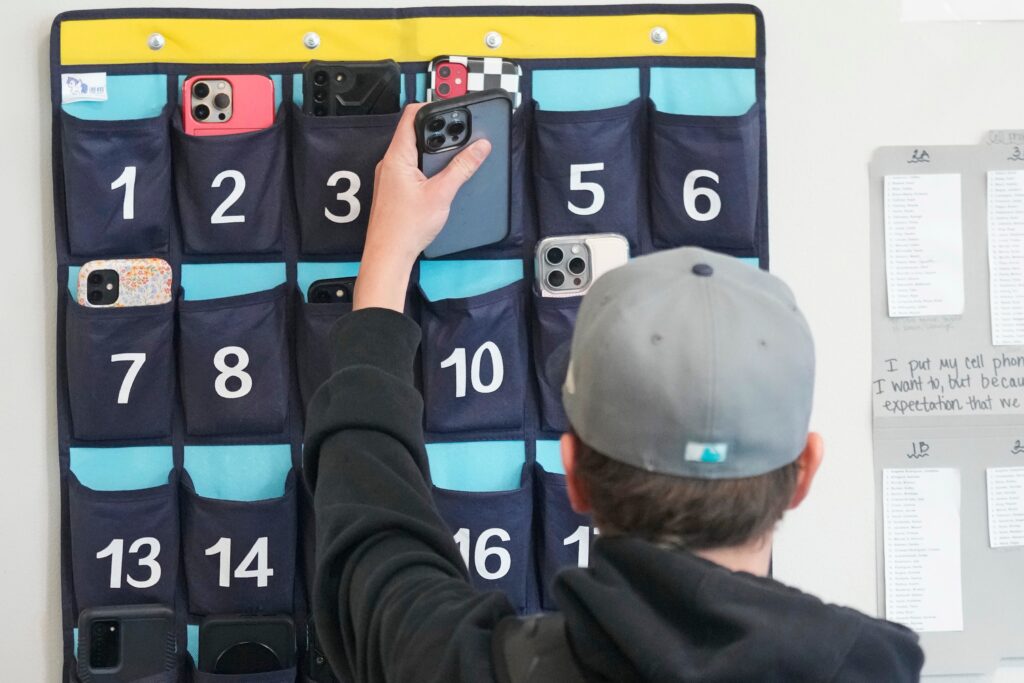
Schools can lock phones in pouches and return to paper and pencil rather than Chromebooks. They cannot determine what children do at home. And because less-educated parents are less likely to set screen time limits, the children most at risk of skill deficits are also the ones with the least structure around screen time at home. A school ban touches a fraction of the hours that matter.
None of this means that reducing screen time in schools is a bad idea. A new study found that strict bans, requiring students to lock phones in pouches for the school day, made both teachers and students happier. That matters. But the same study found no effect on test scores, attendance or self-reported classroom attention.
Nor is all screen time the same: The effectiveness of educational technology varies considerably depending on what skills it targets and how it is designed. The question is not whether screens belong in children’s lives but which uses of technology build skills and which do not.
The gap between advantaged and disadvantaged children is rooted in the years before school starts and in the hours after it ends. Banning screens in school is the easiest intervention to implement. But it is not the one that will move the needle. The tools to do better already exist — what is missing is the will to deploy them where children actually spend their time.
The post School phone bans make big promises. They won’t solve this problem. appeared first on Washington Post.