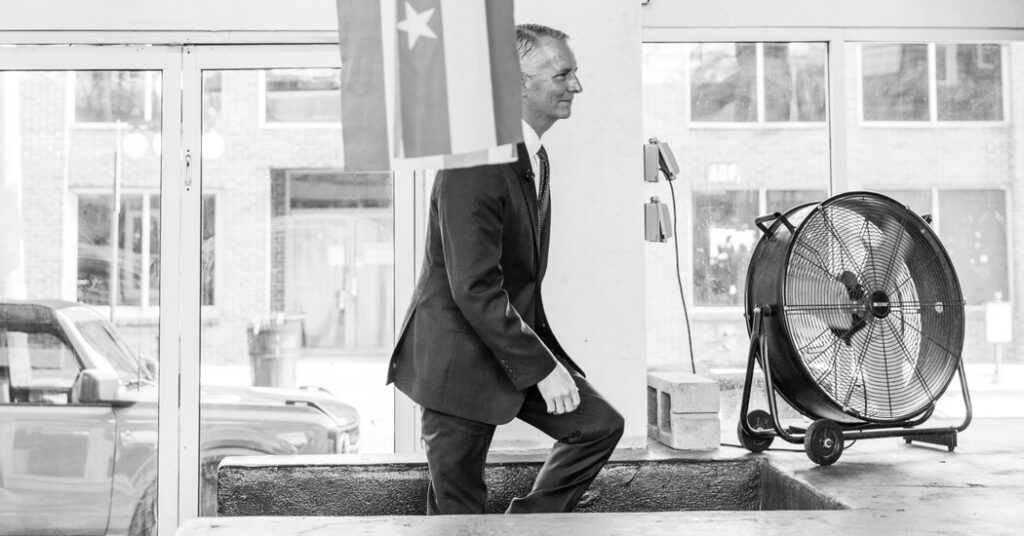
“I’ve got some breaking news: We’re winning,” the Florida gubernatorial candidate David Jolly observed at a recent Democratic picnic near Fort Lauderdale. Though Mr. Jolly is a mild-mannered lawyer with suburban-dad vibes, the crowd erupted as if a rock star had just screamed that his biggest hit was coming next. “I know, that’s crazy,” he continued. “But this is a blue wave!”
It does sound a bit crazy, when Florida Republicans have won seven consecutive governor’s races, and now hold every statewide office along with supermajorities in both houses of the State Legislature. But it’s true that state Democrats are on a roll. With the costs of living soaring and President Trump’s approval rating slumping, they’ve flipped the Miami mayor’s office, a long-shot State Senate seat and even the State House district covering Mar-a-Lago.
Mr. Jolly, a former Republican congressman who sometimes sounds more like a consultant than a candidate, believes that blue wave is building into the biggest tsunami since the post-Watergate wipeout of the G.O.P. in 1974. His campaign reflects that confidence. Even though he became a Democrat only last year, he’s running on a fairly conventional Democratic agenda, betting that voters are so sick of his old party that he can win without distancing himself from his new party. He’s selling himself as a serious-minded problem solver, laser-focused on making Florida less expensive. He told me he’s “building a coalition to Bring Back Boring.”
Mr. Jolly believes Floridians are so exhausted by ferocious Republican culture wars over book bans and rainbow crosswalks that he can prevail simply by promising normalcy, decency and affordability. But while that may sound like a safe strategy, counting on a massive blue wave in a red state carries risks of its own. If Mr. Jolly wants to win a state Mr. Trump won three times and Gov. Ron DeSantis won in a 19-point landslide, he’ll need to persuade voters who have been increasingly hostile to Democrats that he’s a different kind of Democrat.
It wasn’t long ago that Florida was the land of the electoral cliffhanger; President George W. Bush famously won it by only 537 votes, and Mr. Trump, President Barack Obama, Senator Rick Scott and Mr. DeSantis all won statewide races by just 1 percent. But as Republican baby boomers moved south, Florida has transformed from the ultimate swing state into something politically closer to southern Alabama.
In 2022, Mr. DeSantis thrashed another Republican-turned-independent-turned-conventional-Democrat, former Gov. Charlie Crist, and Democratic voter registration has plunged nearly 20 percent since then. There are now 1.5 million more registered Republicans than Democrats here — and the G.O.P. front-runner to succeed Mr. DeSantis, Representative Byron Donalds, has raised almost 14 times as much campaign cash as Mr. Jolly. Even Mr. Jolly acknowledges that Florida Democrats are “still a long way from winning back hearts and minds.”
Many Democrats outside blue America are facing the same challenge; polls consistently show that Mr. Trump’s struggles have tarnished the Republican brand without reviving theirs. But some of them are at least trying to woo swing voters by tacking away from their party’s base, as Mr. Trump did in 2024 by pledging not to cut Medicare or Social Security, and as former President Bill Clinton did in 1992 with his attack on the rapper Sister Souljah’s anti-white rhetoric. The Senate candidate James Talarico has called out Democratic weakness on border security and hostility to oil and gas in Texas, while Mary Peltola has pushed gun rights in her Alaska Senate race.
As a fifth-generation Floridian, son of a Baptist pastor and former Republican who was fighting abortion and Obamacare in Congress just a decade ago, Mr. Jolly ought to be perfectly positioned to show independence from the Democratic brand. He hasn’t, though. He now supports abortion and Obamacare; he says he left the G.O.P. not because the party changed but because he changed. He told me he doesn’t think governors should wade into children’s sports issues, and pledges on the stump to “stop the attacks on the L.G.B.T.Q.+ community.” He doesn’t even describe himself as a “moderate” or a “centrist” anymore; the closest he’ll come is “pragmatist.” Several of his signature proposals are, he says, “pretty far left,” including a cap on utility rate increases, a government-run property insurance fund and huge new investments in K-12 public schools.
Mr. Jolly did call for Sheila Cherfilus-McCormick, a former Democratic representative, to resign over fraud allegations, but other than that mini-Sister-Souljah moment, he’s avoided partisan heresy. He focused on affordability before it was trendy, and after watching that strategy work for Democrats ranging from the democratic socialist mayor Zohran Mamdani in New York City to the moderate governor Abigail Spanberger in Virginia, he doesn’t think he needs to stray from Democratic orthodoxy to show voters he can solve their most urgent problem. I once saw him tell a crowd of Democratic regulars that the only thing they needed to improve was their messaging, which felt like hopium in a state where the Democratic Party is down to 30 percent of registered voters.
Maybe sticking to the party line made some tactical sense when Mr. Jolly faced a Democratic primary against Jerry Demings, an African American mayor with closer ties to the base. But Mr. Demings dropped out earlier this month, and Mr. Jolly still says he’s not planning any major policy shifts toward the middle.
Instead, he’s hoping his nonthreatening, relatively nonpartisan approach will be enough to win over swing voters skeptical of Democrats. He’s not trying to fight the culture wars Mr. DeSantis has waged against gender transition care and “D.E.I.”; he’s just calling for a cease-fire in those wars. And after spending the last few years preaching to the Democratic choir as an MSNBC contributor, Mr. Jolly rarely even mentions Mr. Trump.
He’s focusing instead on the costs of housing, health care and electricity; over the course of our day together, he didn’t even try to exploit voter disgust with high gas prices, which are less connected to state policies. He recently announced that his running mate will be former Representative Gwen Graham, who was also known as a moderate when she represented a conservative district in Congress but ran a similarly conventional Democratic campaign for governor in 2018.
The real message of Mr. Jolly’s campaign, like President Joe Biden’s in 2020, is that politics doesn’t have to be so angry and all-consuming; it’s a case for governing after years of yelling. The three core principles he lays out in his speeches — the economy should work for everyone; government should help when needed; and everyone’s rights should be protected — are not exactly provocative. At a campaign stop in Pembroke Pines, when he was informed that a sign outside City Hall that read “WE ARE BUILDING AN INCLUSIVE COMMUNITY” might run afoul of the DeSantis crackdown on D.E.I., Mr. Jolly’s mild response was: “We won’t govern that way.”
Emily Gregory, the Democrat who recently flipped that Republican-leaning Mar-a-Lago State House district in March after Mr. Trump won it by 11 points in 2024, said she won it with a Jolly-style campaign — technocratic, affordability-focused and moderate-coded without rejecting any specific Democratic policies. She talked a lot about being a small-business owner and a military spouse, but says she never mentions Mr. Trump. “Most Floridians are tired of the toxicity; they just want to hear reasonable solutions,” Ms. Gregory told me.
Mr. Jolly’s theory of the case is that Florida Republicans are so addicted to toxicity that his old limited-government principles — government should stay out of your bedroom, the classroom and most of your life — are now Democratic principles. Ms. Gregory won her special election even though more Republicans voted than Democrats, and Mr. Jolly believes he can do the same.
But a low-turnout special election is different from a high-profile statewide race, and Mr. Jolly might look more appealing to non-Democrats if he were willing to stand apart from Democrats on any high-profile issues. I kept asking if there was any daylight between him and his party — on crime, immigration, taxes, climate change or anything else — but he wouldn’t bite. He said he doesn’t need to throw Democrats under the bus when Republicans are rewriting history curriculums to downplay the harms of slavery, brazenly gerrymandering congressional districts for partisan motives and otherwise drifting out of the mainstream.
Mr. Donalds, his likely G.O.P. opponent, is running as a Trump fan in a Trump state; he recently gave Mr. Trump an A grade on the economy, and he’s already attacking Mr. Jolly as a “radical leftist” out of step with MAGA Florida. Whoever emerges from the Republican primary will have hundreds of millions of dollars to portray Mr. Jolly as an ultrawoke Mamdani clone who plans to raise taxes and ban sunshine. But Mr. Jolly doesn’t think voters will believe that he’s radical or leftist or ultra-anything, especially in the political climate of 2026.
“In this environment, go for it,” Mr. Jolly told me.
He’s convinced that Floridians are so desperate for change that they’ll finally give a Democratic governor a chance. It’s possible. But they might be more desperate if they thought the Democrat on the ballot was different from the Democrats they’ve been rejecting for years.
Michael Grunwald is a contributing Opinion writer and the author, most recently, of “We Are Eating the Earth: The Race to Fix Our Food System and Save Our Climate.”
The Times is committed to publishing a diversity of letters to the editor. We’d like to hear what you think about this or any of our articles. Here are some tips. And here’s our email: [email protected].
Follow the New York Times Opinion section on Facebook, Instagram, TikTok, Bluesky, WhatsApp and Threads.
The post Is Florida Finally Tiring of Toxic Republican Politics? appeared first on New York Times.