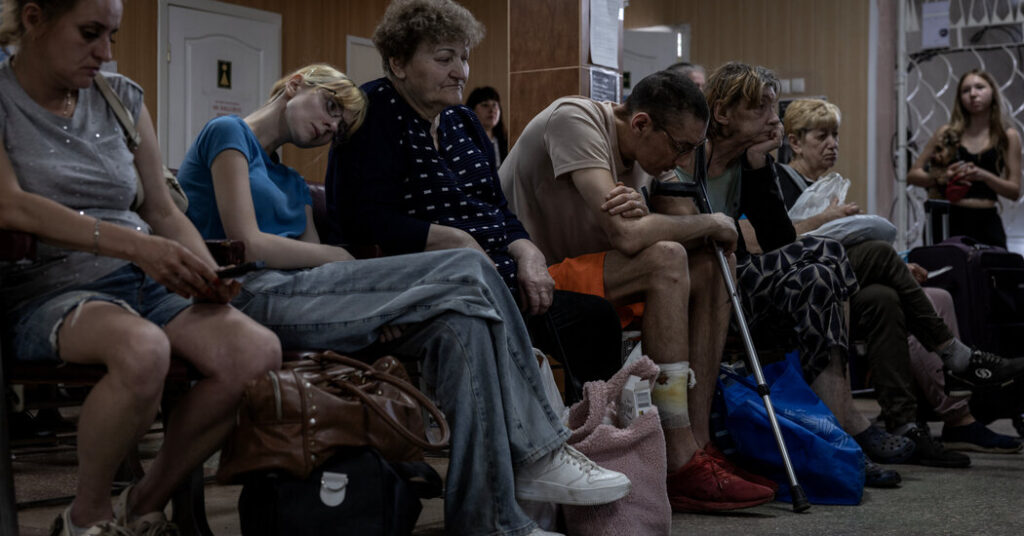
Nadiya Trofimchuk, 79, had lived in the eastern Ukrainian city of Sloviansk her whole life and never thought about leaving, even as war raged for years not 20 miles away. Yet there she was one recent morning at a makeshift evacuation center, sitting next to a small folding table with water and tea but touching neither, just focused on leaving.
“We had a strike,” she explained, eyebrows raised over purple and gold cat-eye glasses. “A very, very, very big strike.”
In that April attack, Russia dropped a 3,000-pound bomb in the middle of the city, wiping out almost an entire block. It was a grim omen for Sloviansk and the rest of the Donetsk region, the Kremlin’s most coveted prize. Ukrainian forces have spent years fortifying and defending the strategic territory at immense cost, and it is now under an onslaught that residents fear is the beginning of the end.
The sense of foreboding in Donetsk is a sobering development for Ukraine at a moment when it has otherwise received a boost from a campaign of longer-range strikes and the stalling of Russian forces along most of the front.
Russia still has superior numbers and firepower. And after years of grinding warfare in the region, its forces have been concentrating on the “fortress belt” cities of Sloviansk, Kramatorsk, Druzhkivka and Kostiantynivka, part of the roughly 20 percent of Donetsk that Ukraine still controls.
Russian troops have fought their way into Kostiantynivka. Druzhkivka is a wasteland. That leaves Sloviansk and Kramatorsk as Ukraine’s last real strongholds in Donetsk.
The two cities are not in imminent danger of falling. But Moscow’s forces have advanced close enough to batter them with growing numbers of glide bombs and exploding drones. Thousands of civilians have fled as life has become more untenable.
Russia’s deployment of the 3,000-pound bomb in Sloviansk prompted worries that it would increasingly turn to even more brutal tactics. Moscow has used such weapons to level and clear out other Ukrainian cities, leaving soldiers to fight for control of smoking rubble.
Ukraine has resisted Trump administration pressure to hand over the Donbas region, which includes Donetsk, and grant President Vladimir V. Putin of Russia his central demand in peace negotiations. While Kyiv insists that it will keep fighting for the region, there might be little left of its main cities to defend.
Bakhmut. Avdiivka. Chasiv Yar. Toretsk. All of these cities suffered that fate, and are front of mind to those now evacuating from Sloviansk, Kramatorsk and their surroundings.
Lena, 71, who was awaiting evacuation farther west, said that her city, Mykolaivka, was already burning, “erased from life” by explosions.
“Everything is destroyed, and it’s not even over yet,” she said hoarsely, patting her chest as if to calm a racing heart. She declined to give her last name.
For years, Sloviansk and Kramatorsk have hung on as Russian forces inched closer. The cities are protected by the fortifications that Ukraine constructed after Russia first began to stir up conflict in eastern Ukraine in 2014.
In December, when Russian forces seized control of the town of Siversk, which sits on high ground, the links of the fortress belt began to crack.
Russian troops slowly advanced to the cities of Lyman and Kostiantynivka. They got close enough to Sloviansk to start regularly striking it with small exploding drones, prompting what has become an exodus of civilians.
By April, about 1,000 people were leaving the city each week, local officials said. The city’s population has dropped to less than 44,000 from about 50,000 in March.
Battlefield maps show that Russian forces are still creeping forward, east of Kramatorsk and Sloviansk. At their current rate of advance, it would take them years to seize those cities and the rest of Donetsk. It took Moscow 18 months to take Toretsk, and 22 months for Pokrovsk, another city in the region.
But Russia can devastate the cities without having to seize them.
Senior Lt. Vadym Kostrytskyi, a commander in Ukraine’s 30th Mechanized Brigade, said Russian forces were trying to get as close as possible so that they could hammer logistics routes and strangle Kramatorsk and Sloviansk into submission.
Already, he said, Kramatorsk was “fading away” before his eyes, emptying more with each strike, as Russia shifts more toward “destroying populated areas” in that city and in Sloviansk.
Vladyslav Arseniy helps with the evacuations. When attacks started intensifying about six months ago, he said, East SOS, the humanitarian organization he works for, started allowing him to keep a drone detector in his van.
He no longer goes to Druzhkivka because it is too dangerous. Most of his work is in Sloviansk and Kramatorsk, but “there will come the point where we will not be able to go,” he said over a coffee before his next pickup.
Just down the road sat the charred wreckage of a Ukrainian military vehicle, which had been hit by a drone that morning. Firefighters sprayed down the pavement as teams worked to repair damaged anti-drone netting above it.
The netting, which is intended to catch Russian drones before they reach their target and explode, has proliferated across eastern and southern Ukraine along with the reach of Russian F.P.V.s. It now covers roads in and out of Sloviansk and Kramatorsk, as well as some streets within the cities.
Each week, Sloviansk’s main hospital treats 10 to 15 civilians with drone-related injuries, according to its director, Volodymyr Ivanenko.
He said he and his colleagues were bracing for a time when it becomes too dangerous to move around the city. The maternity ward closed after sustaining damage in a strike in June. Preparations are underway to turn the main hospital building into a hub if other satellite buildings are forced to shut down.
For now, evacuations are mostly voluntary, and sometimes carried out against a backdrop of explosions.
Yuri Tarasov, 75, slumped in a chair in the evacuation center one recent morning. The previous night, a Russian strike had destroyed his home in Mykolaivka.
“There are no houses, none intact,” he kept repeating, resting an arm on a bag containing seemingly whatever he had been able to grab: a tablet, undershirts, underwear, a pillbox and a small angle grinder.
“I didn’t have time to change my shoes,” he said, weeping. Nor was he able to bring Palma, his dog, and two cats.
Palma was so smart, he started to say, until an air-raid siren interrupted. Glide bombs were in flight. Mr. Tarasov hobbled on a crutch down to a shelter, where he settled into a blue plastic chair and stared into space.
Three days later, a few miles down the road in Kramatorsk, Pavlo Dyachenko, a regional police official, was having a busy morning. Glide bombs had hit the city at around 5 a.m. The explosions woke him, and he immediately drove to the scene. Another wave of booms came at around 11 a.m. After a quick coffee, he would need to go record the impact. Two people were trapped under the rubble, presumed dead.
Mr. Dyachenko came to Kramatorsk by way of some of the war’s worst battles, evacuating civilians in Bakhmut, then Toretsk, Pokrovsk, Siversk, Avdiivka. So he has seen how the death of a city begins.
Photographs on his phone cataloged how life had become more dangerous in Kramatorsk, with images of destroyed buildings, destroyed homes, a severed foot in the trunk of a car.
“Stores are closing. People are evacuating and leaving,” Mr. Dyachenko said, adding: “Living here is frightening.”
Kramatorsk was a ghost town that sunny afternoon. The park was empty, as were most streets, except for teams repairing netting alongside men with anti-drone guns keeping eyes on the sky.
It would not be the end of Mr. Dyachenko’s workday. A few hours later, a third wave of bombs hit central Kramatorsk.
That was the day Maryna, 35, finally fled the city.
A man had been blown apart in front of her. The market kept getting hit, as did buildings next to hers, she said in a monotone, barely blinking. So she had to leave, but wished her mother had come with her.
They had fled Kramatorsk once before, when war broke out in 2022, but returned in 2024.
“Everyone hoped to God that everything would get better,” said Maryna, who declined to give her last name. “But it keeps getting worse, worse and worse.”
The more the front approaches, the more people like Maryna are being taken west to a hub for displaced people in Lozova.
On this day, a large yellow bus pulled up, discharging 31 evacuees. Not 15 minutes later, a van pulled up with 16 more, then a bus with another 30.
Angelina, 4, had just arrived from Kramatorsk with her family. She was shy when asked about her red sequined backpack, but lit up when she showed off her stuffed woolly mammoth, Motya.
“My Motya is beautiful,” she said. As her mother returned from filling out registration paperwork, Angelina held Motya out for a pet.
“We are leaving for a new home,” she beamed, waving goodbye.
Olha Kotiuzhanska and Denys Denysov contributed reporting.
The post Thousands Are Fleeing as Putin Bombs the Donbas Cities He Most Covets appeared first on New York Times.