Jim Banks, a Republican, is a U.S. senator from Indiana and an author of the pending Beautifying Federal Civic Architecture Act of 2025.
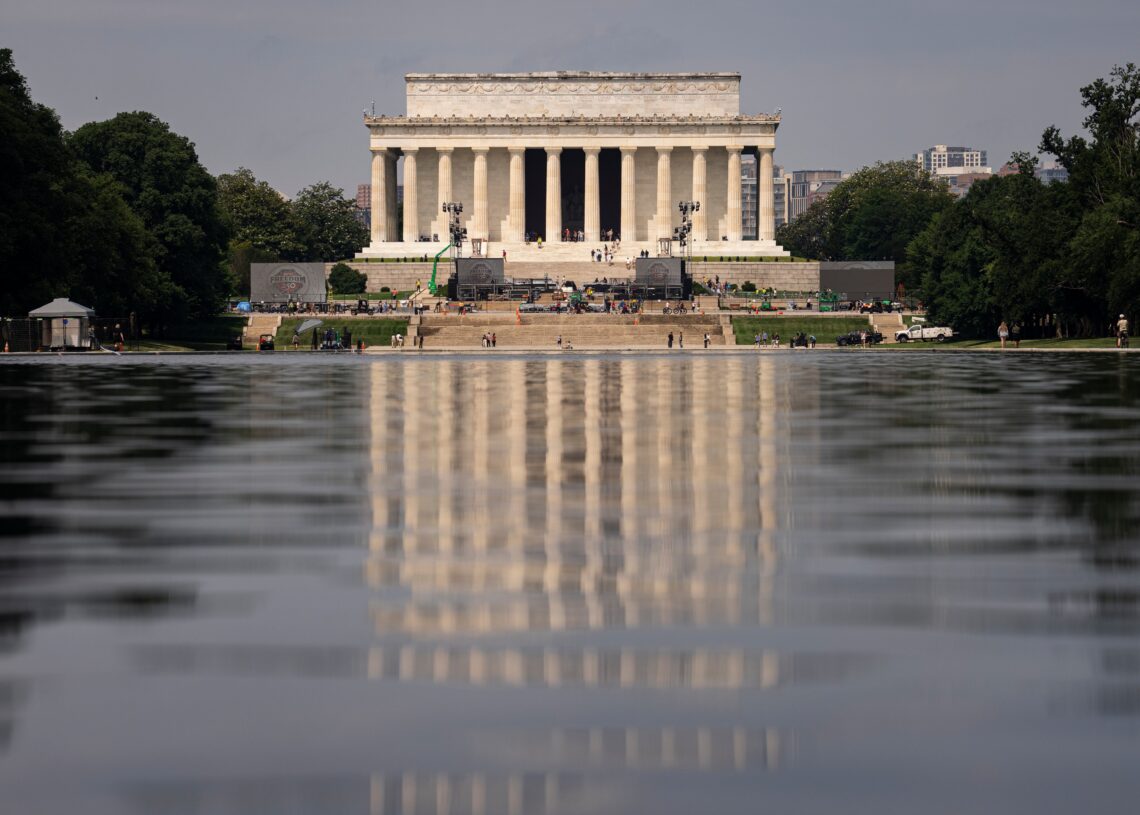
One of the highlights of my job as a U.S. senator is meeting Indiana veterans while they tour the National Mall. It’s a weighty experience for everyone involved. The Vietnam Veterans Memorial and the Korean War Veterans Memorial, where we often meet, sit on opposite sides of the Mall’s Reflecting Pool, at probably the prettiest point in Washington. The harmony of the surrounding neoclassical monuments creates a sense of permanence.
Congress has already recognized the aesthetic importance of this area, declaring it a “substantially completed work of civic art” and prohibiting new construction from the Lincoln Memorial to the Capitol and from the White House to the Jefferson Memorial. Unfortunately, the federal city surrounding the Mall offers a less inspiring vision.
Pennsylvania Avenue east of the White House features some of Washington’s most stunning buildings — but the array is interrupted by the J. Edgar Hoover Building, the FBI’s monstrous brutalist headquarters. Independence Avenue is lined with elegant Smithsonian museums but blotted by the grotesque Hubert H. Humphrey Building, also brutalist, containing the Department of Health and Human Services. That structure borders the American Veterans Disabled for Life Memorial. I have watched veterans honor sacrifice and loss while they stand in the shadow of one of the ugliest buildings in the nation’s capital. It is gut-wrenching.
Brutalism, which emerged in postwar Europe, is marked by concrete blocks and hostility toward ornament. There is nothing transcendent behind the design. No aspiration. Brutalism seems designed to make citizens feel small. It’s no surprise that the Soviet Union embraced it so readily. The style stands in opposition to the graceful and human-scaled tradition that defined the first two centuries of the American republic.
The truth is that architecture teaches, even when no one notices. A citizen who approaches a courthouse framed by columns of the classical orders instinctively understands that justice is something noble and enduring. A veteran who stands before a magnificent memorial senses that sacrifice has meaning. Children who walk into a school filled with light and symmetry learn that they matter. Beauty in public life must not be treated as a niche academic interest, much less a privilege reserved for elites.
It probably seems strange for anyone other than an architect — let alone an elected official — to care this much about the aesthetics of buildings. I didn’t grow up around artists or intellectuals. I grew up in a trailer park in Columbia City, Indiana, the kind where two boys shared a bunk bed and summer heat made the walls sweat. My father worked in a factory that made axles. My mother took pride in meals cooked slowly at the stove. Nobody spoke about Vitruvius or Palladio or theories of design.
Yet beauty was still present. I remember being awed by the Whitley County courthouse in the center of my hometown. Its Indiana limestone exterior, soaring clock tower and galvanized dome impressed something upon me long before I had language for it.
Not long after returning from military service in Afghanistan, I traveled to Italy with my wife and encountered truly supreme architecture for the first time. Standing in Rome, placing my hand on stone that had stood for some 2,000 years, I realized that when beauty and order come together, they elevate the human spirit. And before long, I also recognized that when they are discarded, something essential in us is diminished.
Perhaps nothing in the United States illustrates that type of loss more clearly than the destruction of the original Pennsylvania Station in New York. Designed by McKim, Mead & White and completed in 1910, it was one of the greatest public buildings in the country. Art historian Vincent Scully captured the tragedy of its 1963 demolition, which left the station entirely underground for decades: “One entered the city like a god. One scuttles in now like a rat.”
This decline was not accidental. Beginning in the early 20th century and accelerating in the 1960s and 1970s, many architects rejected the idea of objective beauty, treating it as an outdated relic of Western civilization. Traditional civic architecture was dismissed as oppressive. In its place came blank concrete, barren plazas, and glass boxes stripped of memory and meaning. Americans were told this was progress.
But Americans know better. Nearly 3 out of 4 — regardless of political ideology, race, gender, geography or income — say they prefer traditional over modernist design in federal buildings. People don’t need a degree in architecture to recognize dignity when they see it.
The founders understood that architecture was part of statecraft. A capitol dome, uniting individuals below a single canopy, expresses the idea of collective self-government. With its visual balance and allegorical statues, a courthouse colonnade declares that justice rests on principles higher than the passions of the moment.
American veterans deserve to be uplifted by the buildings surrounding them when they visit the nation’s capital. So do ordinary citizens and visitors from other nations. Beauty should not be reserved for wealthy enclaves or European postcards. It should exist where laws are made, where children learn, where justice is administered and where communities gather.
Architecture matters because people matter. Americans still believe in distinction, continuity and democratic self-government. The nation’s public buildings should reflect those ideals.
The post I went from a trailer park to the Senate. Architecture matters. appeared first on Washington Post.