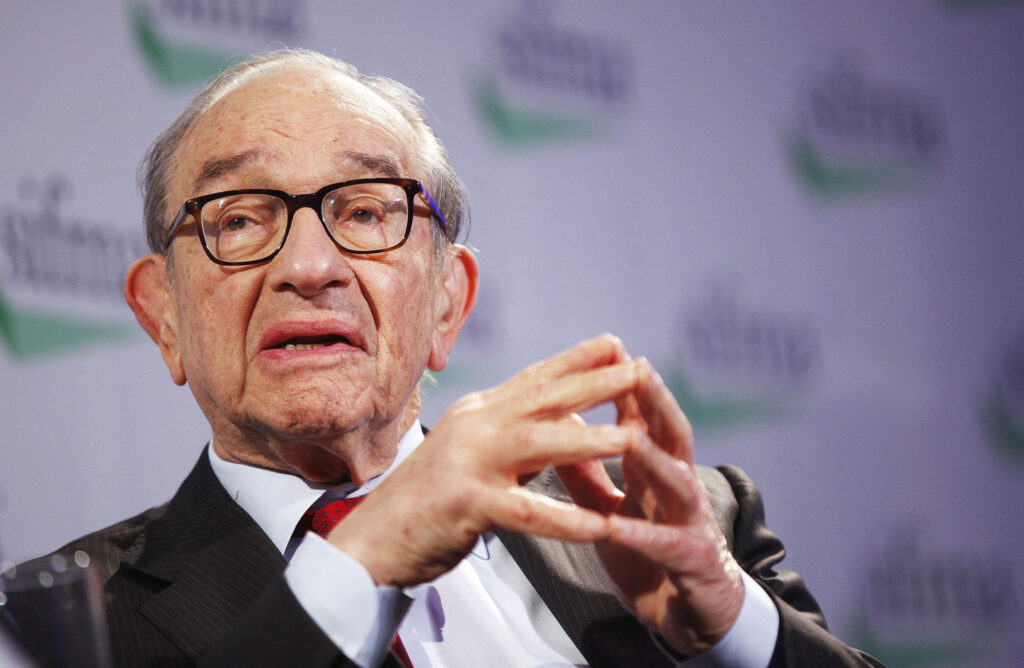
Alan Greenspan, who as the world’s most powerful central banker maneuvered the United States through two decades of stunning prosperity, but whose decisions contributed to the near-collapse of the economy shortly after he left office, died June 22 at age 100.
The cause was complications from Parkinson’s disease, his wife, Andrea Mitchell, said in a statement.
“He was a giant of a man who helped shape the U.S. economy for decades under presidents of both parties, but was always honest in acknowledging his mistakes,” said Mitchell, chief Washington correspondent and chief foreign affairs correspondent for NBC News. “To me he was my husband, who shaped my life from our very first date in 1984.”
A dour intellectual with eclectic interests who attended the Juilliard music school, played the clarinet in a jazz band and was an acolyte of the philosopher Ayn Rand as a young man, Mr. Greenspan initially made his name as an economic forecaster and adviser to presidents Richard M. Nixon, Gerald Ford and Ronald Reagan.
During a more than 18-year run as chair of the Federal Reserve beginning in 1987, Mr. Greenspan achieved greater prominence than any central banker before him. He attained an almost mythical reputation for his ability to guide U.S. economic policy with a whisper in the president’s ear, to steer the multi-trillion-dollar economy by nudging interest rates up or down, and to soothe frazzled global financial markets with a few arcane words in a speech.
Mr. Greenspan was a Washington fixture, named to five terms as Fed chair by four different presidents. He exercised greater power, and for longer, than arguably any public official since FBI Director J. Edgar Hoover.
He was the “Maestro,” as Washington Post journalist Bob Woodward titled his best-selling book about Mr. Greenspan in 2000. He was a founding member of the “Committee to Save the World,” as a 1999 Time magazine cover called the alliance of Mr. Greenspan, Treasury Secretary Robert E. Rubin and Rubin deputy Lawrence H. Summers.
Mr. Greenspan’s 1996 musing in a speech over how hard it is to know when “irrational exuberance has unduly escalated asset values” triggered both a sell-off on global stock markets and a new term of art for financial bubbles.
The financial world was so obsessed with his every move that the cable network CNBC would tape him getting into his car on the morning of Fed policy meetings, hoping to judge by the thickness of his briefcase whether the central bank would move interest rates. An entire cottage industry existed of analysts who parsed his rare and often inscrutable public comments. (“If I seem unduly clear to you, you must have misunderstood what I said,” Mr. Greenspan once said.)
He was a curious mix of cerebral economist and Washington celebrity. He was a man who spent his mornings reading economic reports as he soaked in the bathtub, his days obsessing over monetary policy transmission mechanisms, and his evenings on the Georgetown cocktail circuit. A man once nicknamed “the undertaker” for his serious manner married one glamorous newscaster, Mitchell of NBC, having earlier dated another, Barbara Walters.
Mr. Greenspan’s peculiar brand of celebrity was built on a very real achievement. Economists call it the Great Moderation, and it coincided almost precisely with Mr. Greenspan’s tenure as the nation’s economist in chief: A period in which growth was steady, inflation low, and recessions rare and mild. The unemployment rate averaged 5.5 percent during his nearly 19 years in the job, compared with 6.4 percent in the preceding two decades.
A tarnished legacy
Mr. Greenspan bent the sprawling Federal Reserve system to his will, using a subtle political touch and a vast reserve of knowledge about the inner workings of the U.S. economy acquired while an economic consultant to businesses. His primary job was to set monetary policy — adjusting interest-rate targets to manipulate the money supply, aiming for low unemployment and low inflation.
Mr. Greenspan guided the economy through rocky economic shoals, including the 1987 stock market crash, which occurred when he had been in office for two months, the 1991 recession, financial crises in emerging markets in 1998, and the dot-com bust and the Sept. 11, 2001, terrorist attacks. He titled his 2007 autobiography “The Age of Turbulence,” though in hindsight it appears a period of enviable economic calm.
When Mr. Greenspan left government service in early 2006, he was widely viewed as one of the greatest economic statesmen of all time. But within a few years, the Great Moderation came to look like a mirage, and the maestro’s legacy was severely tarnished.
Much of the economic expansion under Mr. Greenspan’s watch was built on bubbles, first the 1990s stock market boom and then an unprecedented run-up in house prices in the 2000s. Americans financed their consumption with ever-rising levels of debt: The ratio of household debt to the size of the economy as a whole soared to 82 percent from 53 percent during his tenure.
The Greenspan Fed fueled these trends with ultra-low-interest-rate policies, particularly from 2003 to 2005, and by taking a hands-off approach to regulating a financial system that grew immeasurably in size and complexity during his tenure.
“The mindset was that there should be no regulation,” Scott Alvarez, a longtime lawyer at the Fed and Mr. Greenspan’s general counsel starting in 2004, told the Financial Crisis Inquiry Commission. “The market should take care of policing, unless there already is an identified problem … We were in the reactive mode because that’s what the mindset was of the ’90s and the early 2000s.”
Around 2000, he specifically rebuffed a request by a fellow Fed governor, Edward Gramlich, for the Fed to crack down on lending to people who might have little ability to repay their mortgages, Gramlich told the Wall Street Journal in 2007. Those “subprime” loans would serve as the initial trigger to the crisis that enveloped the world in 2008.
Mr. Greenspan repeatedly advised Congress against heightening regulation of derivatives, complex financial contracts that, he argued, made the financial system as a whole more stable by distributing risk to those who can afford to take it on. In fact, the unraveling of those markets was a key factor in the 2007-2009 financial crisis.
And while Mr. Greenspan was renowned for his understanding of the workings of the U.S. economy, and by 2005 had expressed some public worry about home prices having risen too high, he did not identify the scale of the housing bubble that was a major underlying cause of the crisis or use regulatory tools or his bully pulpit to try to combat it.
“There do appear to be, at a minimum, signs of froth in some local markets,” he said in 2005, near the peak of the biggest national home-price bubble in U.S. history.
Fostering complacency
More broadly, Mr. Greenspan’s greatest apparent achievement — preventing the series of crises and near-crises in the financial world from damaging the broader U.S. economy — may have been a factor in the steep downturn. His critics call it the “Greenspan Put,” using a financial term for an option contract that protects investors against losses.
His very actions that maintained financial stability — helping prevent extreme losses when conditions turned unfavorable — made global investors complacent about risk. That helped fuel the bad lending and excessive use of borrowed money that caused a massive collapse soon after Mr. Greenspan left office.
“He was the person who came up with the ‘irrational exuberance’ critique of excessive speculation prior to 2000, but he didn’t follow up on it,” said Robert J. Shiller, a Yale economist who warned of stock and housing bubbles during the 1990s and 2000s. “He has an Ayn Rand, pro-market philosophy, and so it wasn’t in his personality to aggressively pursue those ideas and to lean against bubbles.”
The popping of the housing and credit bubble in 2007 led to a deep global recession and near-collapse of the financial system in 2008, and a far worse outcome was avoided only by an expensive series of government bailouts.
“I made a mistake in presuming that the self-interest of organizations, specifically banks and others, were such that they were best capable of protecting their own shareholders and their equity in the firms,” Mr. Greenspan told a congressional committee in October 2008, amid the darkest days of the crisis. “Something which looked to be a very solid edifice, and indeed a critical pillar to market competition and free markets, did break down. And I think that, as I said, shocked me. I still do not fully understand why it happened.”
A libertarian’s pragmatism
Mr. Greenspan was a staunch libertarian, deeply skeptical of government intervention in the economy. In four decades on the national stage, though, he was a pragmatist who used the tools of government in ways that sometimes were at odds with his philosophy.
He served on a key commission in the Nixon administration that led to ending the military draft, which Greenspan viewed as an affront to human freedom. But he also helped Ford bail out a nearly bankrupt New York City in the mid-1970s.
In 1983, he chaired a commission on the finances of Social Security. The accord raised taxes and raised the retirement age over time, and stabilized the finances of the program for a generation.
As Fed chair, he offered crucial public support both to Bill Clinton’s deficit reduction plan in 1993 and to George W. Bush’s proposed tax cuts in 2001. The former attracted accusations from Republicans that he was trying to ingratiate himself with the new Democratic president who would later reappoint him. The latter drew sharp attacks from Democrats who accused Mr. Greenspan of raw partisanship. (“One of the biggest political hacks we have here in Washington” was how Senate Democratic leader Harry M. Reid of Nevada described him in 2005).
His testimony at congressional hearings in the latter years of his Fed chairmanship resembled nothing so much as a series of efforts by members of Congress to win Mr. Greenspan’s endorsement — viewed as the sine qua non of economic seriousness — for their preferred policies and pet causes.
Mr. Greenspan’s impact on U.S. economic policy, in other words, went far beyond that of his official portfolio as a central banker.
“Alan Greenspan has probably been a key player in more Republican presidential campaigns and Republican party platforms and Republican administrations than any other economist in the country,” Martin Anderson, a senior fellow at the Hoover Institution who recruited Mr. Greenspan to work on the 1968 Nixon presidential campaign, told The Washington Post in 2006. “He’s a wonderful politician.”
The number cruncher
Alan Greenspan was born in New York on March 6, 1926, the only child of parents who would soon divorce. His father, Herbert, was a stockbroker. Raised by his mother, the former Rose Goldsmith, in Manhattan’s Washington Heights neighborhood, Alan channeled an uncanny way with numbers as a child into analyzing baseball statistics with an intensity that would be mirrored in his approach to economic analysis decades later.
“I developed my own technique of keeping box scores,” Mr. Greenspan wrote in “The Age of Turbulence.” “I always used green paper, and recorded each game pitch by pitch, using an elaborate code I made up. My mind, which had been essentially empty to that point, filled with baseball statistics.”
His other great passion was jazz; he played the clarinet and was nearly as obsessed with big-band leader Glenn Miller as he was with baseball. After high school, he studied at the Juilliard School, and when a spot on his lung kept him out of the Army during World War II, he joined a 14-man jazz band that played around the country.
During breaks, when most of the musicians would smoke tobacco or marijuana, Mr. Greenspan read about finance and economics. He took to doing his bandmates’ income taxes.
He enrolled at New York University and took a part-time job at the investment bank Brown Brothers Harriman, where he figured out how to take raw weekly information on department store sales and adjust the data to filter out the normal seasonal fluctuations. That would be an easy task for anyone with a modern computer spreadsheet program, but at the time it required hours upon hours of laborious calculations by hand.
As with his baseball statistics, Mr. Greenspan had found his great obsession — analyzing data to discern trends. He graduated summa cum laude in 1948 from NYU, where he also received a master’s degree in economics in 1950.
While in graduate school, he took a job at the Conference Board, which then as now did economic research for big companies.
“I discovered that the Conference Board had amassed a treasure trove of data on every major industry in America dating back half a century and more,” he wrote in 2007. “It became my passion to master all the knowledge on those shelves. I read about the robber barons; I spent hours over the census of population of 1890; I studied railroad freight-car loadings of that era, trends in short staple for the decades after the Civil War … Instead of reading ‘Gone With the Wind,’ I was happy to immerse myself in ‘Copper Ore Deposits in Chile.’ ”
Mr. Greenspan enrolled in Columbia University’s economics PhD program in 1950, and though he would never finish it, he did cultivate a relationship with economist Arthur F. Burns, a mentor who would go on to chair the Federal Reserve in the 1970s. (New York University awarded Mr. Greenspan a doctorate in economics in 1977 for previously published research — after he had already become one of the country’s preeminent business economists and chief economic adviser to Ford).
Mr. Greenspan married art historian Joan Mitchell in 1952, but the marriage was annulled 10 months later. He wrote in his memoir, “I had no real understanding of the commitment required for marriage.”
In Ayn Rand’s circle
It was through Mitchell, however, that Mr. Greenspan met one of his deepest, most enduring intellectual influences. Ayn Rand, the libertarian author of “The Fountainhead” and “Atlas Shrugged,” maintained a cadre of mostly young men who came over for evening bull sessions, long arguments about philosophy at which Mr. Greenspan was a regular through the 1950s and early 60s.
“When I met Ayn Rand, I was a free enterpriser in the Adam Smith sense — impressed with the theoretical structure and efficiency of markets,” Mr. Greenspan told the New York Times in 1974. “What she did — through long discussions and lots of arguments into the night — was to make me think why capitalism is not only efficient and practical, but also moral.”
Taxes, in her philosophy, were immoral theft; the social safety net an affront to human liberty. He contributed to The Objectivist, a monthly journal published by Rand acolytes, and in a 1966 issue wrote that “the welfare state” was “nothing more than a mechanism by which governments confiscate the wealth of the productive members of a society.”
While Mr. Greenspan distanced himself over the years from many of the extreme implications of Rand’s views, they remained exceptionally close until her death in 1982; she appeared at his side when he was sworn in as Ford’s economic adviser.
While Mr. Greenspan debated with Rand and her other young protégés at night, he was building a business consulting firm by day.
In 1953, he partnered with investment adviser William W. Townsend to start an economic research firm, Townsend-Greenspan, in which Mr. Greenspan would use the knowledge of the inner workings of the U.S. economy he had been accumulating through his work at the Conference Board to consult for some of the biggest American businesses.
When U.S. Steel, Alcoa, Mobil Oil or dozens of other companies wanted to know when the economy was poised to speed up or slow down, or what how demand for steel or aluminum or anything else would trend, Townsend-Greenspan did the analysis. The experience left Mr. Greenspan with a sterling Rolodex, full of contacts across corporate America.
Entering politics
Mr. Greenspan entered politics in 1967, recruited to help Nixon’s 1968 presidential campaign. He briefed Nixon regularly on economics during the campaign but served the administration as an outside adviser rather than within the White House.
By the time he was ready to join the Nixon administration, the president had resigned in disgrace and Mr. Greenspan would serve Ford instead. His adjustment to full-time government work was uneasy at times. In his memoir, he recalled blanching at one of his first major policy meetings. Speechwriters unveiled a campaign called “Whip Inflation Now,” aiming to using a mere publicity effort to keep prices unchanged when powerful economic forces were driving them upward.
“The speechwriters had ordered up millions of Whip Inflation Now buttons, samples of which they handed out to us in the room,” Mr. Greenspan wrote. “I was the only economist present, and I said to myself, ‘This is unbelievable stupidity. What am I doing here?’ ”
Early misgivings aside, Mr. Greenspan proved to be an able public servant, winning a lifelong friend in Ford, who was House minority leader before succeeding Nixon, and the trust of such Nixon and Ford White House officials as Dick Cheney and Donald H. Rumsfeld.
As president, Reagan gave Mr. Greenspan the task of salvaging the finances of the nation’s public pension program, which was on the verge of running out of money.
As chair of the National Commission on Social Security, Mr. Greenspan guided a disparate 15-member group, stocked with disparate figures including AFL-CIO head Lane Kirkland, Sen. Robert J. Dole (R-Kansas) and Sen. Daniel Patrick Moynihan (D-New York), toward a common understanding of how best to put the finances of Social Security on a more sustainable path.
Their agreement, which Congress enacted in 1983, raised taxes on some affluent individuals and increased the retirement age gradually over the decades to follow, among many other provisions that put the finances of the program on a solid footing for a generation.
While the Greenspan Commission, as it was widely known, has been hailed as a triumph of policymaking by bipartisan commission, the reality may have been somewhat different.
Robert M. Ball, a commission member and former commissioner of Social Security, wrote later that the committee was in fact deadlocked. A compromise was achieved when James A. Baker III, Reagan’s chief of staff, and House Speaker Thomas J. “Tip” O’Neill Jr.(D-Massachusetts) hammered out an agreement between themselves, which the commission then accepted.
Mr. Greenspan, for his part, acknowledged the irony that a man philosophically opposed to the social insurance net had played a large role in saving it.
His work on the Social Security commission had another, more personal benefit. A young NBC White House correspondent, Andrea Mitchell, called Mr. Greenspan as a source in 1983. They talked periodically; he declined an invitation to the White House correspondents’ dinner because he was going with Barbara Walters.
Mitchell agreed to go to dinner with him in 1984, and, he later recalled that on their first date, he invited her back to his apartment to read an essay on monopolies he had written for Rand’s newsletter.
Mr. Greenspan and Mitchell quickly became a couple, although they would not marry until 1997. She is his only immediate survivor.
The ‘Black Monday’ test
On Aug. 3, 1987, Mr. Greenspan was confirmed as chair of the Federal Reserve. His first test came remarkably early on. On Oct. 19 that year, the stock market plummeted 22.5 percent in a single nerve-shaking day.
Mr. Greenspan was in Dallas for a previously scheduled speech — or at least he was, until the White House dispatched an Air Force jet to ferry him back to Washington. He immediately realized the risks to the U.S. economy: If banks, reeling from losses and fearful that their clients wouldn’t survive, stopped extending routine credit, the entire financial system could collapse.
Fed lawyers wanted to release a lengthy, complicated statement of the Fed’s stance, according to Woodward’s book “Maestro.” But Mr. Greenspan and a key lieutenant, New York Fed President E. Gerald Corrigan, realized that the central bank needed to give Wall Street a simple, open-ended commitment to prevent financial collapse.
At 8:41 a.m. on Tuesday, Oct. 20, Mr. Greenspan issued a statement under his name: “The Federal Reserve, consistent with its responsibilities as the nation’s central bank, affirmed today its readiness to serve as a source of liquidity to support the economic and financial system.”
That, along with a slew of private calls by Corrigan to Wall Street firms strongly encouraging them not to start canceling credit lines, helped fuel a market rally that day, and ultimately Black Monday in 1987 would have little visible impact on the U.S. economy.
It was the first triumph over markets by the maestro, and Mr. Greenspan’s almost mystical reputation as a soothsayer over financial markets had begun.
Pressure on rates
In Mr. Greenspan’s early years as Fed chair, one of his steepest challenges was the tendency of Reagan and Bush administration officials to constantly — and publicly — push for lower interest rates.
Fed chairs operate independently of the rest of the government for a reason. Higher interest rates may slow down the economy and result in higher unemployment in the short run, but they are often needed to prevent inflation from rising in the longer run. Elected officials, Mr. Greenspan soon saw firsthand, often have a shorter-term perspective than central bankers.
In August 1988, Mr. Greenspan pushed the Fed’s policy committee to raise a key bank lending rate by half a percentage point. Baker was now secretary of the treasury, and Mr. Greenspan went to Baker’s office at the Treasury Department to make the case for raising rates.
Baker, who wanted the economy firing on all cylinders to help Vice President George H.W. Bush win the presidential race that fall, replied, “You just hit me right here” in my stomach, according to “Maestro.”
It was just one in a four-year series of attacks — some veiled, some overt — on Mr. Greenspan from his fellow Republicans in the Reagan and Bush administrations. The frustration that Mr. Greenspan wasn’t doing enough to boost the economy led Bush, by then elected president, to move slowly and reluctantly in deciding whether to appoint Mr. Greenspan to a second term.
The decision was made only a month before his term was to expire, and only after Mr. Greenspan assured the president that he was relatively pessimistic about the economy, which was interpreted within the White House as an indication he was inclined to keep interest rates low.
Referring to Bush’s reluctant decision to reappoint him, Mr. Greenspan wrote in his memoir, “I think he concluded I was his least worst choice” and that any other selection would have roiled markets.
Bush kept pressure on Mr. Greenspan to cut rates in 1992, requests the Fed chair ignored. Bush, he made clear in later interviews, blamed Mr. Greenspan for his losing reelection bid.
A growing reputation
By the mid-1990s, the U.S. economy was growing rapidly and unemployment was low. Mr. Greenspan had a warm relationship with Clinton and his administration, who adopted a hands-off-the-Fed policy. And Mr. Greenspan was using his knowledge of the inner workings of the U.S. economy to great advantage, winning the awe of his Fed colleagues.
Lawrence B. Lindsey, a Fed governor from 1991 to 1997, later recalled a time when the Mississippi River was flooding. “At the time of the weekly Board of Governors’ meeting, the U.S. economy was literally linked together by a single bridge,” Lindsey wrote in his book “Economic Puppetmasters: Lessons from the Halls of Power.” “Greenspan not only knew the location of the bridge, but also the various reroutings that could be used to get merchandise there. Those type of facts fit naturally into the mind of a man who studies statistics on boxcar loadings at all the major terminals in the country.”
The economy, if anything, seemed to be growing too fast. Surely, some Fed policymakers argued, that would soon cause an outburst of inflation. Mr. Greenspan felt differently. He concluded that American businesses were becoming more productive, thanks to information technology and new ways of doing things.
That would allow a speedier rate of growth without prices rising, so he kept interest rates lower than some inflation worriers would have preferred. He even cut rates in late 1998, when East Asian nations were experiencing a financial crisis even as the U.S. economy kept going gangbusters, which in turn helped boost the stock market to stratospheric levels.
Having handled the 1987 market crash, the 1991 recession and the political battles of the Bush years, and having guided the economy through the grand prosperity of the 1990s, Mr. Greenspan was developing a certain aura of greatness.
When Sen. John McCain (R-Arizona) was running for president in 2000, he was asked whether he would reappoint Mr. Greenspan.
“Not only would I reappoint him,” McCain said, “but if he died we’d prop him up and put sunglasses on him as they did in the movie ‘Weekend at Bernie’s.’ ”
Defending his record
Amid the popping of the stock market bubble that his policies had helped fuel, and the Sept. 11, 2001, terrorist attacks, Mr. Greenspan led the Fed on an aggressive series of interest-rate cuts. By the summer of 2003, the Fed’s target rate for loans between banks was down to 1 percent.
It worked to keep the 2001 recession a mild one. But while the economy was growing in 2002 and 2003, it did so at a glacial pace. And Mr. Greenspan feared that the nation could fall into a dangerous cycle of falling prices known as deflation.
To fend off that risk, he wanted to keep the low rate in place for a long time — a “considerable period,” as Fed statements of the time put it. That was one factor, although hardly the only one, behind a booming housing market in which national home prices rose by double-digit rates.
In all, from the beginning of 2000 to the middle of 2006, just after Mr. Greenspan left office and a year after receiving the Presidential Medal of Freedom, national home prices rose 90 percent, according to one popular index. It was much more than that in some markets, and the fundamental economic reasons that might have justified that rise were few.
And while Congress had given the Federal Reserve the authority to regulate mortgage lending practices, the Fed did little with that authority. Mr. Greenspan’s successor, Ben S. Bernanke, would later call it “the most severe failure of the Fed in this particular episode.”
Mr. Greenspan, testifying before the Financial Crisis Inquiry Commission in 2010, defended his legacy and rebuffed criticism. “History tells us regulators cannot identify the timing of a crisis, or anticipate exactly where it will be located or how large the losses and spillovers will be,” Mr. Greenspan said.
“When you’ve been in government for 20 years, as I have been, the issue of retrospective and figuring out what you should have done differently is a really futile activity,” he added. “My experience has been, in the business I was in, I was right 70 percent of the time, but I was wrong 30 percent of the time and there are an awful lot of mistakes in 21 years.”
Irwin, a former Post staff writer, is the author of “The Alchemists: Three Central Bankers and a World on Fire.”
The post Alan Greenspan, most powerful central banker of modern times, dies at 100 appeared first on Washington Post.