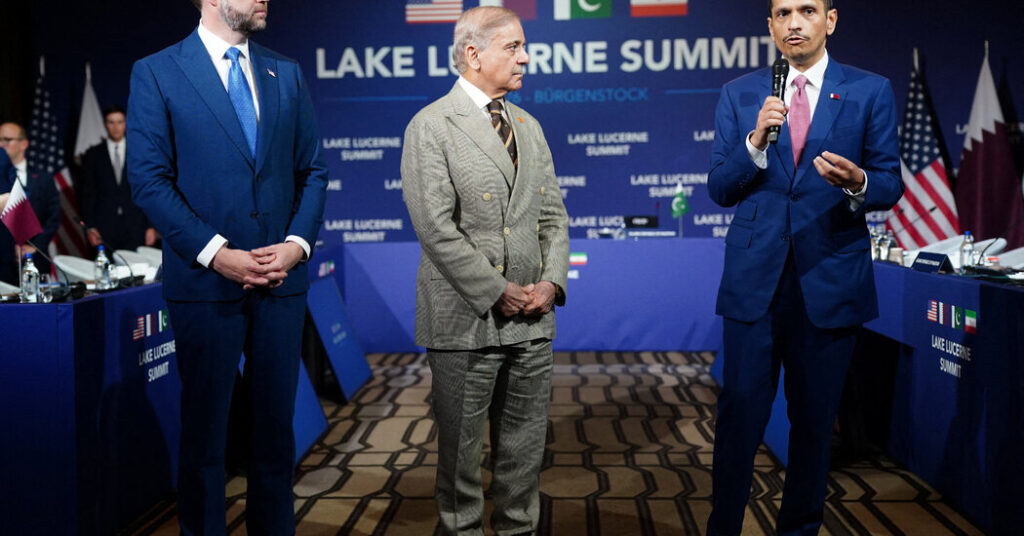
U.S. and Iranian negotiators concluded their first round of talks on Monday to turn an initial peace agreement into a lasting deal within 60 days.
Pakistani and Qatari mediators said the countries had made “encouraging progress” and would proceed to discussions on technical details this week. But frictions over the Israel-Hezbollah conflict in Lebanon and shipping in the Strait of Hormuz could derail the negotiations.
On Monday, the mediators laid out guardrails aimed at protecting the negotiations from these risks. They said both sides had agreed to create a committee to oversee the technical discussions, a direct communication line to avoid incidents in the Strait of Hormuz, and a “de-confliction cell” to keep the peace in Lebanon.
Here are some of the key points to know from what the mediators said.
High level oversight committee
The mediators said that an oversight committee would supervise the execution of a “road map” for reaching a final peace deal within 60 days.
The Iranian delegation distrusts the entire diplomatic process, making such assurances essential, said Ali Vaez, Iran project director for the International Crisis Group.
“Iran has learned from experience that there needs to be a mechanism for verifying both sides’ commitments,” he said.
According to the mediators, the two sides’ chief negotiators will report regularly to the committee.
Those negotiators will also lead working groups on nuclear issues and sanctions, and a “monitoring and dispute resolution group” to oversee the implementation of the U.S.-Iran framework agreement, they said.
Strait of Hormuz communication line
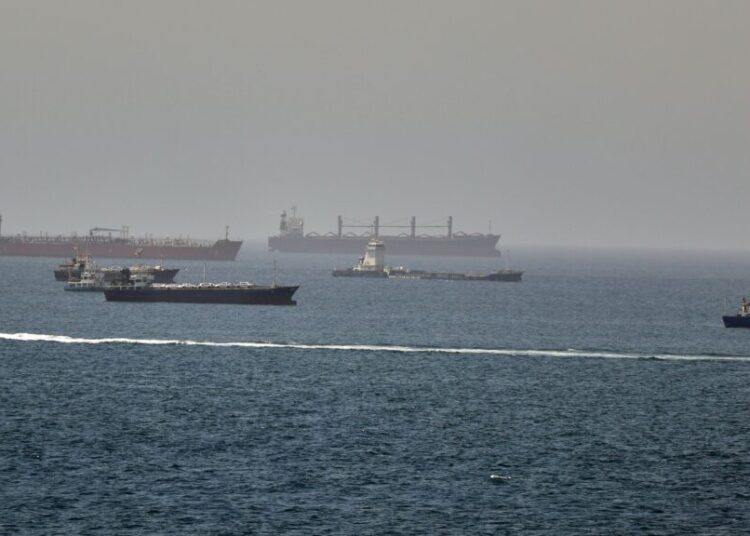
The mediators also announced a communication line with the aim of guaranteeing safe passage for commercial vessels through the Strait of Hormuz.
Control over the waterway, a critical conduit for as much as one-fifth of the world’s oil before the war, has been a flashpoint of the conflict.
Both sides agreed last week to immediately begin reopening the strait, which Iran effectively blockaded during the war. But over the weekend Iran said it was closing it again, after accusing Israel of violating a cease-fire in Lebanon.
Until the middle of the strait is fully demined, some of the largest commercials tankers will be required to transit through Iranian territorial waters to navigate the waterway, Mr. Vaez said.
“Both the U.S. Navy and the Revolutionary Guards’ Navy consider each other terrorist organizations,” he added. “Absent of a communication mechanism, there’s space for misunderstanding that could lead to escalation.”
Aniseh Bassiri Tabrizi, an Abu Dhabi-based associate fellow at Chatham House, a research group, said that a hotline could allow issues to be resolved separately from the main negotiations and avoid them altogether.
“It could avoid a very specific targeted incident from spiraling out of control and leading to a renewed confrontation,” she said.
Lebanon ‘de-confliction cell’
The mediators also said they would facilitate the formation of a new group, which will be known as a “de-confliction cell,” to ensure the “termination of military operations in Lebanon.” It would include representatives from Iran, the United States, and Lebanon.
The preliminary peace agreement between the United States and Iran called for an end to military operations in Lebanon, where Israel has been fighting Hezbollah, the Iran-backed armed group. But Israel — which is not party to the U.S.-Iran framework peace agreement — has insisted that it will defend itself against any Hezbollah threats.
Eruptions of violence in Lebanon since the signing of the cease-fire have already threatened to derail negotiations.
“This is a new and truly the most fascinating part of this,” said Mr. Vaez, referring to the de-confliction mechanism. “The Iranians have probably realized that the U.S. gets its information about who violated the cease-fire in Lebanon from one side in the conflict,” he added.
“Now, there is, another version that could be presented to the United States.”
Ms. Bassiri cautioned that while the de-confliction mechanism could set up guardrails to protect the talks, the group is limited by the fact that it does not include either of the two primary belligerents.
“While the de-confliction cell will be useful to manage progress and try to avoid derailing the process, ultimately the two parties involved are Israel and Hezbollah,” she said.
The post The Guardrails Designed to Protect U.S.-Iran Talks appeared first on New York Times.