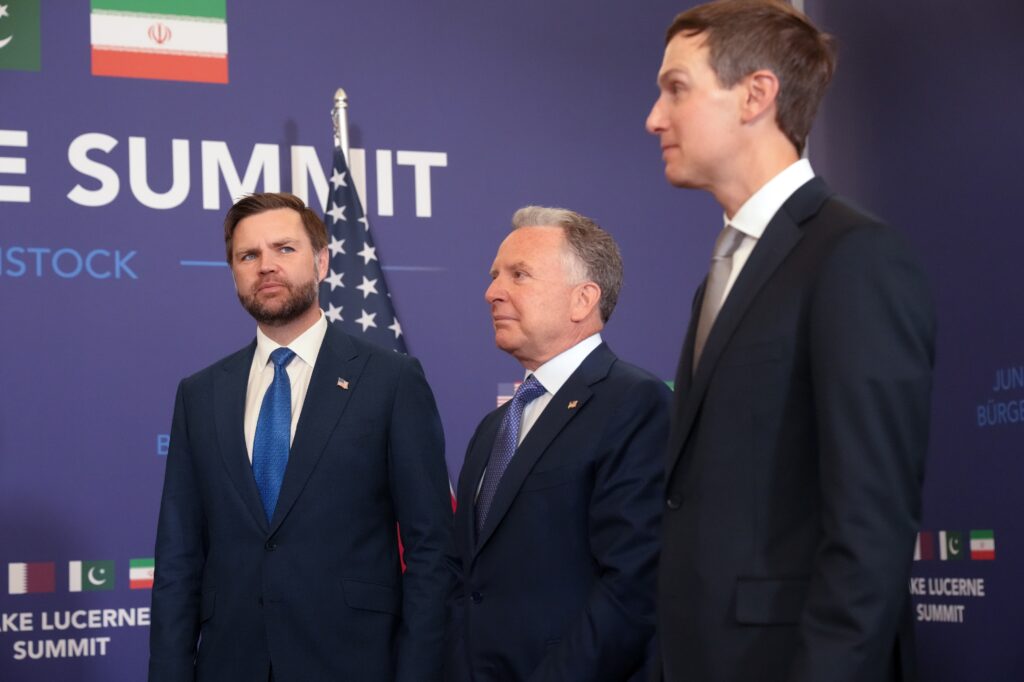
Vice President JD Vance arrived in Switzerland on Sunday for high-stakes talks with Iran on its nuclear program, hoping to bring a 60-day sprint from loosely defined agreement to full peace deal back on track.
The day before, Iran’s military said it was closing the Strait of Hormuz in response to Israeli strikes on Lebanon, a move that tested the strength of recent U.S. diplomatic efforts and underscored how uncertain the war’s endgame remains.
Vance said his top priorities are establishing the structure of the talks, making progress on the nuclear issues and ensuring a ceasefire in Lebanon, where Israel continues to exchange fire with Hezbollah, the Iranian-backed militant group, threatening the tentative deal.
“We’re going to have a principal level of political leadership at the top, and then obviously the technical team is going to stay on the ground,” Vance told journalists at Joint Base Andrews before departing for Switzerland.
The U.S. negotiating team includes White House envoys Steve Witkoff and Jared Kushner, who arrived in Switzerland on Saturday. The Iranian delegation, led by Parliament Speaker Mohammad Bagher Ghalibaf and Foreign Minister Abbas Araghchi, arrived later that day. Pakistani and Qatari officials are mediating the talks.
A memorandum of understanding — which President Donald Trump signed at the Palace of Versailles in France last week — puts the onus on the United States to deliver early, including by lifting sanctions, freeing billions in frozen assets and dismantling a naval blockade of Iran’s ports. The two sides established a two-month timeline to flesh out the details and settle issues that have plagued negotiators for years.
Iran promised to let shipping flow freely through the strait, a vital waterway for transporting fuel whose closure has spiked oil and gas prices. The deal also outlined an end to military operations in Lebanon, which is a core issue for Iran and requires the Trump administration to pressure Israel to halt attacks on Hezbollah there — even though Israel is not a signatory to the agreement and has denounced it.
U.S. intelligence agencies have warned the administration that Israeli Prime Minister Benjamin Netanyahu is likely to remain intent on continuing attacks in Lebanon, which could undermine Trump’s effort to reach a lasting peace with Iran.
In remarks before traveling to Switzerland, Vance downplayed the hostilities, saying that “despite the headlines, things are actually getting better there” and the U.S. is “actively managing” the situation.
“It’s going to just be something we’re going to have to continuously manage to ensure that Israel and Lebanon are both safe and secure,” he added.
Stranded vessels had cautiously begun to transit the Strait of Hormuz after the preliminary agreement was signed and the countries agreed to lift all restrictions on movement through it.
The U.S. military said commercial vessels continued operating in the waterway even after Iran’s Saturday announcement that it would be shut, stating that 55 merchant ships and 17 million barrels of oil passed through and denying that the strait is closed.
Ship-tracking sites show that several crude oil tankers have passed through the strait in the past 24 hours, keeping close to the coast of Oman rather than the Iranian side.
The post U.S. and Iranian negotiators meet in Switzerland to hash out peace plan appeared first on Washington Post.