As a child in South Dakota, Ernie LaPointe was told: Don’t tell anyone who your great-grandfather was.
If his neighbors or friends knew he was descended from Sitting Bull, the storied Hunkpapa Lakota leader, he would never have a normal childhood, his mother told him.
“‘There will be a time and place when you get the permission to do it,’” LaPointe, now 77, recalled his mother saying.
LaPointe kept mum until the early 1990s, when, he said, an aunt told him it was time to “come out from the shadows.”
Now he protects the legacy of Sitting Bull, who helped lead the resistance to the U.S. government’s seizure of the Great Plains and became perhaps even more famous in death than in life.
Almost 150 years ago, Sitting Bull’s followers defeated Lt. Col. George Armstrong Custer and the Seventh Cavalry Regiment of the U.S. Army in the Battle of the Little Bighorn, one of the most closely studied and hotly debated military clashes in American history. Sitting Bull is said to have had a vision that presaged a great victory, which came weeks later for warriors led by Crazy Horse.
More than a thousand miles south, in Arizona, Chip Custer’s lineage was not something he could have hidden, even if he wanted to.
He was born George Armstrong Custer IV, the great-great-grand-nephew of the famous lieutenant colonel. After his father (George Armstrong Custer III) died suddenly in 1991, Chip inherited the job of minding the legacy of a man who is among the most lionized, and vilified, figures in American history.
Chip Custer, 70, has long been familiar with the criticism — of Custer’s devastating offensive against the Cheyenne, of his military tactics, of his ego. He hopes people will try to view his relative in his full complexity, in light of his successes and in the context of his time.
“If someone wrote a thousand stories about me,” he added, “what would I end up looking like after all the time under the microscope?”
This week, crowds are expected to converge where the Little Bighorn River snakes through grassy hills in southeastern Montana and where Custer and all of his men died during an attack on a Native American encampment on June 25, 1876. There will be re-enactments, ceremonies and talk of a new visitor center scheduled to be completed in the coming months.
To the Lakota, Northern Cheyenne and other tribes, the battlefield remains hallowed ground, a place of great triumph over a government that suppressed their way of life.
To historians, it remains an inexhaustible source for debate. Had one cavalry major been drinking? Was Custer undone by recklessness or flawed intelligence?
Chip Custer and Ernie LaPointe are students of the battle and fluent in its intricacies, but their interest is not simply in military history. It is based in a mission to preserve their family legacies.
“The blood of my great-grandfather is in me,” LaPointe said. “He cared for the people; he cared for everything. He even cared for the people who tried to kill him.”
Custer’s kin
Chip Custer first visited the battlefield in 1976, for the 100th anniversary of the battle, as a 21-year-old hippie with no expressed interest in family history. He drove up from college to surprise his father, a retired Army officer who had fought in three wars.
As they sat through a quiet ceremony near what is known as Last Stand Hill, the American Indian Movement leader Russell Means spoke out to celebrate the cavalry’s defeat.
“My father, of course, was incensed over the way that whole event went,” Custer said. “So that was my introduction.”
The national park was known as Custer Battlefield National Monument then, though Native American activists had begun to draw attention to the site’s narrow focus on the more than 260 U.S. deaths, part of a wider discussion of broken treaties and American expansionism.
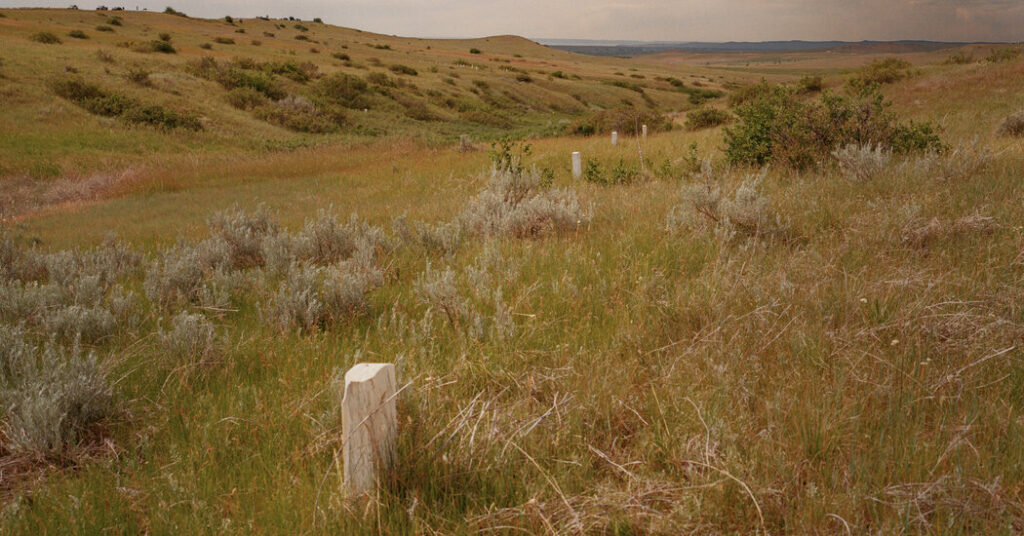
White marble headstones peeked out of the grass across the haunting prairie to mark where soldiers had fallen. The same was not true for the 60 to 100 Native Americans who the National Park Service has estimated died that day.
“You’d see that powerful landscape out there and it was just the Seventh Cavalry headstones,” said John Doerner, who was an historian at the battlefield for more than 20 years.
Perspectives were evolving. Chip Custer said his father recognized that depictions of their relative — long embraced by many as a gallant, fearless commander carrying out Washington’s will to push Native Americans toward reservations — had grown more complicated.
In 1970, the movie “Little Big Man” portrayed Custer as a vain commander who foolishly led his soldiers to slaughter. Chip Custer remembers watching it on an Arizona army base and that his red-faced father stormed out. His father was similarly upset in 1991 at a proposal to drop the family name from the site. He died of a heart attack just months before Congress rechristened it the Little Bighorn Battlefield National Monument.
In the decades since, Chip has served as an occasional spokesman for the Custer legacy, even as he ran a landscape design business and raised two daughters with his wife. Chip is descended from one of the famed soldier’s brothers, Nevin, whose health problems prevented him from joining the military. Two of George Armstrong Custer’s brothers died with him on the battlefield.
Chip has written about Custer’s rowdy days at West Point and his celebrated successes as a Civil War “boy general,” which included commanding the Michigan Cavalry Brigade in the Battle of Gettysburg. He has spoken to groups of Custer buffs.
In 2021, he opposed calls to remove a Custer statue in Monroe, Mich., the lieutenant colonel’s hometown. In a letter to the City Council, Chip argued that Custer, in his writings, had recognized why Native Americans resisted the confinement of reservations and that he had unfairly become the “poster boy for all wrongs committed against the American Indians during our roughly 250 years as a nation.”
The council ultimately left the monument as is.
When it comes to that final battle, Chip Custer believes his relative unquestionably shoulders some blame for the outcome, though some point fingers at subordinates.
“I think he would, as any commander, accept full responsibility for how that all played out,” he said. “But I regret that we only remember him by the last day of his life.”
Sitting with history
For LaPointe, an Army veteran born on the Pine Ridge Indian Reservation in South Dakota, the challenge has been defending, not his relative’s legacy, but his own.
After LaPointe publicly embraced his lineage, he began representing the family at events like the 1992 dedication of a bronze bust of his great-grandfather to the National Hall of Fame for Famous American Indians, in Oklahoma. But in the face of competing claims, his connection was still closely scrutinized by the Smithsonian in the mid-2000s as it worked to repatriate some of Sitting Bull’s belongings. Once satisfied, the museum gave LaPointe a braid of Sitting Bull’s hair and a pair of wool leggings obtained by a doctor who had custody of the Lakota leader’s body after his death.
Sitting Bull was fatally shot in 1890 on the Standing Rock Indian Reservation during a botched arrest by Native American police officers following orders from U.S. officials. In the years after the Battle of the Little Bighorn, the U.S. government had responded to the loss by escalating its efforts to force Native Americans onto reservations.
LaPointe’s ancestry was later scientifically confirmed by a Danish researcher, who did a DNA test on a small clipping of his great-grandfather’s hair. When the results were published, news of LaPointe’s lineage ricocheted across domestic and international media. It escalated the outreach he had long received from people who claim to be his long-lost kin.
“They call, they email, they come to the house,” said Sonja LaPointe, his wife of more than 30 years. “One guy from Wisconsin brought his Winchester to the house because he wanted to take a picture with Ernie.”
LaPointe was involved in the creation of an Indian memorial at the Little Bighorn battlefield, and in 2003 he attended the dedication of a sculpture by Colleen Cutschall, an Oglala-Sicangu Lakota artist. The bronze outline of warriors on horseback is level with the horizon, with the sky and grassy hills shining through the tableau.
With permission from park rangers, LaPointe had a pipe ceremony at the memorial that night and said he noticed something special in the air. “You could hear the horse hooves all around us,” he said.
LaPointe was also asked to share the oral histories he had heard as a child with Doerner, the historian, who worked to add red granite markers where Native American warriors fell.
LaPointe and Custer have each been to multiple events at the battlefield, but neither plans to attend the anniversary this week. Sonja LaPointe said her husband and Custer briefly crossed paths at a battlefield event years ago, but the men do not remember meeting.
Around 2007, LaPointe did speak with Chip’s uncle, Brice Custer, who called him after LaPointe gave a talk in George Armstrong Custer’s hometown.
Brice, who named one of his sons Garry Owen after the Seventh Cavalry marching song, told LaPointe he had not felt well enough to make the trip but wanted to express how much respect he had for Sitting Bull.
“I said I appreciated his call,” LaPointe recalled, “and I don’t hold any animosities toward nobody.”
“‘It happened many years ago,’ I said. ‘I think we have to heal from that.’ He agreed.”
Alain Delaquérière contributed research.
The post For Heirs of Custer and Sitting Bull, a 150-Year-Old Battle Is Personal appeared first on New York Times.