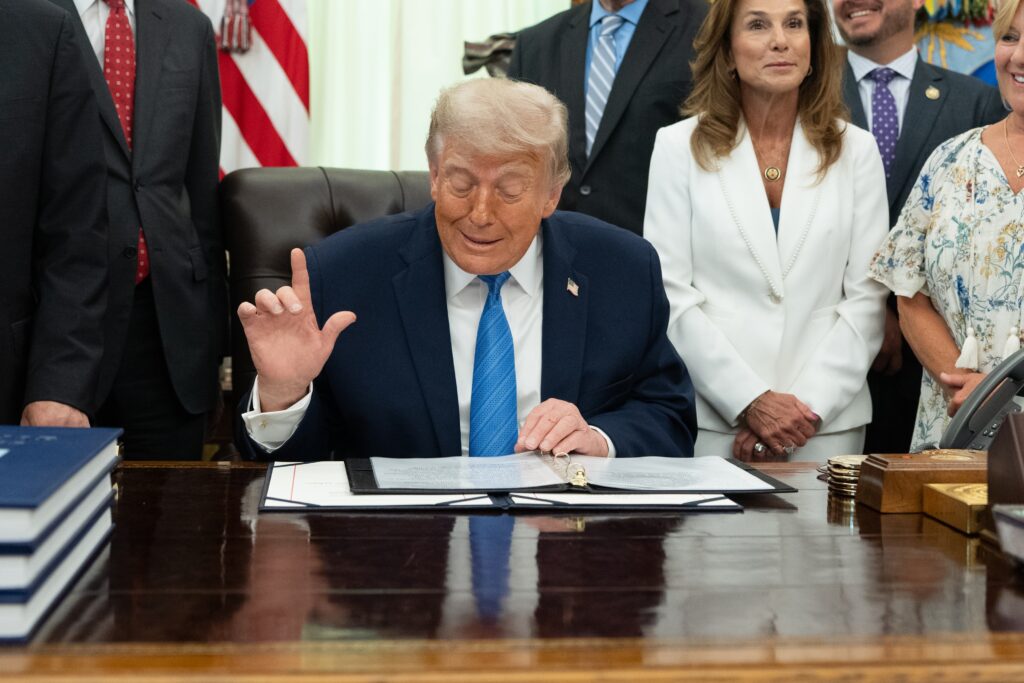
Regarding the June 13 news article “Federal judge indefinitely blocks Trump’s proposed $1.8 billion payout fund”:
Though it is critical to stop President Donald Trump’s proposed $1.8 billion payout fund, which is an immoral expenditure of taxpayer funds, it is equally important to have transparency regarding how the settlement amount was reached between the president and the IRS.
U.S. District Judge Leonie M. Brinkema should use her judicial authority to require the attorney general and counsel for the IRS to explain why this settlement is in the interest of justice and not a product of fraud and self-dealing. The damages listed, to support the settlement amount, appear to be excessive based upon what has been disclosed by the parties on the record to date.
More than 140 police officers were injured on Jan. 6, 2021, many with serious injuries, yet no special fund has been established to support them.
Judicial independence is needed to restore confidence in a case that seems to be lacking any integrity.
Eugene M. Hyman, Los Altos, California
The writer is a retired judge on the Superior Court of California.
Public defender system needed in immigration court
The June 7 front-page article “One judge, 143 cases in push to speed deportations” underscored the cruelty of a legal system that forces a majority of immigrants to navigate deportation proceedings without the benefit of a lawyer. Unlike criminal court, in immigration court there is no right to an attorney for people who cannot afford one. The consequences of legal representation are profound. A recent three-year study from the Vera Institute of Justice found that people with representation were 4.7 times more likely to be granted the relief they are entitled to under our country’s immigration laws than those without — ensuring protection from the life-shattering outcomes of detention and deportation.
The “mega master hearings” reported on in the article are not addressing the near-historic backlogs in our punitive immigration system. And they are cruel. Within minutes, life-changing decisions are made that result in thousands of immigrants languishing in detention, separated from their loved ones and livelihoods, often coerced into forgoing any right they may have to remain in the country.
The impact of this cruelty isn’t limited to those facing deportation. The Brookings Institution estimated that, as of mid-April 2026, about 205,000 children (including 145,000 U.S. citizen children) have had a parent detained by Immigration and Customs Enforcement under the Trump administration.
Fairness in legal proceedings is a fundamental component of due process under the U.S. Constitution, yet it is impossible to guarantee without lawyers. Congress should do its part to protect America as a nation of immigrants by establishing a national public defender system in immigration court.
Insha Rahman, Brooklyn
The writer is president and director of the Vera Institute of Justice.
Return to federalism
Regarding the June 14 front-page article “Congress has lost grip on funding”:
The genius of the founders was federalism. Beginning in the 1960s, with War on Poverty initiatives such as urban renewal and public housing programs, Congress usurped state and local supremacy in nearly all areas of government activity best carried out by state and local governments. The results include runaway national debt, skewed local priorities and one-size-fits-all program designs.
To get Congress back in the game of budgeting will necessitate turning over authority and responsibility for many worthwhile programs to states and local governments. Then Congress can begin to properly address those government activities that can only be done nationally.
This distortion of federalism has been with us for decades, so focusing on the current administration completely misses the point. Basic structural reform is required. Voters need to demand better national attention from their House and Senate members.
Peter A. Michel, Alexandria
A House divided
Regarding Henry Olsen’s May 28 column “How to escape the gerrymandering trap”:
It’s worth remembering, as controversy over redistricting rages on, that the House of Representatives as we know it is far from what the Founders conceived. Article I of the Constitution sets district sizes at 30,000 citizens.
If that were the case today, the 23 million people who live in Florida would be entitled to 766 representatives. Wyoming, with a population of 600,000, would be entitled to 20. California, with a population of 39 million, would be entitled to 1,300.
Congress took it upon itself to limit the number of representatives. Since the Reapportionment Act of 1929, the number has been capped at 435. Gerrymandering would not be a consideration if our House of Representatives were true to the Constitution. It is time to repeal the 1929 act.
Donald Spivey, Pinecrest, Florida
The writer, a distinguished professor emeritus of history at the University of Miami, is president of Freedom Words International.
Letter submissions
Send letters to [email protected].
Submissions must be exclusive to The Post and should include the writer’s address and day and evening telephone numbers. Letters are subject to editing and abridgment. Please do not send letters as attachments. Because of the volume of material we receive, we are unable to acknowledge submissions; writers whose letters are under consideration for publication will be contacted.
As the semiquincentennial approaches, Post Opinions wants to know: Where do you first take visitors to the D.C. area? What makes that spot special to you? Send us your response, and it might be published as a letter to the editor. wapo.st/washington_welcome
The post Trump’s payout fund was dropped. Now it’s time to ask questions. appeared first on Washington Post.