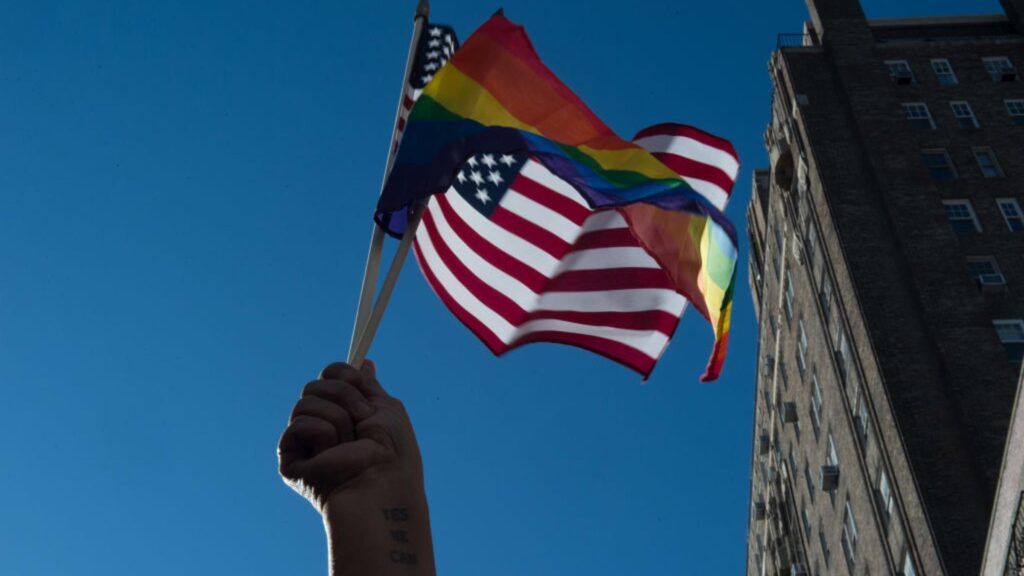
Sentiments toward the United States may be shifting among LGBTQ+ people, a report published Saturday shows—with the change registering both at home and abroad.
For decades, the U.S. was a leading destination for those fleeing persecution, offering refuge each year to more people than all other countries combined. But on the first day of his second term, President Donald Trump signed an executive order that abruptly halted a primary pathway for refugee resettlement—leaving thousands of LGBTQ+ asylum seekers displaced and vulnerable.
One of them is Sophia, who had already left her home country before learning that her pathway to a future in the U.S. had suddenly closed.
Sophia’s youth was defined by a climate of fear. She felt suffocated by the expectations of her conservative family and terrified to live authentically as a transgender woman in Jamaica, where her identity was not recognized and she had no legal protections.
“For me, in particular, as a trans woman—as a Black trans woman—I felt like I had to always hide myself,” Sophia, who asked to use a pseudonym for fear of harassment, tells TIME. “I felt unsafe, hearing all the stories about other trans women in Jamaica being killed or assaulted.”
At the time, the U.S. was in the midst of launching policy efforts to acknowledge the rights of the LGBTQ+ community, including the repeal of the military’s controversial “Don’t Ask Don’t Tell” policy in 2011, a landmark Supreme Court marriage equality ruling in 2015, and a push toward banning conversion therapy for minors initiated that same year by former President Barack Obama. It seemed to Sophia like an inclusive place where she could, finally, stop being afraid and find peace.
With help from Rainbow Railroad, a New York and Toronto-based organization that creates pathways to safety for at-risk LGBTQ+ people around the world, Sophia relocated to Brazil in 2024. She applied for asylum through the U.S. Refugee Admissions Program (USRAP) Priority 1 (P-1) referral pathway for at-risk refugees.
Then, Trump abruptly suspended the program on Jan. 20, 2025.
The effects were immediate. The P-1 pathway was no longer viable. Flights for more than 10,000 refugees were canceled overnight. Over 22,000 refugees around the world were left without critical services, including access to safe housing, according to the International Rescue Committee.
Read more: What’s In the $70 Billion Bill Funding Immigration Enforcement
Left without a path forward, Sophia’s stopover in Brazil stretched into two years—and in that time, her views about the U.S. began to change. She no longer saw it as the safe haven she once thought it was.
“The U.S. was projected to me as a haven for queer people, now it feels like a grave for queer people,” Sophia says, pointing to recent anti-transgender legislation and a rise in hate crimes against trans people in the U.S.
Many LGBTQ+ individuals share her sentiments—and not just those living abroad.
Her experience reflects a broader shift documented by Rainbow Railroad. Its latest data shows that, for the first time, an increasing number of LGBTQ+ citizens are expressing concerns about their future inside the U.S.
In its annual report, published on World Refugee Day, the advocacy group revealed that it had received 20,215 direct requests for relocation assistance from queer and transgender people in 2025—a 51% increase year-over-year and the highest in the organization’s 20-year history.
And for the first time, 30.9% of those requests came from individuals living within the U.S.
In 2023, that figure was closer to 13%.
“Our data shows that the crisis is escalating in a significant way,” a spokesperson for Rainbow Railroad tells TIME.
In previous years, most requests for assistance from within the U.S. came from international asylum seekers who had already been settled there. But the overwhelming majority (88%) of the requests in 2025 came from American citizens who felt unsafe within their own borders. Many referenced a perceived anti-LGBTQ+ agenda from the Trump Administration.
“Once a desirable destination” for LGBTQ+ migrants, the U.S. “now tops the list of countries where citizens, and particularly trans people, are asking for help,” the report reads.
The LGBTQ+ community is “having a horrific time accessing their rights,” Chief Programs Officer at Rainbow Railroad Devon Matthews tells TIME.
Nowhere to go
While the LGBTQ+ population that Rainbow Railroad works with is just a fraction of those impacted by Trump’s complete overhaul of the nation’s asylum and refugee systems, they are among those most vulnerable.
“In order to be eligible for government resettlement, they have to be refugees—they have to have already fled their country of nationality or country of origin, which means that they’re already displaced,” Matthews says.
According to Bridget Crawford, director of Law and Policy at Immigration Equality, many queer and trans refugees who are fleeing violence and persecution on the basis of their gender identity or sexual orientation find it easiest to relocate to a geographically proximal country that is often “just as bad or worse than the country they fled.”
According to Human Rights Watch, at least 67 countries have national laws criminalizing same-sex relations between consenting adults, and at least nine countries have national laws criminalizing forms of gender expression that target transgender and gender nonconforming people.
“It’s from the frying pan to the fire—to another fire, to another,” Crawford says.
She sees the “gutting of the entire refugee and asylum system” as a deliberate way to dissuade refugees and asylum seekers from coming to the U.S.
According to the Center for Immigration Studies, more than 233,000 refugees were resettled through USRAP during the Biden Administration. In comparison, from October 2025 until May 2026, the U.S. accepted 6,668 refugees—and over 99% of those were white South Africans, according to government data, most claiming race-related persecution in their home country rather than risk related to sexual orientation or gender identity.
Rebekah Wolf, an attorney with the American Immigration Council, has been providing free legal services to asylum seekers for over a decade. She tells TIME that she’d virtually never lost a single LGBTQ+ asylum case—until last year. Now, the losses seem inevitable while the wins are ever more elusive.
“It used to be that if you were an LGBTQ asylum seeker, you would get asylum in the United States,” she says. “It was so straightforward, and that’s just not the case anymore.”
Even asylum seekers already in the country increasingly question whether it is still the safe haven it once appeared to be. A rising concern is the threat of detention or deportation.
Wolf tells TIME that the Trump Administration’s immigration enforcement agents have detained many of her queer and trans clients and attempted to deport several of them to what’s known as “third countries”—countries that are neither a migrant’s country of origin nor last place of residence—despite protection orders from judges.
As of June 2026, 30 countries around the world have “third country removal” agreements with the United States, including Canada, Honduras, Uganda, Belize, Cameroon, and the Central African Republic. But Wolf questions how safe these countries actually are, especially when the government is planning to send LGBTQ+ individuals there.
In Uganda, for example, individuals who engage in same-sex acts can be imprisoned for life, while instances of what is described as “aggravated homosexuality” may be grounds for death.
Yet Wolf says that she has several LGBTQ+ clients who are at risk of being deported there by the Trump Administration’s third-country removal policies.
“One of my biggest fears is that people will agree to self-deport—essentially agree to go back to their country of origin—because the fear of a trans person from El Salvador being sent to Uganda is, in some instances, more frightening or more dangerous,” Wolf says.
“I would argue all of the ‘third countries’ that they signed agreements with and are sending people to are fundamentally unsafe for LGBTQ+ people,” Crawford observes. “And some of them are worse than the countries that the people fled to begin with.”
A different American Dream
With pathways for resettlement in the United States dismantled, advocacy groups like Rainbow Railroad have instead steered asylum seekers toward options like Canada’s Government-Assisted Refugees program. It offers permanent residency upon arrival, as well as access to healthcare, housing, and employment.
Terry-Kay Walker, a 38-year-old transgender woman, was relocated to Canada by Rainbow Railroad.
After traveling from her native Jamaica to Colombia, her asylum application was approved in January 2025 to resettle in America. She was waiting for her flight date when Trump’s executive order was issued. Stranded in Colombia and unable to speak Spanish, Walker struggled to pay for rent or groceries. Later that year she was cleared to relocate to Canada.
Despite the “disappointment” she describes regarding her canceled resettlement opportunity in America, Walker says it’s “for the best.” If she had come to the United States, she says she would have been worried by the Trump Administration’s escalating anti-trans policies—particularly the growing number of states restricting transgender people’s ability to obtain identity documents that reflect their gender identity.
But with the greatest uncertainties and fears now behind her, she says: “Mentally and physically, I am doing way better.”
For Walker, having an answer is better than living in limbo. Sophia is still waiting. Like thousands of other displaced refugees affected by the suspension of USRAP, she spent months wondering whether the future she had imagined for herself would ever materialize. Now she is in the process of attempting to resettle to Canada.
Years ago, Sophia saw the U.S. as a refuge. Today, she is preparing to build her future somewhere else.
The post For LGBTQ+ People, America’s Promise of Refuge Is Fading appeared first on TIME.