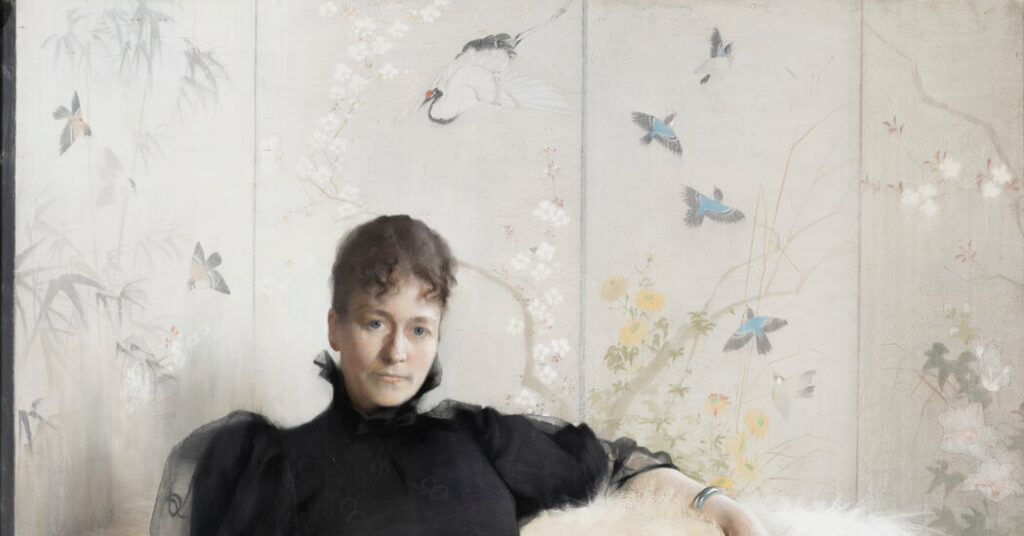
Asta Norregaard was a sought-after portrait painter among the rich and famous in Norway at the turn of the 20th century, but when she exhibited her work in the country’s capital, critics were quick to dismiss her pictures as decorative and frivolous.
The director of the National Gallery of Norway at the time, Jens Thiis, described Norregaard as a mere “fashion portraitist” of “high-society ladies.” During his tenure, from 1908 to 1941, he did not buy a single Norregaard work for the museum.
Today, the same Oslo institution, now called the National Museum, has revised its opinion and has brought together 48 of the painter’s key works, mostly from private collections, for “Asta Norregaard: Truth and Beauty,” running through Oct. 18. It is the first major exhibition devoted to a painter almost unknown outside Scandinavia.
The show’s curator, Wenche Volle, has called Norregaard the “Sargent of Norway,” referring to the great American Belle Époque painter John Singer Sargent.
Norregaard, like Sargent, created high-society portraits that highlighted elegant settings of the sitters and the fine textures of the silk and satin gowns. Both artists were criticized for focusing on fashion and engaging in commercial portraiture, said Volle, but both were highly sought after by private clients and produced enduring images of prominent figures.
“He’s the master of the portrait in his time, of course,” Volle said in an interview. “But when I see her paintings, I think she can challenge him, and she can stand up against all the best painters of that time.”
Norregaard was born in 1853 in Norway’s capital, known as Christiania at the time. Her mother died that year in a cholera epidemic, and Norregaard became an orphan at 18 when her father also died. She never married and supported herself all her adult life as an independent artist.
She trained as a painter first in Munich, and then in Paris, where she studied with teachers like Jean-Léon Gérôme and Jules Bastien-Lepage, major portraitists of the time.
Although Norregaard also painted landscapes and biblical scenes, she achieved her greatest success after returning to Norway and finding her way into a milieu of wealthy and powerful men and pioneering women who were social reformers. Her 1911 self-published catalog of her work listed 327 pictures made in oil paints, charcoal and pastels, including a rare portrait of the artist Edvard Munch that she painted when he was 21.
Like Sargent, Norregaard portrayed her female sitters as ambitious, complex and unconventional.
Volle said that the “masterpiece” of the exhibition was Norregaard’s portrait of Elisabeth Fearnly, a Norwegian socialite and the wife of a shipping magnate, seated on the hide of a polar bear, whose teeth are visible just beside her feet. She appears composed in a black silk gown, with her eyes fixed on the viewer, as she twirls a sprig of lilac in her fingers.
Erica Hirshler, a co-curator of the 2021 exhibition “Fashioned by Sargent,” at the Boston Museum of Fine Arts, which later went to Tate Britain in London, said the portrait reminded her of Sargent’s, “Lady Agnew of Lochnaw,” which he painted the same year, 1892.
But she noted that Sargent’s portraits of that era had more impressionistic, looser brushstrokes. For Sargent, Hirshler said, it was “more about the lusciousness of the paint.”
Hirshler noted that artists from around the world trained in Paris in the late 19th century, and often returned home to produce Belle Époque-style portraits of “the great and the good,” adjusted to the desires of the patrons of their own countries.
Sargent was born in Florence, Italy, to American parents and trained in Paris after an itinerant childhood. But after his portrait of “Madame X” caused a scandal in France in 1886 — her revealing dress with a strap that seemed about to fall off was considered indecent in Parisian society — he moved to London, where he became Britain’s leading society portraitist. Norregaard moved back to Norway in 1889 and produced more than 200 portraits over the next two decades.
Barbara Dayer Gallati, a curator emerita of American Art at the Brooklyn Museum who has curated two exhibitions of Gilded Age portraits, said that “portraiture really came into its own” when the industrial revolution created a wealthy class whose members wanted to be remembered for their social stature.
Portraits were usually commissioned for a private homes or company headquarters, she said, but the owners would often loan them to charity exhibitions. By raising funds for orphanages and hospitals, the owners once again promoted their own social significance. “It was cultural currency,” Gallati said. “If you had your portrait displayed, that enhanced your public persona.”
Today, public interest in Gilded Age or Belle Époque portraits seems to be spiking. In the last five years, Sargent has been the subject of four major exhibitions in Boston, London, New York and Paris, all of which emphasized his society portraits and fashion.
The shows coincide with a craze for Julian Fellowes’ HBO historical TV drama, “The Gilded Age.” Its latest season closed with a finale that garnered five million viewers across various streaming platforms, according to Variety. In one episode, a Sargent-like society painter creates a full-length portrait of the fictional young debutante Gladys Russell for her coming-out party.
The interest is not just in the United States. In Italy, the Belle Époque painter Giovanni Boldini, the so-called “master of swish,” has been featured in two recent exhibitions in Pisa and Lucca. In Germany, the Swedish artist Anders Zorn, known for his portraits of the Scandinavian upper crust, had a recent show in Hamburg.
Hirshler, the Boston Museum of Fine Arts curator, said the last time there was a surge of interest in Gilded Age portraiture was in the 1980s, when popular culture admired wealth, celebrity and excess — which also seems to be happening now.
“It wasn’t surprising to me that a huge Sargent revival happened in the ’80s, when things like ‘Dallas’ and ‘Lifestyles of the Rich and Famous’ were on television,” Hirshler said. “Now we’re seeing ‘The Gilded Age’ and a lot of emphasis on celebrity and high society, so it’s a moment for this sort of thing to be rediscovered.”
Gallati had a similar view. “We’re interested in money, in personality, and fashion,” she said, “and it’s all there in late-19th-century society portraiture.”
The current director of the National Museum in Oslo, Ingrid Roynesdal, said it was time for the museum to update its position on Norregaard and acknowledge her as an artist of serious stature.
“We really strongly believe that she can have her renaissance,” Roynesdal said. “There’s something about the way younger generations are connecting to those artists, the nice dresses and beautiful settings. Her story hasn’t yet been told in this way.”
The post A Scandinavian Answer to John Singer Sargent Gets Her Due appeared first on New York Times.