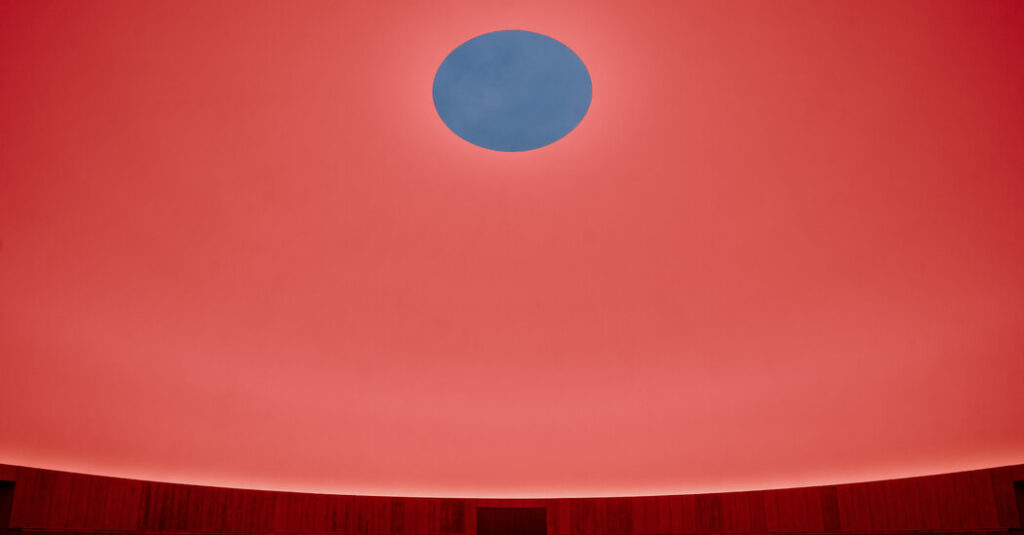
Outside, the Danish evening sky was a mottled gray. But to the viewers gazing up through the opening inside the huge dome that is the American artist James Turrell’s latest creation, the sky was a flat circle of pure color that morphed seamlessly from cobalt blue to teal green, to a yolk-like yellow and back to blue. With each cycle, the colors grew subtly deeper, gradually reaching an intensity that compelled several visitors to lie down directly below the aperture, as if waiting for the mothership to beam them home.
Such is the power of “As Seen Below — The Dome,” the 100th “skyspace” enclosure with a sky-framing opening that Turrell has built around the world — in museums, public buildings, private homes and even a dormant volcano. This iteration, which he created for the permanent collection of the ARoS museum in Aarhus, Denmark, where it opens Friday, is the largest in a museum setting. It is also, as Turrell explained in a phone interview from his home in Flagstaff, Ariz., his most ambitious.
“In the context of the skyspaces, I always wanted to enter Earth and emerge in the heavens,” the artist said. “This one does that.”
To enter “As Seen Below,” you travel through a curving passage that leads from the museum’s main building to an underground circular chamber that’s capped with a dome about 130 feet in diameter. At its center is an “oculus” whose vanishingly fine edge creates the impression that the sky is a flat membrane stretched over the opening.
Over 1,100 artificial lights hidden in the room combine with natural light and the peculiar physics of the human eye to create an installation that plays with perception and demonstrates that light, as Turrell is fond of saying, is not something that reveals, but is itself the revelation.
Turrell, whose work has been influenced by the Nordic artists Lars Hertervig and Thomas Wilfred, said that he was drawn to the region because of its relationship with light. “It does intrigue me that in Denmark, where you have the long winters, in terms of light there’s often very little of it,” he said. “These are people that seem to treasure light the most.”
But the complexities of the site-specific installation meant that it took 12 years to become reality. Because the installation’s dome extends above ground in a public park, the permit process was lengthy. Unfeasible costs compelled Turrell to abandon his original plan to create an entire sphere underground. Even as a dome, the size — about one yard wider than the Pantheon’s — presented significant technical challenges.
Engineers used a technique not previously used at this scale, molding 40 sheets of fiberglass, each about 72 feet long, into a cupola shell whose interior had to be sanded smooth by hand to avoid any seams. The shell’s exterior was then covered with concrete, and — because it is visible as a mound above ground — laid with soil and grass. Partway through the process, Turrell decided to include a retractable lid that closes the aperture.
The 19-ton lid is almost 1,000 square feet in size and has to slide soundlessly on rails, “so there’s a lot of ingenuity in the mechanics,” said Jette Birkeskov Mogensen, the project director for Schmidt Hammer Lassen, the architecture firm that worked with Turrell.
It didn’t help that the company supplying the lid went bust in 2025, delaying the planned completion by a year.
Yet for all its monumentality, “As Seen Below” is also an intimate work, and the interior experience is integral to Turrell’s project. His skyspaces can feel sacred, but unlike medieval cathedrals or Gaudí’s recently completed Sagrada Família in Barcelona, Spain, they are not didactic. Instead, like the Quaker faith in which Turrell was raised, they invite viewers to move between the outer light of the world and the inner light inside themselves.
“In the Quaker viewpoint, there is no one between you and God,” Turrell said. “It is your personal responsibility, as the seeker, to do this yourself, to go inside and greet the light.”
Ringed by a bench that encourages viewers to sit together in silence — but whose acoustics produce some astonishing reverberations when they don’t — the work allows them to encounter that light on their own terms, whether spiritual or secular.
The architect Morten Schmidt, who has been involved with the project since its inception, said he appreciated the way it complements “Your Rainbow Panorama,” a ring-shaped promenade of translucent multicolored glass the artist Olafur Eliasson that tops the museum’s main building and offers 360-degree views of the city below.
“‘Rainbow’ is horizontal, and because you look out, it’s an extroverted space,” Schmidt said. “Turrell’s is vertical, you look directly up into the cosmos. But at the same time, it makes you reflect inward, so you have this introverted experience.”
ARoS’s director, Rebecca Matthews, described the work as the work as “part sanctuary, part observatory, part architecture and part immersive, sensory art experience,” and said she expected the museum’s broad audience to find it deeply affecting.
“It’s very easy to encounter,” she said. “You don’t need an understanding of art history or the manipulation of light. There’s no right way to experience skyspace, no wrong way. There’s just your way.”
Sixty years into his own explorations into what he calls the “thingness” of light, the phenomenon continues to hold mysteries for the 83-year-old Turrell, too. “It was a slow working at figuring out how to make something that captured light that was passing,” he said of his trajectory as an artist. “But our relationship to light is stronger than I ever thought when I was young.”
That relationship is not always as calming or uplifting as a twilight session beneath “As Seen Below — The Dome”: Although he was hoping to travel to Aarhus for the installation’s inauguration this weekend, which the king and queen of Denmark plan to attend, Turrell is recovering from treatment for melanoma and had to stay home. The irony is not lost on him.
“Melanoma comes from too much exposure to shortwave UV light,” he said. “I got too much of a good thing.”
The post To Take Us to the Heavens, James Turrell Went Underground appeared first on New York Times.