“Sculpture is an art of the open air,” said the English sculptor Henry Moore, back in 1951. “Daylight, sunlight, is necessary to it, and for me its best setting and complement is nature.”
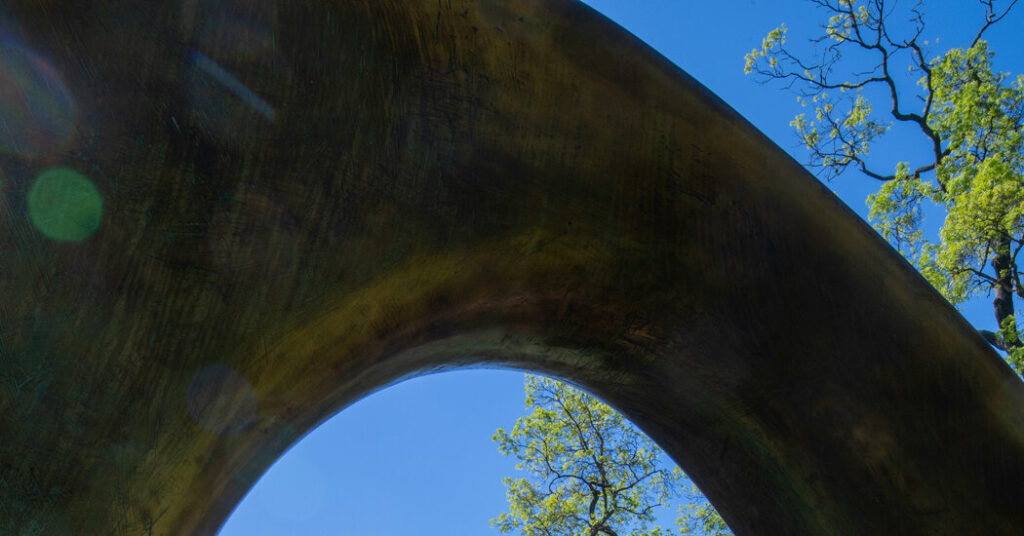
Moore’s words, summing up his lifelong approach to making art, appear on a panel near his monumental bronze sculpture “Double Oval” (1966), which, this summer, has been strategically placed in a wide tree-lined pathway in the Royal Botanic Gardens, Kew, in a district on London’s western outskirts.
Along with that bronze, “Henry Moore: Monumental Nature” presents 29 other large-scale sculptures, spread across the 326 acre garden in a show that runs through Jan. 31.
It is one of several ambitious open-air sculpture displays taking place within reasonably easy reach of London, where the Treasure House Fair is running from June 25 through June 30.
Several smaller indoor works by sculptors featured in these shows can be seen on dealers’ booths at the fair. Richard Green gallery, for instance, is bringing several small-scale bronzes by Moore, while Osborne Samuel Gallery is showing the tabletop size “Sitting Figures in Robes I” by Lynn Chadwick, whose sculptures are on view at a country house in Norfolk this summer.
Sculpture parks are a “thing” in Britain. Pete Moorhouse, a sculptor who lives and works in Bristol, England, and whose outdoor works feature in many regional museums and sculpture parks around England, has compiled a list of 48 such venues in Britain.
“There are definitely more sculpture trails and parks in the U.K. compared to other countries,” Moorhouse said in a Zoom interview.
“Nature is a big aspect of the British psyche,” he added. “So is art. People like the unexpected, they like having their spirits raised by a work of art. Sculpture is an easy way to bring art into the landscape.”
That attraction to nature has inspired Britons to visit permanent sculpture venues for decades. Some of the best-loved include Yorkshire Sculpture Park, where pieces by major international names are displayed in the rolling hills of northern England; the intimate Barbara Hepworth Museum and Sculpture Garden in St. Ives in Cornwall; and Ian Hamilton Finlay’s quirky Little Sparta garden some 25 miles southwest of Edinburgh, which uses stone carving to explore historical and philosophical themes.
In both those venues and newer ones, the distinctively English tradition of Picturesque landscape gardening — a more naturalistic gardening style that emerged as a sort of counterpoint to the formal geometry of gardens like Versailles — continues to shape how open-air sculpture is exhibited in Britain. For instance, Kew Gardens got a Picturesque makeover in the 1760s. The resulting network of winding paths, humps, hollows, woods and vistas provides a suitably varied setting for “Monumental Nature,” which is among the largest outdoor presentations of Moore’s work.
“The pieces aren’t plonked in the landscape,” said Paul Denton, Kew’s director of creative programming and exhibitions, in an interview on the back of a golf cart-like buggy, touring the show.
“It was a very thoughtful process,” Denton added. “You get a glimpse of one in the distance. You see relationships between works. You see pieces between trees or in large vistas. It helps visitors to see the gardens in a different way.”
The show also offers a fresh take on Moore. During his long, successful career, the artist dominated the 20th-century British sculpture scene. He became an establishment figure, his works featured in museum collections around the world (On its website, MoMA lists no fewer than 59 Moore sculptures and works on paper in its collection.) But in later years, Moore’s pieces, made in different sizes and series, could look formulaic and repetitive, particularly in urban environments.
But here in the idyllic, green setting of Kew Gardens, 40 years after Moore’s death, these monumental creations can be seen afresh. Glimpsing “Large Two Forms” (1969) in the distance through the apertures of “Double Oval” is a memorable sight — different from what you might see in a museum. So too is the vision of the enormous white fiberglass “Large Reclining Figure” (1983) playfully lounging on the grass in front of Kew’s 18th-century Chinese-style Great Pagoda.
Goodwood Art Foundation in West Sussex, a two-hour drive south of London, offers a different kind of experience. Set in 70 acres of ancient woodland and open five days a week, this is a permanent sculpture trail featuring works on loan, in which nature is more natural than landscaped and where there is less art than in the Moore show — but more of it takes you by surprise. This selective display of works, situated on the estate owned by the 11th Duke of Richmond, opened last year, replacing Cass Sculpture on the same site, which closed in 2019. The venue’s new iteration currently features just 13 outdoor works by acclaimed international names.
“We wanted to go for fewer works, so that moving from one to the next through the landscape becomes integral to the overall experience,” said Richard Grindy, director of the Goodwood Art Foundation.
Walking through a wooded area along the trail, you are suddenly surrounded by an ancient dance melody, seemingly chanted by invisible forest spirits. This is the 2015 piece “As Many As Will,” sung in all its four parts by Susan Philipsz, the Turner Prize-winning sound sculptor. And then, further along, as you leave the woods, there is Yayoi Kusama’s massive, marvelously incongruous 2023 banana-yellow bronze sculpture, “Aspiring to Pumpkin’s Love, the Love in My Heart,” standing in psychedelic splendor on the edge of a wildflower meadow.
“We want people to engage with art in this beautiful location in a more considered way,” Grindy said. “Art and landscape are in dialogue. They’re not competing with each other.”
Architecture, rather than landscape, tends to be the other half of the dialogue at Houghton Hall, a magnificent 18th-century country house in Norfolk that is hosting “Lynn Chadwick at Houghton Hall,” an exhibition of some 30 works by Chadwick that runs through Oct. 4. A key figure in the development of postwar British sculpture, Chadwick broke through in 1956 when he edged out Alberto Giacometti to win the International Prize for Sculpture at the Venice Biennale.
Houghton was originally built for Sir Robert Walpole, generally considered Britain’s first Prime Minister, and subsequently became the home of the Cholmondeley family, who owned extensive estates in northern England. Since 2015, it has hosted a series of contemporary art shows, devoted to such major names as Damien Hirst and Anish Kapoor.
Chadwick’s angular 20th-century metal sculptures of human figures and beasts might seem like art from a different era than that of his 21st-century counterparts. But, with their slightly dated quality, the sculptures somehow seem made for the classical grandeur of Houghton. The nearly 10-foot-high stainless steel “Sitting Couple on a Bench” (1990) looks majestic placed in front of the Palladian-style facade, while inside the house, smaller works look strangely at home, such as the 1956 bronze “Beast IX,” which stands in front of a monumental fireplace, like a Labrador about to take a snooze.
Another opportunity to enjoy looking at sculpture in a longtime bastion of British privilege are afforded by a thematic show at Worcester College, Oxford. Curated by Iwona Blazwick and Katie Delamere, “The Storytellers” (through July 5) presents a mix of figurative sculptures and live performances by 14 international artists in various places around the quad, garden, lake, orchard and cricket ground of an Oxford University college that was established in the 18th century and is well known for its gardens and grounds.
The show is split into five “acts,” reflecting the long tradition of performing plays outdoors within Worcester College’s centuries-old walls. Pieces by established figures like Elisabeth Frink and Antony Gormley are mixed with works by less familiar up-and-comers.
Just in case you think you feel like you have traveled back decades — or centuries — when you reach this Oxford college’s ornamental lake, you are confronted by a larger-than-life white marble statue of a political protester. Fusing references to Michaelangelo’s “Dying Slave” with contemporary images of suppressed demonstrators, this realistic stone carving, featuring a smartphone in a sagging trouser pocket, was made this year by the Iranian-born sculptor Reza Aramesh.
“We were very conscious of the legacy of the 18th-century landscape garden, particularly the role of statuary,” said Blazwick, the show’s co-curator, who was formerly director of the Whitechapel Gallery in London.
“Young artists are bringing their life experiences into this realm,” said Blazwick. “It’s a legacy of these incredible parks and gardens that have evolved over the centuries.”
“Bringing contemporary art into these spaces makes them feel 21st century and relevant,” she added. “They’re a wonderful context for artists to explore ideas.”
The post Why Have Sculpture Gardens Become a Thing in Britain? appeared first on New York Times.