Blame the Met Gala. Ever since the party and the institution it serves, the Metropolitan Museum of Art’s Costume Institute, went stratospheric, fine art institutions everywhere have cottoned on to the attendance-grabbing power of fashion exhibits.
Just last month, for example, the Met unveiled “Costume Art,” their blockbuster about dress and culture. Shortly thereafter the Brooklyn Museum welcomed everyone to “Iris Van Herpen: Sculpting the Senses,” a show dedicated to the work of the Dutch designer. In Los Angeles, the newly re-opened LACMA has “Fashioning Chinese Women: Empire to Modernity.” And last week the International Center of Photography offered its own contribution to the trend. “Yves Saint Laurent and Photography,” which runs through Sept. 28, is the institution’s first show focused entirely on fashion in 15 years.
It’s a potentially hot idea.
After all, Yves Saint Laurent didn’t just change how people saw clothes, he changed how they saw designers. He was the first founder of a fashion house to turn himself into a brand, using his own likeness to sell his work, pushing boundaries with both images and ideas. He scandalized, subverted and seduced in equal measure, and understood that the camera’s lens and those who wielded it were an essential part of that process.
To see his clothes through the eyes of photographers such as Helmut Newton, Richard Avedon, David Bailey and more, as you do in the ICP show, is to see the way fashion and photography came together to crystallize moments of change in gender relations, culture, and society in the second half of the 20th century.
And yet the exhibition itself proves less thrilling, or even enticing, than the source material.
Organized in conjunction with the Yves Saint Laurent Foundation rather than the fashion brand (the house, now renamed Saint Laurent and owned by the fashion conglomerate Kering, provided financial support), the show was originally part of the 2025 Arles photography festival. At ICP it has been divided into two parts.
The main gallery features what the curators Nastasia Alberti and Clémentine Cuinet call “iconic” images taken by over 50 different photographers, like Helmut Newton’s moody black and white 1975 shot of a model in Saint Laurent’s first woman’s tuxedo standing in a darkened Parisian street. The second gallery displays the ephemera of everyday life and business: advertisements, magazine pages, Polaroids.
Both sections are organized chronologically, moving from the birth of Saint Laurent as a designer in the ateliers of Christian Dior through the birth of his own brand and its transformation into a global phenomenon.
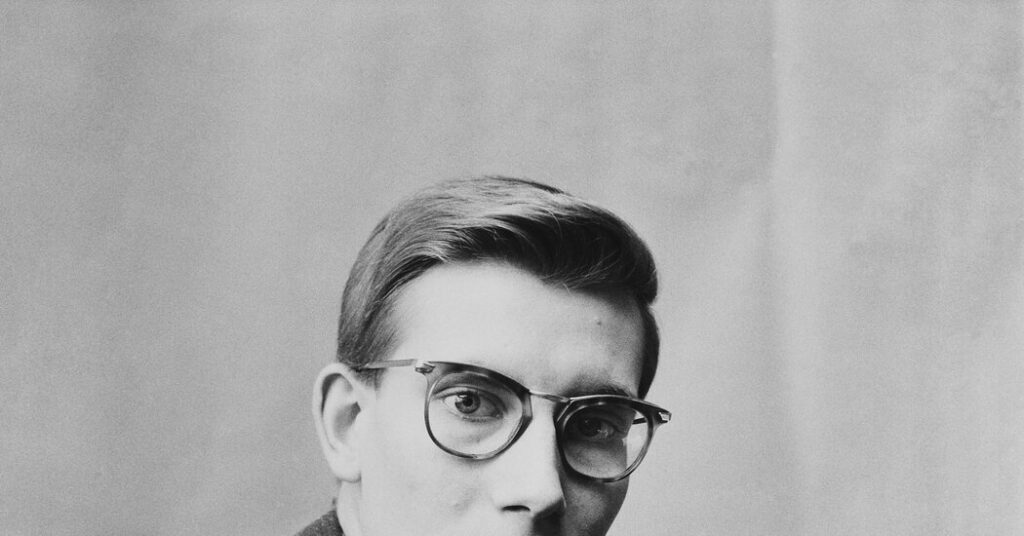
Thus you see the designer as a weedy young man in suit, tie and dark-framed glasses, hovering backstage at a fashion show. You see him metamorphosize, in the decades after he founded his own company, into a longhaired avatar of the hedonistic 1970s, and then transform back into a prosperous businessman, surrounded by such muses as Catherine Deneuve, Loulou de la Falaise and Betty Catroux.
You see him sitting naked atop leather cushions, by Jeanloup Sieff, and, unusually, caught without his glasses by Andy Warhol, an image that was the basis of a Warhol silk-screen. (Almost half the photographs in the first gallery are of Saint Laurent himself — a reflection of the fact that for him, his brand, c’est lui.)
You see the clothes that made his name, and became history. Here, the first haute safari jacket, modeled by Veruschka and captured by Franco Rubartelli for French Vogue, in an image that merged exploration and aspiration; there, the pop art shifts of 1966 caught by Jean-Claude Sauer for Life magazine with the same sense of cartoonish fun that defined the dresses.
And you see how all of it went from prints on the wall to images seeded around the world through mass media; why so much of what we think of when we think of these clothes is actually the pictures of the clothes. To contextualize it further, the exhibit has been updated to include a new emphasis on Saint Laurent’s relationship to New York, with video clips from events like the opening party for the retrospective of his work held at the Met in 1983, and the famous introductory celebration of his Champagne perfume at Liberty Island in 1994. It’s also very apropos, given current events, to see the YSL halftime fashion show that was orchestrated at the World Cup in France in 1998.
What you don’t see, however, is any larger explanation of why all this matters. Or any real contextualization of the designer’s relationship with the photographers he worked with, or the photographs’ relationship with their times. There is pleasure in simply engaging with these images, many of which have entered not just the fashion but the cultural canon. Vicarious fun in identifying some of the models: The former first lady of France, Carla Bruni Sarkozy, before she became a political wife, for example; Jerry Hall in her pre-Mick Jagger/Rupert Murdoch days. There could also, however, be revelation.
The pictures Saint Laurent inspired or commissioned, here potently on display, and his understanding of their power to shape opinion and desire, helped conquer the attention economy as it once existed. They were a crucial part of creating not just his own empire but the modern fashion world, blurring the lines between art and commerce in a way that has become crucial to the industry’s identity.
That insight is hinted at by the image that opens the show: Horst P. Horst’s 1939 shot of a woman in a Mainbocher corset, seen from the back. The only non-YSL-centric photograph on display, it is from Saint Laurent’s personal collection and represents the implicit origin story of the exhibit.
What he saw in that picture — the shapes it painted, the relationship between body and clothing it described, the play between light and shadow, the elegance and emotion — inspired his approach, and his approach helped get us to now. It’s part of why we have all these exhibitions today, for goodness’ sake. Like the woman’s tuxedo, now part of basic fashion vernacular, YSL did it first. But ultimately, rather than being in conversation with the world, the exhibit is mostly in conversation with itself.
Yves Saint Laurent and Photography
Through Sept. 28 at the International Center of Photography, 84 Ludlow Street, Lower Manhattan, icp.org; 212-857-0000.
The post Yves Saint Laurent and Photography: A Hot and Heavy Romance appeared first on New York Times.