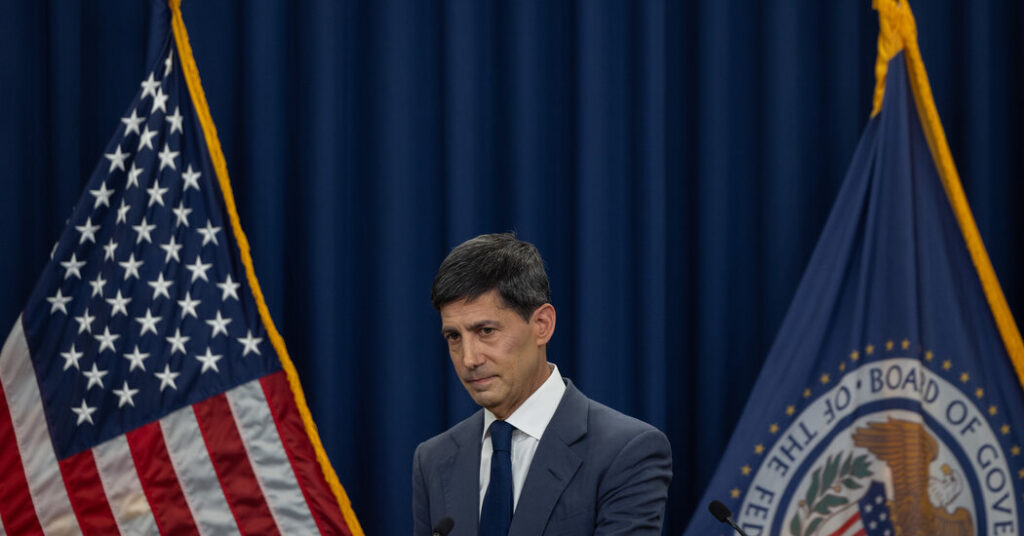
Financial markets wasted little time on Wednesday filling a void left by Kevin M. Warsh during his first news conference as chairman of the Federal Reserve.
Mr. Warsh kept his views on the path for interest rates closely held during the 42-minute exchange with reporters, providing little steer in either direction about what might happen to monetary policy in the coming months. As if to drive home the point, he declined to submit economic projections as part of a quarterly release the Fed publishes. The policy statement was also significantly scaled back.
Investors — cuing from the new set of projections, which showed a groundswell of support for rate increases this year — quickly piled on bets for higher borrowing costs. The yield on two-year US Treasury bonds, which are highly sensitive to changes in the Fed’s stance, leaped higher to roughly 4.2 percent. Markets tracking federal funds futures also moved sharply, indicating elevated odds of a September move and one fully priced in by October.
Mr. Warsh’s approach has the benefit of carving out significant flexibility for the Fed in terms of what it does next. But it also raises the risk that the Fed chairman will not have as firm a grip on the narrative that takes hold about either the trajectory of the economy or the central bank’s policy response. That in turn could create greater scope for some kind of misunderstanding that then needs to be resolved, leading to greater volatility in the markets that directly influence mortgage rates and those for other types of borrowing.
“By not saying anything, you are basically leaving a lot more in the hands of the market,” said Marc Giannoni, chief U.S. economist for Barclays. “Ultimately, he might grow frustrated with what the market is thinking about the future.”
The genesis of Mr. Warsh’s view, which will be examined in greater depth as one of five task forces that he announced on Wednesday, stems from his longstanding view that Fed officials should be more guarded in what they share. When policymakers speak about the economic outlook or their expectations for rates, Mr. Warsh believes they convey a false precision that can end up backfiring on the central bank if the economy does not evolve as expected.
Proponents of this practice both inside and outside the Fed, however, contend that providing guidance helps the central bank to do its job effectively — something that might be lost if it is jettisoned altogether. That is in part why the central bank embraced transparency more than a decade ago under then-Chair Ben S. Bernanke. His predecessors, Janet L. Yellen and Jerome H. Powell, later expanded on it.
“It’s considered just more efficient if markets can react to incoming data and news with knowledge of the central bank’s reaction function,” said Jonathan Pingle, who used to work at the Fed and is now the chief U.S. economist at UBS. Otherwise, he said, “you would end up with periods where you’re unaligned and need to be realigned.”
Tim Mahedy, chief economist at Access/Macro, a research firm, who formerly worked at the Federal Reserve Bank of San Francisco, likened Mr. Warsh’s approach to turning back the clock.
“We’re going to be parsing through comments trying to figure out what the reaction function is,” he said. “It’s just like 1995 again.”
The added complication for Mr. Warsh is that his penchant for silence does not appear to be shared by his colleagues. Presidents at the 12 regional Reserve Banks and members of the Board of Governors in Washington speak with regularity about the outlook and how policy might evolve given certain circumstances.
“Quiet is not a feature of modern central banking, and his core problem is those with a different view from him will fill the vacuum,” said Vincent Reinhart, a former Fed economist now at BNY Investments.
Mr. Reinhart expected the most vocal people to be those who have embraced the need for rate increases — a cohort that has grown significantly in recent months. As of the latest projections, nine policymakers forecast at least one quarter-point increase this year, while eight penciled in no reductions at all. Only one person penciled in a quarter-point cut.
Those in favor of rate increases are primarily concerned about the recent deterioration in inflation because of the war with Iran and the lengthy process ahead to get it back to 2 percent. Mr. Warsh sought to convey in as strong of terms his displeasure with this lingering inflation problem, vowing repeatedly that the Fed would “deliver price stability.”
But in his sparse statements on the economic backdrop, he could not completely obscure his leaning against rate increases.
Mr. Warsh stressed how supply-related factors, such as the energy shock caused by the conflict in the Middle East, had driven up price increases. He made clear he did not see a “cruel choice” between inflation and the labor market, suggesting he believes the economy can grow without stoking price pressures. Mr. Warsh also sounded optimistic about the prospects that artificial intelligence will increase productivity, an argument that he has previously used to make the case for rate cuts. Lastly, he argued that rates were restraining some sectors in the economy such as housing, although he conceded that it has been “uneven.”
Seth Carpenter, a former Fed economist who is now at Morgan Stanley, warned that Mr. Warsh’s pledge for price stability has a “shelf life” if the inflation data takes another turn for the worse. That might require Mr. Warsh to break his own rule and speak out about the Fed’s policy plans.
“If they keep saying it and inflation starts to rise, then I think it is necessary to put some action behind the words to keep the market believing it,” said Mr. Carpenter, who as of now still believes the Fed will keep rates on hold for the remainder of the year.
Ben Casselman contributed reporting.
The post Warsh Wants the Fed to Send Fewer Signals. That Comes With Risks. appeared first on New York Times.