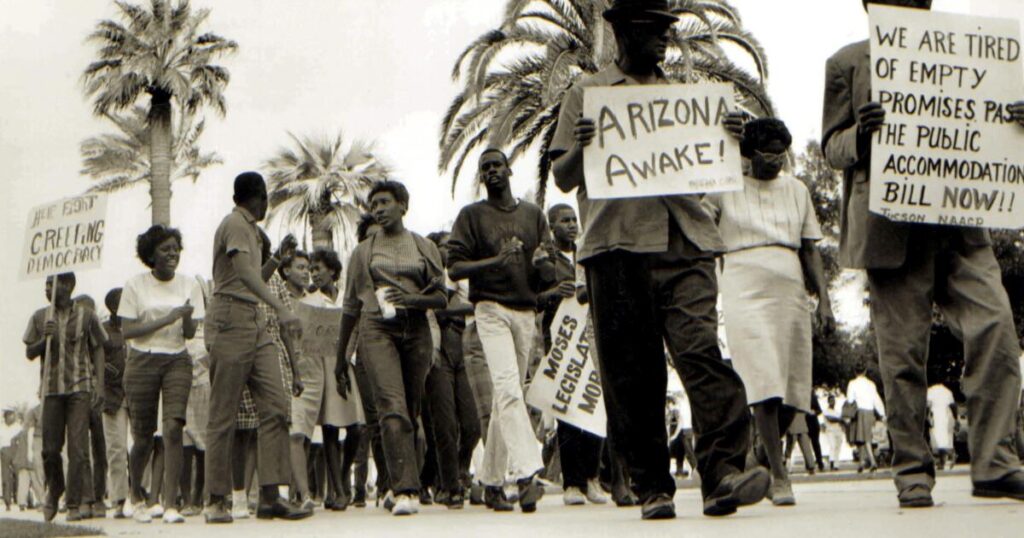
When Americans assess the legacy of the civil rights movement, we usually count laws passed and barriers dismantled. Brown vs. Board of Education. The Civil Rights Act. The Voting Rights Act. These milestones reshaped American institutions. But they do not fully explain what happened.
Recent research suggests that the movement also produced a large and lasting psychological transformation — one that unfolded not in legislatures or courts, but in how Black Americans came to understand their own agency, their capacity to act in the world.
Noah Love and I, both researchers at the University of Pennsylvania’s Positive Psychology Center, examined more than 200 billion words published in American newspapers over the past century. Using methods from psychology, linguistics and data science, we sought to answer a simple question: Did the civil rights movement change how Americans — particularly Black Americans — expressed personal agency?
Personal agency is the belief “I can achieve my goals.” Decades of psychological research show that agency predicts effort, persistence, innovation and well-being. People who believe their actions matter try harder and persist longer; people who don’t, disengage. Agency is one of the most powerful drivers of human behavior that psychologists have identified.
But agency is difficult to measure historically. There were no national surveys of this mindset in the 1930s or 1950s. So we turned to language.
Language, at scale, provides a window into collective psychology. The words people use — especially repeatedly, over time — reflect how they think about causation, responsibility, effort and possibility. Psychologists have shown that changes in word use reliably track changes in emotion, personality and cognition.
We assembled two huge newspaper corpora: one consisting of newspapers owned and operated primarily by Black Americans and another consisting of predominantly white-owned newspapers. They spanned more than 100 years. We then analyzed for words that connote agentic thinking, such as terms associated with effort, initiative, control and achievement. We also tracked words capturing optimism and imagination.
We didn’t rely on a single definition or dictionary but drew on different theoretical traditions and methods, including one lexicon generated by an artificial intelligence large language model.
The results converged and were striking.
From the 1920s through the early 1950s, Black and white newspapers expressed similar levels of agency, and by some measures Black agency was lower. Then, beginning in the early 1960s, Black agency rose sharply. Within a few years, it surpassed white agency. And it stayed there — for decades.
The same pattern appeared for optimism and imagination. Around the time of the civil rights movement, Black newspapers increasingly used language associated with hope, possibility and future-oriented thinking. These were not brief spikes around particular events. They were sustained, multiyear shifts.
This matters because psychological change is often the missing link between structural reform and human outcomes. Laws do not act by themselves. They work through people — through their willingness to try, to persist, to innovate and to believe that effort is worthwhile.
The civil rights movement was an extraordinary display of agency in action: students staging sit-ins, families boycotting buses, ordinary citizens confronting violence and arrest. What our data suggest is that these visible acts coincided with — and likely helped generate — a deeper internal transformation. A sense of “we can” replaced a sense of “nothing will change.”
This does not mean the movement solved racism or erased inequality. It did not. Substantial gaps between Black and white Americans remain, particularly in health, education and imprisonment. Our findings do not minimize those realities.
But they do challenge the sentiment sometimes heard recently that the civil rights movement achieved little or nothing of lasting value — a claim expressed as some landmark legal progress of the 1960s has been rolled back in the 2000s. One of the movement’s most enduring achievements appears to be psychological. It cultivated a mindset that fuels continued striving, resilience and innovation. This is part of what the United States celebrates every June 19, marking the anniversary of enslaved people’s emancipation in Texas in 1865.
Causation, of course, runs both ways. Legal victories likely strengthened agency, and increased agency likely fueled further action. We see this as a reinforcing cycle: Agency drives action; successful action strengthens agency. Over time, that cycle can reshape a culture.
This research also points to a broader lesson about social change. Structural reforms matter deeply — but they are most powerful when they also alter how people see themselves. Progress is sustained not only by policy, but also by psychology.
The civil rights movement did more than change American law. It changed American minds. That psychological shift — measurable, durable and still visible today — may be its most important legacy.
Martin Seligman, a professor of psychology at the University of Pennsylvania, is the author of the forthcoming “Agency: The Psychological History of Human Progress.”
The post Civil rights era changed how Black Americans see themselves appeared first on Los Angeles Times.