At the often volatile crossroads of art and politics in Russia, Alexander Sokurov stands out. A renowned filmmaker and art house favorite in the West, he has a habit of publicly questioning President Vladimir V. Putin about a range of contentious issues, including government repression.
Nonetheless, this year’s Venice Biennale dropped him as a speaker following protests by a group of exiled Russian artists who said he exemplified officially approved dissent, circulating unimpeded in Russia while real critics were imprisoned or forced to flee.
“In many ways his fate is the fate of a talented loner,” said Anton Dolin, a prominent Russian film critic living in exile. “That explains both the cult around him and the hostility toward him.”
“On the one hand, his films are banned in Russia,” he added. “On the other hand, he remains highly respected and continues to participate in state councils and institutions.”
The December gathering of the Presidential Council for Civil Society and Human Rights, most recently put a spotlight on Mr. Sokurov, 74. Mr. Putin appointed the director to the council in 2018, and Mr. Sokurov used the group’s annual meeting with the president to criticize oppressive government policies. It was a remarkable departure for a 50-member advisory organization that has been stacked with pro-war figures and other Kremlin cheerleaders.
At the meeting, Mr. Sokurov called stringent censorship of the arts worse in present times than in the Soviet Union; described the ritual of ostracizing government critics as “foreign agents” as humiliating; and questioned favoring the children of Ukraine War veterans for the already limited number of free spots at prestigious state-run universities.
It was not the first such encounter. At similar meeting in 2021, for example, Mr. Putin, visibly angry, rejected his suggestion that minority republics be allowed to freely leave the Russian Federation.
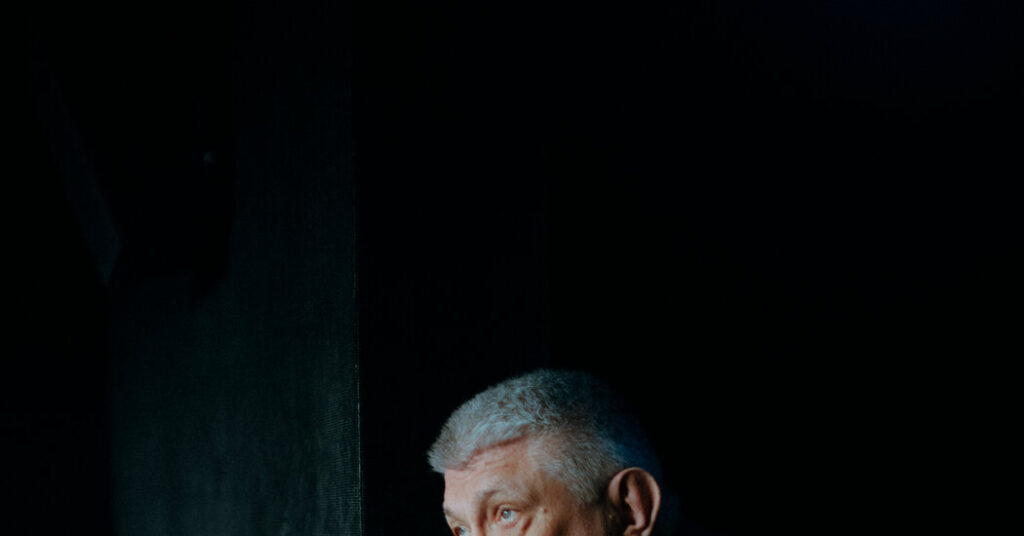
In an interview, Mr. Sokurov — a heavyset, avuncular man with a shock of white hair who walks with a cane — acknowledged that most people could not get away with such remarks. But he has interacted with the president for decades, since Mr. Putin was a city official in St. Petersburg and the filmmaker petitioned him to save its Soviet-era film studio from oblivion.
This time, Mr. Putin largely avoided answering before suggesting that they discuss the issues in person — a meeting that has yet to happen.
Mr. Sokurov said he felt a special responsibility to make public comments, especially to insure that young Russians inherited a livable country.
“Sometimes people tell me that I am a fool, that I shouldn’t say these things, that it’s crazy, that it’s pointless,” he said, speaking on the sidelines of a Russian film festival last March in Paris. He presented works by his students as well as his latest film, “Director’s Diary,” a five-hour documentary weaving together historical newsreels with entries from his diaries from 1957 to 1990.
“My interest is purely public, purely about life,” he said. “I am surrounded by real people, not some government or elite circle. I’m just a working-class filmmaker.”
His critiques often go unheeded, Mr. Sokurov said. He prepares such reproofs carefully, he said, writing out the script as he would a movie scene to ensure that he does not forget any points.
“For me, it’s very stressful: to speak out publicly, to invite a backlash, to worsen my own situation,” he said. Still, he can’t hold back, he said.
Mr. Sokurov was born on June 14, 1951, in a village near Lake Baikal, in Siberia, to a father whose military posts led to an itinerant childhood for him and his older sister.
He described his father, a decorated World War II infantryman, as “sharp-tempered and strong-willed.” His mother knew Russian and Italian opera by heart, although his parents did not consider the arts a profession.
He credits radio, especially the wealth of Soviet programs featuring classical music and dramatic performances, with opening his eyes to the world beyond the military backwaters where he grew up. “It was my teacher and my mentor,” he said.
His lifelong contrarian impulses emerged from his university experience, he said. He proposed writing a history thesis about Czar Nicholas II, but was told the subject was taboo. In protest he picked an obscure topic, the economic relations between the Soviet Union and Chile. He wanted to test his ability to see a protest through to the end, he said.
A haphazard college job producing both plays and live sporting events for a local television station eventually led him into film. As a young adult, he recognized that Soviet movies were “a serious, vast and highly motivated body of creative work,” he said, but he was not drawn to the profession. “I never liked movies, and I’m not a movie fan now, either,” he said. “I’m a reader.”
His independent nature brought trouble. The director of the Lenfilm, the center for film production in Leningrad, now St. Petersburg, denounced him to the authorities for his “anti-Soviet” attitude. He was interrogated and put under surveillance. His career was doomed, he said. But then the Soviet leader, Mikhail Gorbachev, suddenly introduced the concept of “perestroika” — openness — to society. Soon after, the U.S.S.R. collapsed.
In 2002, Mr. Sokurov directed “Russian Ark,” a surreal romp through 300 years of Russian history, which attracted a global audience.
In the film, an anonymous narrator wanders the labyrinthine halls of the Hermitage Museum in St. Petersburg, encountering famous figures like Catherine the Great. Filming the entire 95 minutes in one uninterrupted take was widely hailed as unprecedented.
The dialogue included some criticism of Russia. For example, the narrator, admiring copies of works by Raphael, said: “Russians are so talented at copying. Why? Because you don’t have ideas of your own. Your authorities do not want you to have them.”
Mr. Sokurov’s films vary widely and do not fall easily into categories like drama or comedy. They are often experimental and their plots, if they exist, are rarely linear.
“He is a guru of auteur cinema — highly independent, deeply original and widely respected,” said Mr. Dolin, the critic. “In Russia, he is admired more as a moral authority and revered for his work than he is actually watched.”
In 2011, his film “Faust” won the top prize at the Venice Film Festival. The movie formed part of a tetralogy that examined in turn the legacy of Lenin, Hitler and Emperor Hirohito.
To explore the life of Lenin, he drew on the expertise of the dissident Soviet writer Alexander Solzhenitsyn.
“The first impression Sokurov made on me was a rare combination of masculinity and tenderness,” said Mr. Solzhenitsyn’s widow, Natalia D. Solzhenitsyna, in response to emailed questions. That impression, she said, endured.
“I deeply respect his willingness to speak openly with the authorities about the shortcomings in our lives, though I grieve that it takes so much strength from him,” she said.
After failing to secure public or private funding for “Faust,” he sought Mr. Putin’s aid. The president, a former secret agent in Germany, was intrigued and helped raise the 10 million euros needed. The filmmaker remains impressed with Mr. Putin’s attention to detail.
Some of his movies have been banned in Russia, including a recent, black-and-white film, “Fairytale,” in which he used archival footage to generate animations of Stalin, Mussolini, Hitler and Churchill together in the afterlife.
In Soviet times the authorities at least explained why a film was banned, he said. The letter rejecting a license for “Fairytale” cited “federal law” as the reason without specifying which one.
Earlier this year, the Moscow International Film Festival informed him that he would receive a prestigious lifetime achievement award, he said. The notice came after his latest public exchange with Mr. Putin. But, he said, the award was abruptly canceled on the eve of the ceremony. A retrospective of his work to mark his 75th birthday was also rejected by numerous St. Petersburg theaters.
In May, at the Venice Biennale, Mr. Sokurov was due to be a featured speaker at a seminar about dissent. Then a group of Italian cultural figures and prominent exiled Russian artists published an open letter criticizing him as an example of “safe dissent” that operated under Kremlin approval.
The festival unexpectedly announced that Mr. Sokurov was unavailable. He denied withdrawing.
Ultimately, Mr. Sokurov said, fear stops most people from speaking out. But he feels compelled to try to force the government to listen to dissent. Even if at times he regrets the fallout, he said, the powerful Russian state should hear different views.
For that reason, he said, he will never chose exile.
“I am sitting in this boat, and if it starts to sink, I will go down with it,” he said.
The post The Russian Film Director Who Chooses Moments to Challenge Putin appeared first on New York Times.