Donald Trump knew as well as anyone that he had lost the 2020 presidential election fair and square. He knew there was no conspiracy to commit voter fraud — no mysterious mail ballots, no “illegal” voting, no suspicious activity in key swing states. When he told his supporters that the election had been “rigged,” he was lying.
His monthslong effort to “stop the steal,” culminating in the Jan. 6 attack on the Capitol, was an exercise in deception. And we know it was an exercise in deception because Trump’s aides and allies said so. On the record. Under oath.
“The Defendant’s vice president,” reads the indictment in United States v. Donald J. Trump, “told the Defendant that he had seen no evidence of outcome-determinative fraud.” His attorney general at the time, Bill Barr, said the same. So did his director of national intelligence, senior White House attorneys and the top staffers and strategists on his campaign.
Everyone told Trump that he had lost. They showed him the numbers. They urged him to relent. The party was over and Joe Biden would be the next president.
Even Trump seemed to acknowledge, in private, that he had lost the election. “Can you believe I lost to this effing guy?,” he said while watching Biden on television, according to testimony given by a former White House aide, Alyssa Farah Griffin.
To say, in the face of all evidence to the contrary, that there was systematic voter fraud is to lie. And Trump, again, was lying. But he was also making a specific political claim. If there were no shenanigans but there was still “fraud” because the election was “rigged,” then it’s clear that the meaning of fraud has less to do with any particular set of rules and procedures than it does with the more elemental aspects of American political life. And it doesn’t take much work to decipher the president’s conception of “fraud.”
There was a reason, to put it differently, that Trump centered his crusade on ferreting out “illegal votes”; there was a reason he focused on cities with large Black populations like Atlanta, Detroit, Milwaukee and Philadelphia; and there was a reason that when his supporters fought their way into the Capitol building, they unfurled Confederate flags to mark their achievement.
The president’s convoluted and false claims about “fraud” were little more than a smoke screen for a more basic claim about who belongs to the community — about who counts as a voter and who counts as a citizen. To say that Democratic victories in Pennsylvania or Georgia were the product of fraud in Philadelphia or Atlanta was to say, in short, that the wrong people were voting. And in the same way that Trump’s “birtherism” wasn’t really about whether Barack Obama was born in the United States, his crusade to “stop the steal” wasn’t about the nation’s election procedures. It was a declaration that the only real voters were his own.
Last week, Spencer Pratt — a former reality television star turned de facto Republican candidate for mayor of Los Angeles — was knocked out of the first round of the Los Angeles mayoral election. Pratt had held second place, just behind the incumbent, Karen Bass, in the days following the election. But as mail-in ballots came in, Nithya Raman, a Democratic member of the Los Angeles City Council who ran as the left-wing challenger to Bass, gained ground. Raman eventually overtook Pratt in the race for the second spot on November’s ballot, ending his campaign.
Now, it is important to say that even as we use the language of motion to describe election results, the fact of the matter is that the outcome is set at the moment the polls close. Someone won; the job of election officials is to count the votes and say who that was. There is no “blue shift” or “red mirage.” Nothing changes when a candidate starts strong and then falls behind; that movement is nothing more than an artifact of the order in which ballots are counted.
Nevertheless, Pratt’s reaction to losing was to dance with claims of fraud. On his X account, he amplified claims of vote tampering and illegal balloting. Other Republicans followed suit, claiming without evidence that there was no way that Pratt could have slipped behind Bass and Raman sans fraud.
“The Mayoral election in Los Angeles is being stolen from @spencerpratt in real time!,” Laura Loomer, an influential conservative activist. declared. When asked for evidence of fraud, the House speaker, Mike Johnson, brushed off the question, saying instead that “some of these efforts are so diabolical and so far upstream that it’s impossible to prove. But I think everybody knows instinctively that something is wrong here.”
The speaker might be interested to know that in Los Angeles Democrats vastly outnumber Republicans. You don’t need “fraud” to explain Pratt’s defeat — you just need math.
You could, if you were inclined, ask whether this fraudmongering was sincere; if it was a reaction to something real in the world — for example, the slow pace at which California counts ballots. But it seems more likely, looking at the state of Republican politics since Jan. 6, that the claims of fraud emanating from Republicans are part of a political attack meant to sow mistrust in the electoral system as well as delegitimize Democratic voters.
As he often does, President Trump washed away all doubt when, in a recent interview with Kristen Welker of NBC’s “Meet the Press,” he raged against supposed fraud. “The election was rigged,” he said of the 2020 contest. “It was a dirty election. And it’s happening again in California.” American elections, Trump continued, are “like a third-world country.”
Recall that last year, Trump targeted Los Angeles with National Guard troops and agents from Immigration and Customs Enforcement and Customs and Border Protection. And consider the regularity with which the president says things like, “if you import people from Third World Countries, you quickly become a Third World Country.” The logic is straightforward. A city of immigrants, like Los Angeles, must also be a city of voter fraud, even if those immigrants are legal voters, entitled to participate in the political process.
“Voter fraud” is not about fraud. It is about who votes and how. It is about the breadth and scope of the political community. It is, as with most MAGA obsessions, about who can call themselves Americans — entitled to govern as equals — and who are mere subjects. Trump’s obsession with voter fraud is just another expression of the reactionary populist belief that the people who inhabit a place are not equivalent to the people, who are entitled to rule.
We should treat this contretemps in Los Angeles, as silly as it is, as a dress rehearsal for what will probably happen in November, if and when Republicans lose control of Congress. Any result short of victory for Trump and his allies will be denounced as “fraud.” Not because there is anything wrong with the system, but be because, as they see it, this is their country and theirs alone.
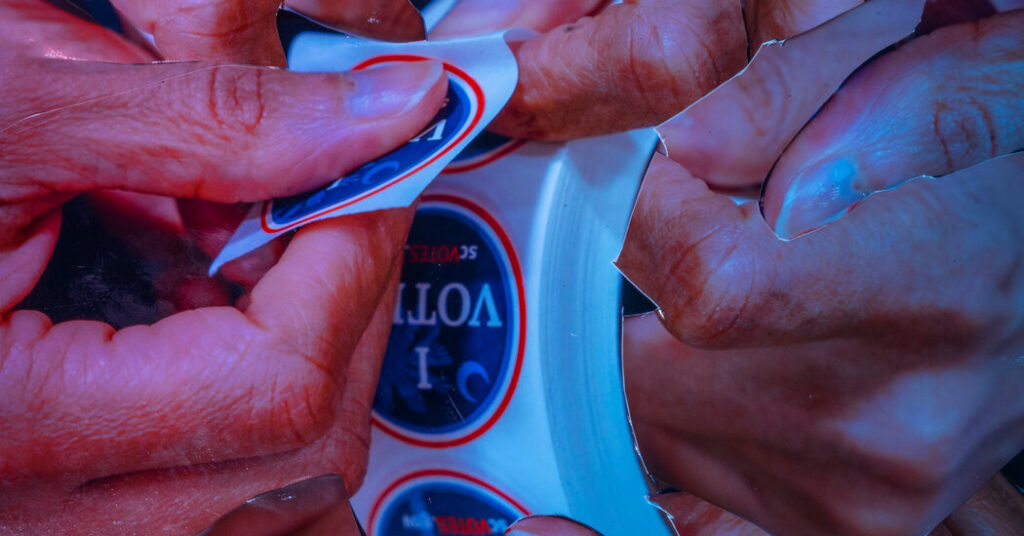
Source photograph by Caroline Gutman for The New York Times.
The Times is committed to publishing a diversity of letters to the editor. We’d like to hear what you think about this or any of our articles. Here are some tips. And here’s our email: [email protected].
Follow the New York Times Opinion section on Facebook, Instagram, TikTok, Bluesky, WhatsApp and Threads.
The post If You Don’t Vote for Republicans, You Don’t Exist appeared first on New York Times.