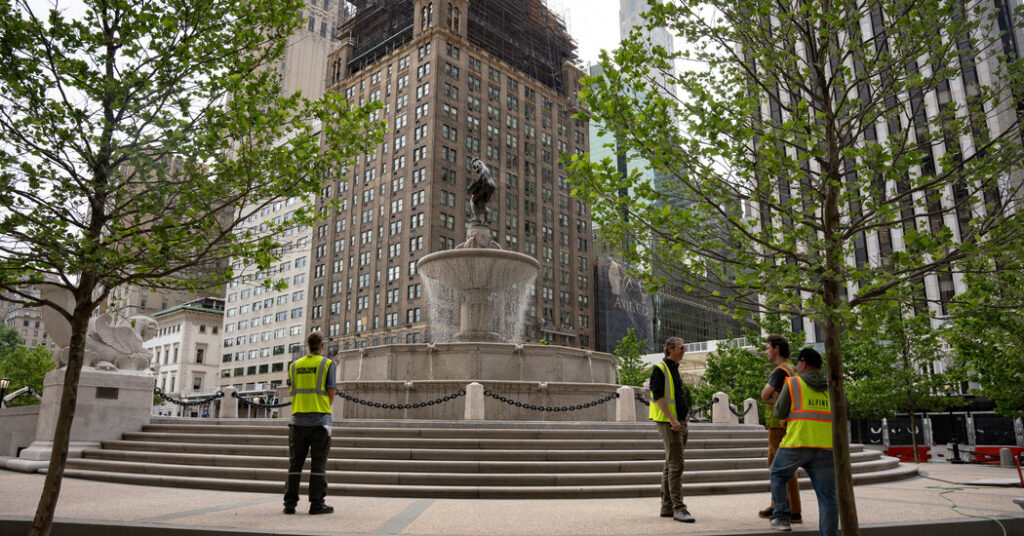
The Grand Army Plaza in Manhattan is not nearly as big or as famous as the one in Brooklyn, and it does not have its own subway station, either.
But this long overlooked plaza at the southeast corner of Central Park is finally getting its moment.
The plaza re-emerged on Wednesday from a $21 million restoration by the Central Park Conservancy that took place in two separate phases over 13 years. The final phase, which started in 2024, refurbished its Beaux-Arts showpiece, the Pulitzer Fountain; replicated its original pavement with ribbons of bluestone and pebblestone; and replanted a double row of London plane trees that had been taken out decades ago.
The restoration has revived a heavily used plaza — with over two million visitors a year before the restoration — that lost its glow over the years like an aging grande dame. Many passed through without knowing its name, often assuming it was just part of the Plaza Hotel across the street.
“I think it’s going to reawaken a lot of people, myself included, that this was part of the grand entrance to Central Park,” said Peg Breen, the president of the New York Landmarks Conservancy, a nonprofit, adding that “aside from the Knicks, it’s another thing to be proud of in New York.”
The oval-shaped plaza, which sits on parkland along Fifth Avenue, was designed by the architectural firm Carrère and Hastings as part of a 1912 competition to reimagine the main entrance to Central Park. It is divided in half by 59th Street.
The south side opened in 1916 with a memorial fountain for the newspaper publisher Joseph Pulitzer, who bequeathed $50,000 for it. A bronze of Pomona, the Roman goddess of abundance, stands on top of the wedding-cake-like fountain, while water cascades from a bowl below her feet down five tiers of basins.
It took five more years to finish the north side, where there is a gilded equestrian statue of General William Tecumseh Sherman by Augustus Saint-Gaudens.
The public space was officially named Grand Army Plaza by the Board of Aldermen, the predecessor of the City Council, in 1923 — a full three years before the board designated a second Grand Army Plaza in Brooklyn at the main entrance to Prospect Park.
Both plazas honored the Grand Army of the Republic, an influential organization of Union veterans of the Civil War with close ties to the Republican Party, which developed memorials around the country, said Robert W. Snyder, a former Manhattan borough historian.
Despite sharing a name, the two plazas are “very different in tone and temperament,” said Jonathan Kuhn, the director of art and antiquities for the city’s Department of Parks and Recreation.
The Brooklyn plaza sprawls over 14 acres and is anchored by the towering Soldiers’ and Sailors’ Memorial Arch. It has become a chaotic traffic circle, and city officials recently announced a plan to ban cars from parts of the plaza.
The 1.4-acre Manhattan plaza was designed as “an outdoor living room” surrounded by buildings, which once included the Vanderbilt mansion, in the tradition of grand European plazas, Mr. Kuhn said.
From the beginning, Pulitzer Fountain required constant care. Fashioned from Kentucky limestone not suited for New York winters, it soon cracked and chipped. A large chunk even broke off. According to a 1928 headline in The New York Times: “Removal of Pulitzer Fountain Considered; So Broken, It Is Held to Mar Plaza Square.” The fountain stayed and was rebuilt with marble and then granite.
In 2013, the Central Park Conservancy, the nonprofit that manages the 843-acre park for the city, embarked on a full-scale plaza restoration. The work on the north side, completed in 2015, included regilding General Sherman’s monument.
However, work did not start on the south side until 2024, in part because it took time to raise more money, and the pandemic caused delays, said Betsy Smith, the conservancy’s president and chief executive officer. About 85 percent of the total $21 million plaza restoration came from private donations, with the rest from city funding.
The fountain was leaking by then and had to be dismantled for repairs, cleaning and waterproofing. A concrete vault underneath the fountain, which houses its plumbing, mechanical and electrical systems, was expanded and outfitted with modern equipment.
Calling the plaza a “very important civic space,” Ms. Smith said the restoration has made it more accessible. Workers raised both sides of the plaza to sidewalk level to make it easier to cross for pedestrians, including wheelchair users. New lighting will be added to illuminate the fountain and General Sherman’s monument.
The other morning, the fountain gurgled again with falling water, and Pomona gleamed with hints of green, gold and brown in the sunlight. “We sent her off to a spa,” Ms. Smith said.
Brian Coltrinari, 42, who works nearby, said he often walks around the plaza at lunchtime. While he has visited Grand Army Plaza in Brooklyn, he said he preferred the Manhattan one because it was closer and better for “pedestrians and people watching.”
The post The Other Grand Army Plaza Gets a $21 Million Makeover appeared first on New York Times.