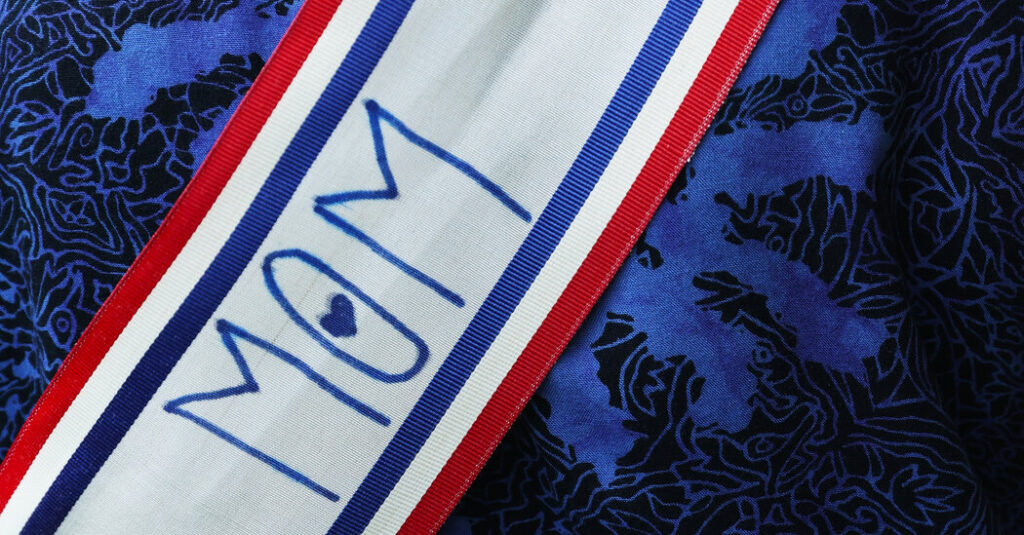
Alex Bores’s mom patrols her son’s would-be Manhattan congressional district in a sash that reads “ALEX BORES’ MOM.” She takes the title as seriously as the thick blue Sharpie implies.
Before a recent debate in the closing weeks of a ferocious Democratic primary long shadowed by a more famous mother (and her Kennedy surname), Mr. Bores, a 35-year-old state assemblyman from the Upper East Side, had hoped for a quiet moment in the green room. His mother, Lori Bores, was not strictly invited. But the sash opens doors.
“I show up, and they’re like, ‘Oh, come on in!’” Ms. Bores, 69, said of the building security days later, as her son performatively grimaced beside her in Central Park.
Across town, Micah Lasher’s mother, Stephanie Lasher, spends her mornings pivoting in strategic semicircles on high-traffic sidewalks, greeting plausibly persuadable voters with a bespoke message about her assemblyman son, who lives in the same building as she does, several floors down, on the Upper West Side.
“My son, Micah Lasher, is in the Democratic primary …”
“My son, Micah Lasher …”
“Micah is my son …”
“Congratulations,” a man told her tersely at a Chelsea greenmarket recently, with Mr. Lasher, 44, a few feet away. “I’m sure he’s a very nice boy.”
The nationally watched race for New York’s 12th Congressional District, which covers most of the long torso of Manhattan, has been about many things: A.I., Israel, antagonism toward President Trump, what kind of emissary should replace the departing congressman, Jerrold Nadler, after more than three decades.
It is also about moms. Manhattan moms, to be explicit. Manhattan moms of boys, if we’re really being precise.
One of the borough’s most prominent such moms, Caroline Kennedy — the daughter of John F. Kennedy and Jacqueline Kennedy Onassis — has watched her son, Jack Schlossberg, campaign as a conscious link to the family political legacy, occasionally dispersing some of her motherly gravitas.
“I’m so proud of my son Jack, and I know that both my parents and his Uncle Teddy would be, too,” she says in an ad posted on Wednesday.
“Vote for Jack,” she concludes, as he emerges to bear-hug her in the spot’s final frame. A very nice boy.
Yet if the primary once seemed to turn, in part, on how receptive voters might be to the most pedigreed son-of-a-mom, the wider roster of sons and their paths to maybe-power have affirmed something plainer: Maternal endorsements and reinforcements, in politics and otherwise, are kind of Manhattan’s thing.
Here live the not entirely gentle suggesters forever nudging their children into the right clothes, the right schools, the right romantic relationships; the self-taught experts in chess or baseball or politics or whatever animated their sons, in youth or adulthood; the very concerned citizens who make Hollywood stage parents look hands-off and carefree.
Ms. Lasher, 81, who served as treasurer on her son’s Assembly campaign, was asked recently what defined an archetypal Upper West Side mother. She paused thoughtfully.
“Involved,” she began.
“Rule No. 1 in New York City politics,” said Scott Stringer, a former city comptroller who described Ms. Lasher as a second mother (he is supporting Mr. Lasher) and appointed Ms. Bores to a community board when he was Manhattan borough president. “You do not disrespect the mothers.”
Ms. Kennedy, who lost a daughter, Tatiana Schlossberg, to cancer late last year, has been a less consistent presence on the campaign trail than the mothers of her son’s chief rivals.
But she has solicited donations from friends and relatives and has sometimes joined Mr. Schlossberg at events, including a Mother’s Day policy announcement for what he called a “Monthly Mom’s Bonus.”
“People are really impressed with Jack,” Ms. Kennedy said in a brief interview on Wednesday on the Upper East Side, where Mr. Schlossberg, his parents and volunteers chatted up voters on a street corner.
She also recently encountered Ms. Bores at a candidate forum.
“She said, ‘You must be so proud,’” Ms. Bores recalled. “I said, ‘As you must be.’” (Ms. Bores reminded Ms. Kennedy that they had crossed paths years earlier at a children’s karate class, she said.)
Ms. Bores and Ms. Lasher, longtime civic fixtures themselves, have lived the kinds of New York lives more familiar to most district voters.
Both have cultivated independent relationships in the sometimes comically overheated world of uptown Democratic clubs and community boards, where sidebars on bike lanes or parade routes can end friendships.
Ms. Bores, who worked in television news for programs like “Good Morning America” and “Dateline,” was diagnosed in 2000 with multiple sclerosis and has become an activist for people with the disease. When her son was 10 or so, he once had a more modest municipal aim, she said: petitioning City Hall to ease traffic and improve her taxing commute.
“I have a big Alex folder,” Ms. Bores said, holding her thumb and pointer finger several inches apart to ballpark the size. “I found this letter that he had written to Mayor Giuliani.”
Ms. Lasher’s path to politics was less direct, hastened by Mr. Lasher’s interest in a local Democratic club as a teenager.
She and her husband worked as consultants in the food packaging industry and cheered their son’s adolescent turn as a semi-notable magician, with a book to match: “The Magic of Micah Lasher: More Than Fifty Tricks That Will Amaze and Delight Everyone — Including You.” (“We tried as parents to be supportive,” Ms. Lasher said, “of whatever it was that he was interested in.”)
After his father died in 2020, Mr. Lasher and his wife urged his mother to move into their building on Riverside Drive, where Ms. Lasher could spoil her grandchildren, convene Shabbat dinners and (as it happened eventually) supply a bonus space from which her candidate-son could conduct business in relative quiet.
“This is not a Kramer and Jerry situation,” Mr. Lasher said, invoking the neighborly drop-ins of “Seinfeld” on a fictional bygone Upper West Side.
But it is also not not that.
Mr. Lasher said he had availed himself of the upstairs apartment for calls and campaign work, especially when his son had a trumpet lesson.
If the weather cooperates, mother and son sometimes walk home together after events.
“Any activity that a parent can share with their kid is just gold,” Ms. Lasher said, adding that she was grateful to have been bypassed for campaign treasurer this time.
She had just been canvassing in Chelsea on a recent Saturday, studying the faces that sometimes recognized hers from past weekends (“hey, mom”) and talking up Mr. Lasher with the kinds of voters who decide elections in this district: a shopper with a handmade sign on her cart (“Litter Ain’t Nice. Neither Is ICE.”); a man with a “Jazz at Lincoln Center” tote; a woman with a bag instructing fellow pedestrians, “You Will Never Be a New Yorker If You Don’t Learn to Walk Faster.”
“The stroller moms are often fruitful ground,” Ms. Lasher said, after a young mother paused to accept campaign literature.
While Mr. Lasher and Mr. Bores are generally polling best, other candidates include George Conway, the anti-Trump commentator and former Republican (whose mother, a Filipino immigrant and former organic chemist, is in assisted living, he said), and Nina Schwalbe, a public health researcher (who is, as she has noted, an actual mother).
In Ms. Bores’s zeal to elevate her son above the fray, she said she feared she would start repeating her voter script — “My son, Alex Bores, is running for Congress. My son, Alex Bores … ” — in her sleep.
“I do really well face to face,” Ms. Bores clarified. “Don’t put me on a phone.”
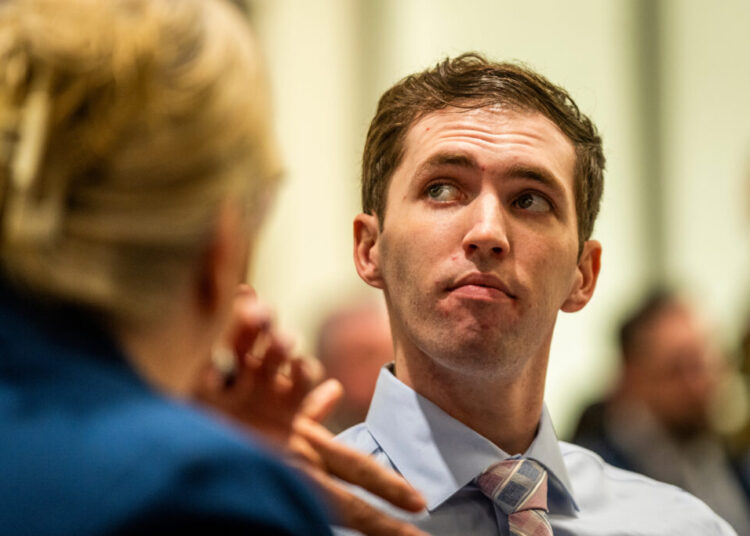
She was asked if she had ever overstepped in her fervent advocacy. Mr. Bores, milling around Central Park within earshot, wandered over.
“Have I been a pest?” she asked him.
He said no. But he did raise the debate-crashing.
“I’m sorry,” she said. “Did I apologize?”
He said he had moved on.
And days later, sash-flashing and emboldened, Alex Bores’s mom talked her way into another debate.
Emma Goldberg contributed reporting.
The post The (Very) Manhattan Moms Whose Sons Are Running for Congress appeared first on New York Times.