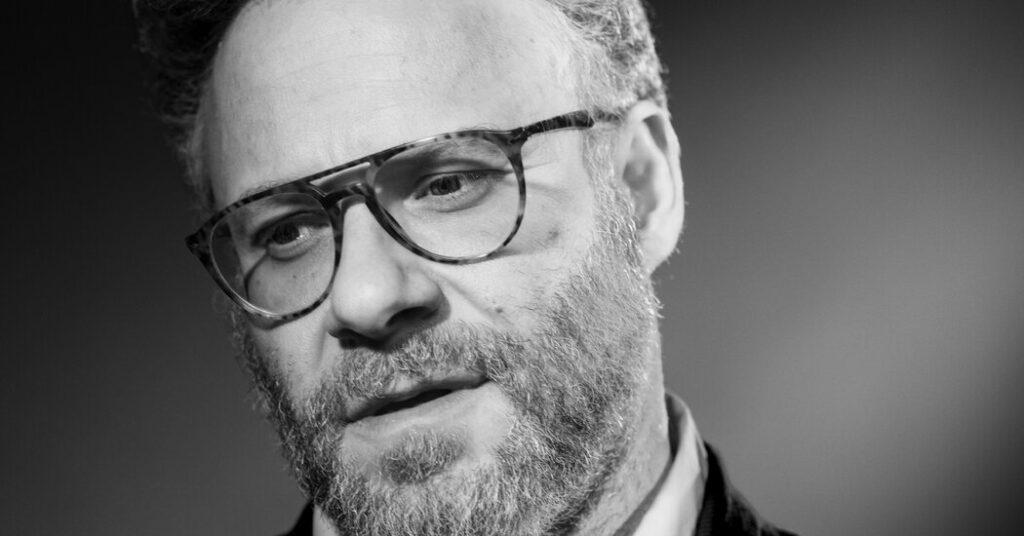
At 44, Seth Rogen seems to be having the opposite of a midlife crisis. His HBO series that lovingly skewers Hollywood, “The Studio” — which he created, writes, stars in, directs and produces — won 13 Emmys last year and is currently filming its second season. He stars in and produces the very funny Apple TV show “Platonic” with Rose Byrne — the two play college buds renewing their friendship in middle age. His production company, Point Grey Pictures, co-founded with his childhood friend and longtime creative partner Evan Goldberg, has been banging out hits like the dark superhero series “The Boys.” The animated film he and his wife, Lauren Miller Rogen, produced, “Tangles,” about a mother and her daughter dealing with an early-onset Alzheimer’s diagnosis, just premiered at Cannes to an emotional response. And now he’s starring in the upcoming movie, “The Invite,” in which he plays the husband in a struggling marriage, opposite Olivia Wilde, who also directed.
I’m not sure I would have pegged the teenager we first met as a surly high school misfit on the short-lived but iconic show “Freaks and Geeks,” who went on to play a lovable stoner in “Knocked Up,” to have one of the most prolific, wide-ranging and successful careers in Hollywood. But as I learned in our conversation, despite his slacker persona (and his very real love of weed), he’s been extremely driven this whole time.
Subscribe: Apple Podcasts | Spotify | YouTube | Amazon | iHeart
You were just in Cannes, which you go to often. I’ve never been to Cannes!
What?! That was my first time.
I actually didn’t know one way or the other. I was assuming. I don’t generally make the kind of films that go to film festivals. I’d never made anything that was at Cannes before. It’s funny that there’s this entire other side of the industry that has just been withheld from me for the last 20 years. I never thought about it much because I always thought that’s for those types of movies. But it’s amazing the level of pomp and circumstance that I had nothing to do with all these years. A lot of parties I was never invited to until now.
I find it very comforting that there’s a velvet rope that you were not allowed to go by. There’s plenty more, trust me. I remember as a kid hearing from either Judd Apatow or Garry Shandling that you work your way up through Hollywood, and eventually you are led into a room alone with Jack Nicholson. It’s just you and him in a small room together. And that’s when you’re like, I did it.
So you’re in a new film, “The Invite,” and you play Joe. Joe is an angry person whose long-term marriage to Angela, played by Olivia Wilde, is not in a good place. The movie is funny, tender, very dramatic. To a long-term married person, it brought up a lot of familiar themes. You’ve been with your wife for a long time. What did it bring up for you? We rehearsed the movie going into it, and the movie was completely rewritten, I would say, in the weeks leading up to shooting. Huge ideas that are in the movie were not there when we started the rehearsal. What’s funny with a movie like this is that you’re rehearsing, and the actors are there, the writers are there, and you’re talking about relationships, and at some point you have to define what, according to this film at least, is a good relationship and what is a bad relationship. People really bring their own personal stuff into those definitions. I remember feeling like I could really confidently speak about what a very good relationship was like — one that had been good for a very long time.
What is that? It’s a couple who is nice to each other, who loves each other and who goes out of their way to excuse the other person rather than to find things that they hate about the other person. To me it comes down to caring and tenderness. You have to want to love your partner, and you have to want them to love you back. You have to be intimate with your partner and sexually attracted to your partner, and that should be returned as well. The movie really gets into that. So very quickly, me and the other cast members and the writers found ourselves having incredibly revealing conversations.
Are you saying you now know about Penélope Cruz’s marriage? I do know that Javier Bardem had back problems that were similar to my character’s, and she does think it had to do with stress and emotion more so than a physical ailment. [Laughs]
I have a theory about your relationship. Great!
I saw you talk about your wife on Howard Stern, and you told several anecdotes that boiled down to: I was on drugs and my wife encouraged me to go on live television, get onstage with Madonna, do something potentially publicly risky but very fun. I just loved that. This is clearly someone that is not trying to shut you down or circumscribe you. She wants you to be full Seth. She does, yes. And at times she will also tell me maybe it’s too much Seth. When we were making the “Neighbors” movies, a lot of the dynamic between me and Rose Byrne came from conversations with me and Lauren. She’s not the naggy woman who’s trying to shut down the fun. Me and her love doing the same stuff, and if anything, she’s encouraging it.
You often play with thwarted desire in your projects: Dude wants a hot girl, isn’t in her league. What makes desire funny? When a character is getting in their own way of what they want is the funniest thing. And when a character has a personality that does not allow them to easily achieve what they want, and they’re their own worst enemy, and they’re doing things that are making their situation harder and worse, that to me is the funniest thing. It comes from something I relate to deeply: The thing that makes you the happiest is also the most painful thing in your life at times. “The Larry Sanders Show” is the thing that me and Evan Goldberg reference a lot. That’s an incredibly great comedic character. He’s constantly trying to be someone he isn’t. He’s constantly trying to be nice and cool, cool, cool to the employees that he works with, but he’s too wound up to allow it to happen. He wants to think he can date a woman who’s more famous than he is, but he can’t. He wants to think he can allow his sidekick to be funny, but his ego won’t allow it. It’s the conflict between what the worst parts of your ego make you do versus what your purest desires want you to do.
Truthfully I haven’t made a romantic thing in a long time. It’s not that creatively interesting to me to show two people falling in love. When we were first coming up, every movie had a romantic story line or, like, conflict between the main couple that had to be resolved. I remember we were making “Pineapple Express” and we had a really silly, ridiculous story line with me and the woman character, and it’s not even remotely a romantic story line. It’s this disastrous thing. And I remember at the time everyone was like, It has to be romantic. And we were like, No, we don’t care about that. … We’re making “The Studio” now, which has no romantic story lines on the show.
You got to work with one of the greats in “The Studio”: Catherine O’Hara. How did you experience that loss? Any good Catherine O’Hara stories? So many. When we first conceived of the show, she was the one that we wanted on it more than anybody. She was like a god to us, especially as Canadians. “Home Alone” is the movie that made me want to make movies. And then as we got older, we became obsessed with Christopher Guest’s films, “Waiting for Guffman.” “Beetlejuice” was one of my favorite movies ever growing up. To us, she was as funny as a person could be. Getting to work with her on the first season, it really pushed us to want to do right by her and to make the show live up to her standards.
And then it was just incredibly sad. We started to hear she was sick. As we were nearing the second season, we would talk to her and she really wanted to come back. Honestly, in the back of our heads we were like, We hope she can, but we don’t know if she’ll be able to. So it is this very sad thing where, creatively, in the back of your mind, you’re making contingency plans but you don’t want to think about it. But your brain is kind of telling you one thing and you’re trying not to believe it. Then we heard she passed away one morning. It was the first week of shooting. It was really, really sad. We were all together, the whole crew, and everyone loved her very much. We didn’t know what to do, and we just kept shooting. I think the idea of making each other laugh and being together felt preferable to anything else we could have done that day.
I’m sorry. [Rogen nods]
I want to go back a little bit to your upbringing. You grew up in Vancouver and started in comedy really young, doing stand-up in clubs at 13. Your mom was really encouraging. She would let you stay out all night working on your routines. That’s pretty unusual for a parent. She was there all the time, so it wasn’t like unsupervised freedom. “Freedom” is not the word I would use to describe it. She was just very supportive of a goal I had. It didn’t feel like my mom was taking me to comedy clubs to hang out. I was there to do something. The comedians were old and I didn’t like hanging out with them. I was a teenager. I had teenager friends. Every time I did hang out with them socially it was weird. It more felt like I was ravenously pursuing a thing, and my parents recognized that I was pursuing this thing in a very serious way.
You ended up moving to L.A. at 16 to star in “Freaks and Geeks” after an open casting call in Vancouver where you got the part. You were financially supporting your family. Do you think that responsibility shaped your work ethic? For sure. I had a fear of going broke and a fear of not having money. A lot of my friends were much more well off than we were. I’m sure that had something to do with my drive from a young age.
Has that shaped how you think about money and success now? If anything, I think I spent so much time worried about money when I was younger that now that I make more money than I ever thought I would, the gift I’ve given to myself is I never think about it. I almost never think of how much money I’m spending or making. I don’t fetishize money. I don’t care if other people are making more money than me. I don’t have an ego about it. I see other actors who are very competitive, and that has just not been my approach. I see rich people and I’m like, The amount of stress you are causing yourself over an amount of money that will never impact your life in any way, shape or form is insane to me. The gift I’ve given myself is I truly spend as little time thinking about it as humanly possible.
You know how every once in a while you read one sentence and it snaps your whole perspective into place? I remember reading that book “Going Clear,” about Scientology, and there was one sentence about how if famous people aren’t treated in a certain way, it makes them think they’re not as talented as they wish they were. Like, if I go to a restaurant and I have to wait 20 minutes for a table instead of them just seating me right away, am I not as talented as I thought I was? If someone has a nicer hotel room than me on the press tour, does that mean I’m not as good an actor as I thought I was? I think that’s how a lot of famous people interpret how they’re treated.
Once you’ve moved out of that, how do you define your success? I wish it had nothing to do with how the work was received, but that is definitely a part of it.
Obviously. Obviously. That’s the thing that most artists feel the most conflict about: external validation versus “Did I do what I wanted to do?” But the truth is, if my work isn’t received well, then I didn’t do what I wanted to do, because I want people to like what I do. Especially when you’re making comedy, which I think is the hardest thing to make in a lot of ways because you are announcing that you are going for a specific reaction. With a dramatic film, you’re saying, We hope you find it insightful or interesting or meaningful or sad or cathartic. But with a comedy, you’re saying, I want you to laugh, and if you don’t, I’ve failed.
Your on- and offscreen history is a testament to male friendship. There’s Judd Apatow, of course, who hired you for “Freaks and Geeks,” and then you met a whole bunch of buddies through that — Jason Segel, James Franco — and you’ve had the same writing partner, Evan Goldberg. I asked you earlier what makes a good relationship. What makes a good male friendship? I think the same thing as any other dynamic: a desire to be good to one another — which again, sounds intuitive, but when I look at people who have bad relationships, the thing I notice is that they seem to be looking for every reason to not be nice to each other. I come from a world that wasn’t a macho sports-oriented environment. Everyone’s parents were in therapy. I’m from the Pacific Northwest. We were ahead of the curve on a lot of that stuff in the ’80s and ’90s. I come from a group of friends who were very communicative and open and not afraid of sharing what they were feeling with one another.
Why do you think that version of male friendship translated so well onscreen? Me and Evan marvel that “Superbad” is a thing kids still really watch. When we were young, we would all watch “Fast Times [at Ridgemont High].” It seems like “Superbad” has filled the slot of the high school movie you watch and relate to when you’re in high school. Part of it is because it’s about exploring being vulnerable with your friends, and that’s a coming-of-age thing in its own right.
I remember when I was moving to L.A., I did a bunch of shrooms with my friends. I was 16 years old and we were at my friend’s house, and the sun was coming up and I was laying on the couch, and my friend Fogell, who McLovin [the character in “Superbad”] is based on, was laying on the couch beside me. And I remember just being like: “I’m so terrified to move to Los Angeles to do this show and I’m not going to see you guys anymore. I don’t know anybody out there.” And he was like: “Yeah, man, high school ends next year for us too. I don’t know where any of us are going to college, if we’re going to be friends anymore.” It felt like a big moment, the first time any of us had really acknowledged to one another how much we cared about one another and how afraid we would be without one another. You’re on the cusp of something unknown. However we were able to bottle that feeling and put it into the movie seems to resonate.
One interesting thing about your character in “The Invite” is that he has no friends. It seems pretty reflective of what’s happening in the culture today more broadly with men, the loneliness epidemic. And I just wonder: Is Hollywood doing a good job of showing positive male friendships the way it used to? I mean, I came up watching “Lethal Weapon,” “Ferris Bueller’s Day Off.” Things just don’t seem to look like that anymore. We did this roast many years ago, and Nick Kroll had a joke that really hit close to home. He was making fun of me and Evan, and he was like, “What, are you guys gonna make another movie where they’re friends, then they stop being friends, and then they end up friends again?” And I remember being like, Oh, yeah, that is every movie we’ve ever made. Not to say that’s a bad thing, but the fact that he could boil it down that simply into a joke, I think we were like, Maybe we should move away from that a little bit.
I’m going to ask you about a friendship that you did have a public break with, which was your friendship with James Franco after allegations of sexual misconduct were leveled against him. I am curious about how you worked through that decision, and did that change the way you think about friendship at all? I’m trying to think how much I want to personally share about this.
I understand that. The reason I ask is, I think as a culture we are still grappling with if and how we allow people who behave badly back into our lives, back into the culture. I honestly think the nuance of it is too personal for me to get into right now. It is a very personal thing. There’s the public-facing side of it, which I’ve spoken about, and I have the same stance publicly that I’ve had, and I think the proof is in the pudding — I have not worked with him in years. But the personal side of it is just so nuanced, and it involves people that I don’t know if I should be dragging into this. I don’t know what I would benefit from getting deeply into it. Nothing has changed since the last time I talked about all this, and I haven’t worked with him in a really long time and I have no plans to.
Do you talk to him? I haven’t talked to him in a long time, no.
Do you think Hollywood has become more risk averse? Yeah, 100 percent. “Superbad” is a good example. When we made that movie, they bought our script, they said it would have a $20 million budget and it would start shooting that year and would come out in August of the following year. That’s it. We cast the movie, we found a director for the movie, we made it according to their schedule and we released it on the date they chose. That would never happen today in a hundred million years. No studio would just buy a script, give it a release date, cast it and then make it. Now everything has to be in place before they’ll decide whether or not they’re making it. Who’s the director? Who are the actors? Are they famous enough? Do they have big enough names? If not, then we’ve got to get different ones, or else we won’t make it. And I know we want it to start shooting in April and release it next summer, but if we don’t have the right actors, we’re not going to do that, because we think these actors will get us more money than these actors, even though they might not be the funniest actors for the role. Not to say you won’t ultimately get to the funniest people for the role, but you’ll have to go through an incredible process that is all due to risk aversion. [The former head of Sony] Amy Pascal was willing to say: “Make this movie. You’ll put the funniest people in it. That will make the best version of the movie, and the best version of this movie is what will make us the most money.” That is not said anymore in Hollywood.
We just saw two YouTubers dominate the box office. One of them, Kane Parsons, the director of “Backrooms,” is 20. He was 16 when he made the YouTube videos the movie is based on. And then Curry Barker, the director of “Obsession,” is 26. These have just been huge successes. What do make of that? It totally fits in line with advice that I’ve been giving people for years. They say, “I want to make it in movies,” and I tell them, “Make stuff that is really good.” Trust me, people like me are begging and praying that they see something impressive. I met with Kane when he was 16 or 17 years old, because I watched his YouTube videos.
Wow! And I remember the people at my company being like, “Why are we meeting with a 16-year-old?” And I was like, “Trust me, this kid is very talented.” Ever since our phones had cameras on them, that has become my default advice to people. And now with Blender and visual effects, you can make a thing literally on a laptop that when I was growing up would have cost you tens of millions of dollars.
Hollywood always seems to be in the middle of an angsty crisis. Variety called what just happened with these two YouTubers a “tectonic shift in Hollywood that sent shock waves through the industry.” [Rogen laughs]
Is that overstating it? Because I guess what I think is so alluring to executives is that YouTubers, as you just mentioned, have cheap technology that they can use to get millions of eyeballs. They can workshop an idea and then have a built-in audience. So I guess it takes the guesswork out of selling tickets? I don’t know if online engagement necessarily translates into ticket sales. But to the first part of your question, I think it’s overstating that it’s a “tectonic shift” if your assumption is that these shifts don’t happen constantly in Hollywood. That’s something me and Evan talk about a lot. I always think of that line in “Network” where Robert Duvall is like, It’s a volatile industry, and the investors are like, Why are we financially invested in a volatile industry? I think by definition it is a volatile industry. The one defining feature of Hollywood from my experience is that every few years there’s a tectonic shift. Thank god it’s not really my job to be overly invested in these trends. I’m able to keep my head down, and we’re aware of them, and we’ll ride the waves if it fits in with our own creative ambitions.
To me, it’s not that shocking that something like this happened. There’s a whole generation of people who have access to essentially professional filmmaking equipment for a price that, again, when I was young was completely unobtainable. They’re making their own stuff, and studios are making tons of money off of it, which is not that different from when Lonely Island and those guys made YouTube videos and people hired them, or when the “Broad City” girls made their show on YouTube and people hired them, or Nathan Fielder.
Just as an aside, what makes a good pitch? I think a good pitch is short. If the idea is genuinely good, the pitch is easy. The quintessential pitch I’m used to hearing is from a nervous comedy writer who has terrible people skills. When someone comes in too slick and flashy, I get a little suspicious. But I’m just looking for the idea. I know myself, I’ve had so many ideas that are so hard to pitch. I remember trying to pitch “Pineapple Express,” and them just looking at us like we were insane. When we pitched “The Studio,” our only thought was to way overdeliver. What makes it easy for these people whose entire job is, like, risk mitigation to say yes?
All right, hard pivot. As I mentioned, you were on Howard Stern, where you told a lot of stories about drugs. And you said the only time that you were drug-free was on a trip to Singapore, where drugs are illegal on penalty of death. What was it like not to be high for the first time since you were a kid? It was fine. It’s not that weird. In my day-to-day life, I am not in a position where I can just smoke weed literally all day, every day. Last week we were filming in some skyscraper downtown. I couldn’t smoke weed in there. I went all day without smoking weed, and it’s not like I’m freaking out or anything. It’s just, I’m a little happier if I can smoke weed all day, that’s all.
You’ve really helped normalize cannabis use. When I think about “Pineapple Express” to today, there’s been a complete sea change. It’s a real testament to the cultural impact of your work. Was that an explicit aim or just a fortunate byproduct? I’d say it was sort of a specific aim, but a very personal one. I don’t think our goal was like, If this works, we will change culture’s view on weed. It was more like, We don’t like how we are stigmatized as people who smoke weed. And the ultimate way to show that people who smoke a lot of weed are not who you think they are is to really proficiently make an entire movie about people who smoke weed, by people who smoke weed, that is for people who smoke weed, but has the thought and care and consideration and technical acumen put into it that any real Hollywood movie has. That’s what had never been done before. “Friday” is probably the closest, and I love that movie, but they made it for almost no money. It was a very small movie that had an outsize impact. We were like, What if we made a real weed movie and it wasn’t this outcast thing for idiots? We were shocked when it was so embraced, honestly. When we were promoting that movie, it was not easy. I remember going on [MTV’s] “TRL,” which dates this story, and literally right before I went on they were like, “You can’t talk about weed at all.” And I’m like, “I’m here to promote a movie. The movie’s title is weed. What am I going to talk about?” And they were like, “I don’t know, figure it out, but you literally can’t mention weed on the show.”
How did you do it? I talked about it, they aired it once and then scrubbed it from “TRL” existence.
OK, before I say goodbye, you’re filming “The Studio” today. Anything that you can say about the new season? Anything at all? I can say it is far more ambitious than the first season. There have been many times I’ve been on set this season and been truly amazed — in a way that has offered me a lot of gratification and pride — in what we’ve been able to pull off and the people we’ve been able to talk into doing the show. I’ve watched the episodes, and I really feel as though I’m pushing myself more and more creatively. I’m in the middle of it right now, but I’m excited and nervous for people to see it. We tried to up our game, and there are moments where I really feel like we are doing something that I’m very proud of.
This interview has been edited and condensed from two conversations. Listen to and follow “The Interview” on Apple Podcasts, Spotify, YouTube, iHeartRadio or Amazon Music. Follow us on Instagram and TikTok.
Director of photography (video): Aaron Katter
The post Seth Rogen Knows the Secret to Marriage — and Being Rich in Hollywood appeared first on New York Times.