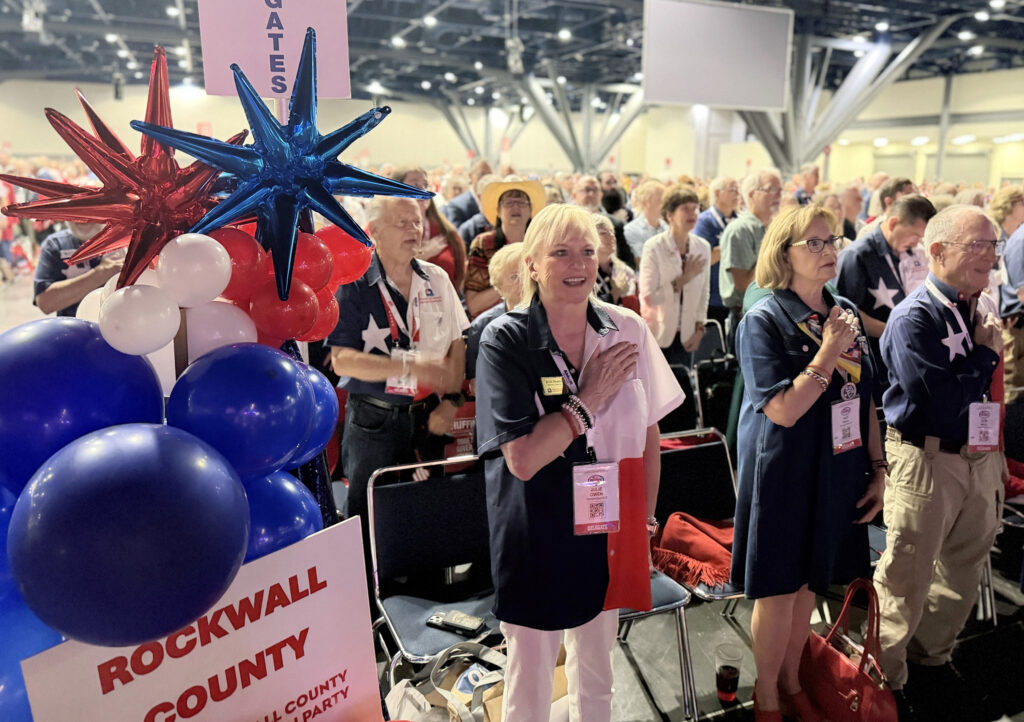
HOUSTON — At the biennial state Republican convention this week hundreds of attendees packed a ballroom, some sitting on the floor or standing at the back, for one of the most popular panels: “Don’t sharia my Texas.”
“I look across this packed room and you are truly saving the nation,” said conservative activist Amy Mekelburg. “We see Texas as ground zero. If Texas falls, the nation falls.”
Many Texans in the room and beyond agreed with her.
“We’re more awake,” Pam Reid, 72, of Kaufman County in North Texas, said of Islamist extremism in Texas, which Republicans addressed in their draft party platform for the first time this year after GOP primary candidates seized on the issue. “It’s already started and we need to stop it.”
Texas’s Republican platform, which attendees will vote on Saturday, has become increasingly extreme in recent years even as it has become more influential in helping to shape national policy. In 2024, the platform called abortion homicide, advocated aggressive local border enforcement, endorsed Bible instruction in public schools and barred teaching about sexual orientation and gender identity — stances the national GOP platform ultimately mirrored.
Political scientists said Texas’s influence derives from a combination of size, plenty of wealthy donors and its leaders’ competitive desire to establish themselves as the most conservative in the nation.
“We have to become the capital of conservative states,” Texas GOP Chair Abraham George told the assembled at the convention’s opening ceremony.
“What the Texas Republican Party does ends up having an impact on national conservative politics because of the grip they have on the party and their ability to establish what makes a conservative conservative,” said Jim Henson, director of Texas Politics Project at the University of Texas at Austin.
Henson said hard-right activists also increasingly use the Texas platform “to enforce party discipline” during the state’s biennial legislative sessions like the one set to start in January, threatening to sanction or run challengers against lawmakers who refuse to address their priorities.
This year’s draft platform calls for “declaring that Sharia law is an incompatible, seditious, subversive, competing enemy of the Texas and U.S. Constitutions, and that its advocacy or implementation is a seditious criminal act, worthy of criminal punishment, disqualification for public, military, and law enforcement service, denaturalization, and deportment.”
It also calls for blocking taxpayer funds and residential developments for advocates of sharia law, allowing the state attorney general to enforce Texas sedition law against advocacy of sharia and adopting a Texas Domestic Terrorist Organization Designation Act. Sharia is a broad body of moral and religious precepts derived from the Quran that guides daily life for Muslims.
“Republicans in many states look to Texas for both legislative ideas and as a role model to follow,” said Mark Jones, a political science professor at Rice University.
The 135-page draft platform lists a slew of other new priorities, including regulating data centers that are being built rapidly across the state, threatening water resources and pushing electricity prices higher. But it’s the numerous proposed restrictions on sharia law and immigration that are likely to catch on, Jones said.
“Islam has become such a hot-button issue for the most conservative wing of the Texas Republican Party, that’s likely to be one that not only passes but generates more national coverage because it’s so extreme,” he said.
GOP state lawmakers at the convention acknowledge that even if they pass state laws to limit sharia law and legal immigration — including H-1B visas for specialized workers that have brought an influx of South Asian immigrants, and sparked intense culture clashes — the measures will be largely symbolic given federal and constitutional protections.
The Council on American-Islamic Relations, the country’s largest civil rights and advocacy organization for Muslims, has denounced such measures as political fearmongering and a violation of First Amendment freedom of religion protections. Gov. Greg Abbott declared CAIR a terrorist group last year, and Attorney General Ken Paxton has investigated its local chapters. CAIR filed suit in federal court to block the designation, and called the state’s moves defamatory and unconstitutional.
The language of the platform matches the rhetoric that has dominated during the recent primary elections.
Bo French, a businessman and former GOP chair in Fort Worth’s Tarrant County who won his statewide race for Railroad Commissioner, drew criticism in the past from fellow Republicans for social media posts including asking followers whether Jews or Muslims pose “a bigger threat to America.” But now he’s ascendant in the party.
On Thursday night, as a platform committee incorporated testimony from supporters and voted to approve it, French addressed supporters at an event sponsored by Young Republicans of Texas. The event also drew Paxton — who’s running for U.S. Senate — and George, an immigrant and the state’s first Indian American GOP chair, who lost his bid for reelection at the convention to vice chair D’rinda Randall.
“The people of Texas are worried about the issues I talk about,” French said, calling H-1B visas “a giant scam.” He said a 1965 law that removed restrictions on immigrants from Asia, Africa and the Middle East led to “importing” more than 100 million people “who shouldn’t be here, who don’t share our values.”
On Friday, Abbott echoed some of French’s views on the convention’s main stage as thousands applauded.
“We need to ban sharia law in the state of Texas,” Abbott said, “end H-1B visa abuse” and hiring of immigrants by state and local governments. “Texas jobs should go only to Texans.”
In the crowd, Pamela Woods of Corpus Christi said she doesn’t oppose Islam as a religion. She said she believes sharia law threatens women’s rights.
“That is not compatible with the Texas Constitution,” said Woods, who described herself as a born-again Baptist.
Cheryl Gonzalez, a retired real estate agent who lives outside Houston, switched parties soon after she moved to Texas from New Mexico 20 years ago.
At the committee meeting, she watched as proposals were displayed on a large screen at the front of the room. Gonzalez called measures banning sharia and Islamist extremism “a no-brainer.”
Gonzalez, 74, is enamored of bottom-up governance. She sees Texas’s extreme GOP party platform as an extension of voters’ passions.
“This grassroots stuff, I love it!” she said. “It almost brings tears to my eyes.”
The post Texas’s GOP platform is getting more extreme — and influential appeared first on Washington Post.