Days before President Trump left office in 2021, the State Department broke ground on an $850 million construction project at its aging embassy in New Delhi. By last fall, alongside work on smaller buildings, crews had dug a 200-foot-long pit for the project’s centerpiece: a sleek edifice of glass and stone that was supposed to make the biggest U.S. mission in South Asia more “secure and resilient.”
In recent months, without public announcement, the U.S. government canceled that building project and filled in the pit.
The reversal has stunned diplomats who see it as a long-term blow to America’s ability to operate in the world’s most populous country. It has stung some intelligence officials who wanted more modern classified facilities in a volatile region. And it shed light on the influence of the man who spearheaded the reversal and has become a major force in U.S. foreign policy: Mr. Trump’s new ambassador to India, Sergio Gor.
Mr. Gor, 39, is a former congressional aide who helped publish Mr. Trump’s books and ran the presidential personnel office last year, acting as a gatekeeper to power. Then Mr. Gor became more active abroad, using his close ties to Mr. Trump to push for economic deals in Central Asia, including in his native Uzbekistan. In January, he took up his post in New Delhi, with the added title of special envoy to South and Central Asia.
Since then, Mr. Gor has put on display the changed role of an ambassador in the second Trump era, a role defined almost exclusively through personal ties to the president. It is an approach to diplomacy that focuses on business deals and other near-term priorities, with little regard, critics say, for long-term strategy.
In both India and Central Asia, Mr. Gor has pleased officials with his ability to secure direct access to U.S. cabinet members. He has satisfied them by emphasizing commerce and staying silent about the rollback of democracy and human rights in much of the region.
And Mr. Gor’s push to terminate the construction project in New Delhi — one of the government’s most ambitious diplomatic building efforts in recent years — illustrates an approach that critics say puts his short-term needs over long-term stewardship of U.S. global interests. Those critics are quick to point out that the decision ended the din of construction outside Mr. Gor’s office and allowed him to reopen the iconic ambassador’s residence years ahead of schedule.
In an at-times combative interview at his office in the 1950s-era embassy last month, Mr. Gor said that the cancellation would save taxpayers “hundreds of millions of dollars” and that Mr. Trump had personally approved the move in a meeting at the White House a few months ago.
Current and former U.S. officials familiar with the project said that it had indeed suffered from delays and cost overruns. But several contended that the cancellation was reducing disruption at the embassy now at the expense of U.S. interests in the long run.
“Eventually, we’re going to have to do this,” said Donald Heflin, a senior fellow at the Fletcher School of Law and Diplomacy at Tufts University, who served in senior roles at the embassy in New Delhi from 2020 to 2023. “We’re being penny-wise and pound-foolish.”
Several of the people familiar with the project said some intelligence officials were particularly disappointed by the cancellation, given their desire for newer space in New Delhi. The people spoke on the condition of anonymity because of the official secrecy surrounding the U.S. spy presence overseas. A senior U.S. intelligence officer said that the cancellation did not negatively affect the intelligence community and that claims to the contrary were false.
Mr. Gor showed his influence as this story was being reported. Treasury Secretary Scott Bessent provided a statement saying Mr. Gor had “perfected the second Trump administration’s economic statecraft.” Secretary of State Marco Rubio said the ambassador’s “access to the president” made him “an enormous asset for both the host country and for us at the State Department.”
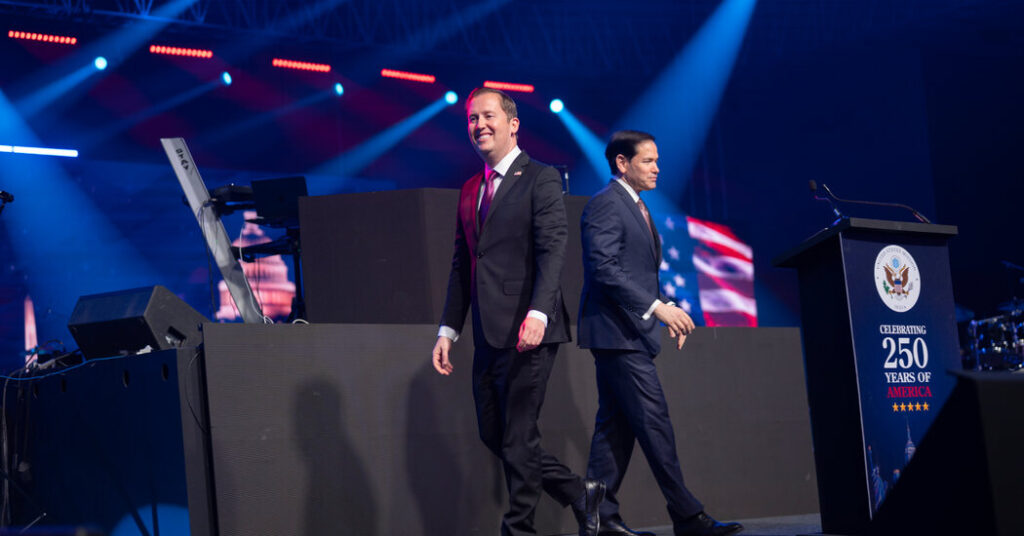
Mr. Rubio, in a brief interview during his visit to New Delhi last month, endorsed the decision to cancel the embassy construction project because “we’re not going to be in the business of pissing away money.” He spoke as he headed for Mr. Gor’s lavish “Freedom 250” party that featured the disco group Village People and mock-ups of the Oval Office and the White House briefing room where guests could take pictures.
A White House spokesman, Kush Desai, said Mr. Gor “stands out as the most impactful ambassador in modern American history.” It was a notable superlative given that several old friends of Mr. Trump’s serve as ambassadors.
Eric Garcetti, the former Democratic mayor Los Angeles and the Biden administration’s envoy to New Delhi, referred to Mr. Gor as the “old-school model” of an ambassador: “a trusted confidant from the court.”
Central Asia
Mr. Gor’s pivot to foreign policy began last summer, amid tensions with some people in Mr. Trump’s orbit, including Elon Musk. The president valued Mr. Gor for his perceived loyalty and his willingness to freeze out of government people he considered insufficiently so.
Mr. Gor’s appointment as ambassador to India in August came with a broader title, special envoy to South and Central Asia. His early focus became resetting U.S. policy in Central Asia around business, departing from Washington’s past emphasis on democracy and the region’s broader geopolitics.
Mr. Gor helped set up a Sept. 5 call between the autocratic president of Uzbekistan, Shavkat Mirziyoyev, and Mr. Trump, according to Nozima Davletova, an Uzbek official. Mr. Trump later called Mr. Mirziyoyev “Highly Respected” in a social media post and congratulated him on buying $8 billion worth of Boeing airplanes.
Two months later, several Central Asian officials credited Mr. Gor with arranging the first-ever summit at the White House of all five Central Asian leaders.
Mr. Gor has continued to pay attention to Uzbekistan, in particular. He shepherded Saida Mirziyoyeva, the powerful daughter of the Uzbek president, on a whirlwind tour of American power in April. They had breakfast with Mr. Rubio in Washington and met with Mr. Trump’s daughter Tiffany and her husband, Michael Boulos, at Mar-a-Lago, the president’s Florida resort.
“He has always been there trying to get more attention to Central Asia,” Ms. Davletova, an adviser to Ms. Mirziyoyeva, said of Mr. Gor. “Just a couple of years ago, we couldn’t imagine the things happening today.”
Trump Administration: Live Updates
Updated
- A judge blocks the National Park Service from removing ‘negative’ signs.
- The Trump administration says it will restart asylum and immigration processing.
- A judge declines to halt Sunday’s U.F.C. fights at the White House.
Ms. Davletova recently moved to Seattle to run the new American-Uzbek Business and Investment Council, which Mr. Gor helped start.
Uzbekistan is also where Mr. Gor was born — a fact that became known only last year, when investigative reporters uncovered it. (An earlier New York Post article said Mr. Gor had declined to divulge his birthplace.)
In last month’s interview with The New York Times, Mr. Gor confirmed being born Sergei Gorokhovsky in Tashkent, the Uzbek capital, in 1986, when the country was part of the Soviet Union. He said he moved with his family at age 2 or 3 to Malta, where his first name became Sergio, and then to the United States in 1999. He said he became a U.S. citizen five years later and shortened his last name “to make it easier to pronounce.”
Ms. Davletova and other Central Asian officials said they always spoke English with Mr. Gor, even though he said he speaks some Russian, the region’s lingua franca.
“I had no memories of Tashkent,” Mr. Gor said. “I don’t know one word in Uzbek.”
But Mr. Gor said he had already become so close to Central Asian governments that he was “talking to the foreign ministers” in “every single one” of those five countries. He said he was helping one U.S. Embassy there get the necessary paperwork for its cars.
“A lot of times, they have problems that get stuck in bureaucracy,” Mr. Gor said of his U.S. ambassador colleagues across the region. “I’m able to elevate those things.”
India
Mr. Gor staged his January arrival in New Delhi like a campaign rally, walking through a crowd at the embassy to the tune of a Trump favorite, “Hold On, I’m Comin’.”
“President Trump has a habit of calling at 2 in the morning,” Mr. Gor told the crowd. “With the time difference in New Delhi, it might work out pretty well.”
He has fascinated Indians with his close ties to Mr. Trump. Manash Neog, a Delhi political consultant who said he had found Mr. Gor remarkably open to meeting Indian businesspeople from midsize companies, said the ambassador gave the impression that “he’s one of those top 10, or top 15,” in the president’s inner circle.
People close to the Indian government said they saw that as a boon. Optimism in New Delhi about Mr. Trump’s seeming affinity for Prime Minister Narendra Modi gave way to repeated shocks last year as the administration imposed tariffs on India, castigated it for buying Russian oil, clamped down on work visas and cozied up to the country’s archrival, Pakistan.
Mr. Gor said he was able to get Indian officials and companies direct access to U.S. cabinet members, given that in his previous job, “I led the department that hired everyone.” When pharmaceutical companies were complaining about U.S. regulators, he said, he offered to arrange a video call to discuss the matter.
“With who?” Mr. Gor recalled them asking.
“I’ll get Secretary Kennedy on,” he said he responded, referring to Health Secretary Robert F. Kennedy Jr.
Mr. Gor said he had “replicated that model across departments.” He said that when India’s foreign secretary — the top civil servant in the Foreign Ministry — was planning a trip to Washington, he told him, “Why don’t you come when I’m there?” The two met with Mr. Rubio in April.
Mukesh Aghi, the president of the U.S.-India Strategic Partnership Forum, a group that pushes for closer business and political ties, said Indian officials were “leveraging Sergio to reach out directly to the president.” And he noted another benefit.
“Sergio is not focused on talking about democracy, freedom of the press, religious freedom,” Mr. Aghi said. “That kind of goes well with the current leadership in India.”
At the same time, journalists and intellectuals who had been used to regular gatherings with prior ambassadors said they found their access cut off. Other senior U.S. diplomats attended fewer events and said little when they did, they said. They described the three staff members whom Mr. Gor brought with him from Washington as playing an outsize role in the embassy’s operations.
Shishir Priyadarshi, the president of a think tank called the Chintan Research Foundation, said that wooing the Indian public did not appear to be part of Mr. Gor’s mandate.
“It’s a quiet embassy,” he said.
The Embassy
The Embassy Chancery in New Delhi, designed by Edward Durell Stone, is a landmark of 1950s American architecture, a grille-enclosed box fronted by thin columns that preceded Stone’s Kennedy Center in Washington.
But the building grew out of date, diplomats who have worked there say. Its outdoor corridors surrounding an interior courtyard with a decorative pool became impractical as air-conditioning improved and New Delhi’s pollution worsened. As staffing expanded, more officials had to work off-site, presenting security concerns.
The construction that began in 2021 was supposed to erect a new main office building next to the old chancery. Roosevelt House, Stone’s ambassador’s residence next door, had to be shuttered as a large pit was dug behind it for the new building.
There were delays and cost overruns. The budget swelled to $1.2 billion from $852 million, according to Mr. Gor. The completion date, he asserted, went from 2027 to 2036. The project had contributed to low morale, Mr. Gor said, because “when people sign up to be here for two or three years, they don’t expect to live in a construction site.”
Mr. Rubio, while visiting India last month, inaugurated a smaller office building that was also part of the project. An apartment building is to be finished next year, Mr. Gor said.
Mr. Trump agreed to cancel the construction of the new main office building after a presentation with plans and models from the director of the State Department’s overseas buildings unit, Mr. Gor said. The ambassador insisted that the government’s needs for the embassy in New Delhi could be met with the existing buildings, especially after the elimination of the U.S. Agency for International Development. He did not detail how much of the $1.2 billion budget had already been spent or how much the termination of contracts and filling of the construction pit had cost.
Several retired diplomats who served in senior posts in New Delhi described the cancellation as a geopolitical blow, given the investment in the relationship with India that the project had represented. Representative Gregory W. Meeks of New York, the top Democrat on the House Foreign Affairs Committee, called the project “critical” and said canceling it “would be deeply troubling.”
But some saw merit to considering more cost-effective alternatives.
“You have an ambassador who’s got enough influence to get this looked at again,” said Edgard Kagan, who served as deputy chief of mission in New Delhi from 2019 to 2021. “The truth is, he may be right.”
Satellite images show that the pit was filled by early April. Days later, Mr. Gor hosted a reception at his newly reopened residence, with a fleet of New Delhi’s green-and-yellow auto rickshaws on display with images of Mr. Trump. Dozens were soon on the capital’s streets.
Mr. Gor said he did not yet live in the residence himself and was not sure whether he would. Last month, Roosevelt House was the venue for Mr. Gor’s black-tie dinner in honor of Mr. Rubio. The two posed with Ms. Mirziyoyeva, the Uzbek president’s daughter, on the red carpet. Outside, the lawn covering the filled-in construction pit had been decorated with pink plastic flowers.
Reporting was contributed by Julian E. Barnes and Edward Wong from Washington; Hari Kumar and Alex Travelli from New Delhi; and Christoph Koettl from New York.
The post How Sergio Gor Is Transforming the Role of U.S. Ambassador in the Trump Era appeared first on New York Times.