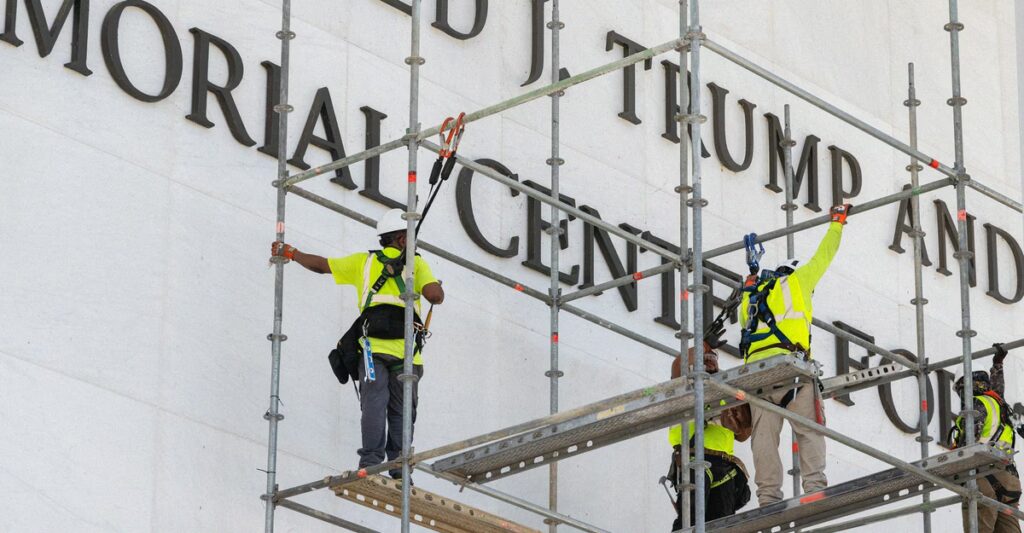
A crowd amassed, anticipating a cathartic moment and chanting, “Take it down! Take it down!” Livestreams were up and running. Scaffolding appeared. And then, early this afternoon, the ruling came: A federal judge had denied an emergency motion to let President Trump’s name remain on the John F. Kennedy Memorial Center for the Performing Arts. It remains unclear whether the 18 letters in question—THE DONALD J. TRUMP AND—will be yanked from the marble facade or simply covered up. But one way or another, they are no longer permitted to grace the building.
U.S. District Judge Christopher Cooper was responding to the Kennedy Center’s request for a stay pending appeal, which would have allowed Trump’s name to remain on the building while the center fought a legal challenge brought by Representative Joyce Beatty. Later in the day, the board of trustees filed for an emergency stay through the U.S. Court of Appeals for the D.C. Circuit. Even as the center was struggling to contain one legal fire, another erupted: The Washington National Opera filed a lawsuit yesterday against the institution, where it had long been a resident company before severing its relationship with the center in January. Since the two organizations parted ways, the opera claims, the Kennedy Center has refused to return more than $17 million in gifts and donations. The Kennedy Center called the lawsuit meritless and said that it planned to file a countersuit.
The center also defended its decision to appeal the legal challenge brought on by Beatty, who argued that the center had violated its authority in renaming the institution. “The Center remains the living memorial to President John F. Kennedy,” a spokesperson told me. “President Trump remains in his role as chairman.” In court, the center had argued that Trump’s addition represented a “secondary” name, to no avail.
Cooper’s May 29 ruling—which ordered the removal of Trump’s name from the institution and temporarily halted plans to shut down the center for renovation work—seemed to mark a new phase in a 16-month drama that began last year when Trump took over the Kennedy Center by populating its board with his allies. Trump’s putsch foreshadowed the assertiveness with which he would try to remake a whole host of institutions—not just government agencies but also the physical landscape of Washington, D.C., where his name, face, and will are hard to miss around the city’s monumental core.
Cooper’s ruling describes how the Kennedy Center board cut corners. “There is no evidence that the Board took account of its full range of statutory obligations in determining that a wholesale shuttering of the Kennedy Center was appropriate,” Cooper wrote in a 94-page opinion. And on the name change, he wrote: “Congress gave the Kennedy Center its name, and only Congress can change it.”
To critics who see Trump’s Kennedy Center tenure as ruinous, the ruling suddenly made these changes seem reversible—all the more so because Trump had initially signaled that he would walk away from the endeavor and let someone else clean up the mess.
Last week, lawyers for the Kennedy Center instructed staff to scrub Trump’s name from email signatures, letterhead, webpages, brochures, promotional materials, press releases, and signs. Some employees appeared eager to get started. A Kennedy Center shuttle bus bore a haphazard attempt to blot out Trump’s name with black marker. Elsewhere, the center restored its original branding and logos to its website, but on Instagram, where usernames can be hard to reclaim, the institution settled for a cryptic handle: @officialtkc.
Confusing matters, Trump told reporters last week that he would remain chairman of the board and perhaps continue his efforts to remake the institution.
By yesterday, the deadline for removal was approaching. Photographers roamed the campus with equipment in tow as cherry pickers and barricades appeared along the complex. Scores of locals and tourists wandered over, taking photos and pointing at the signage. One cyclist had begun documenting his daily trek to the center to check on progress. And the advocacy group Hands Off the Arts set up a livestream of the center from a residence in the adjacent Watergate complex.
The videos have attracted more than 65,000 views since streaming began on Wednesday, Mallory Miller, a former Kennedy Center employee and an organizer for Hands Off the Arts, told me.
At a board meeting yesterday, the center’s trustees voted to appeal Cooper’s ruling. Trustees appointed by Trump outnumber ex officio members, such as Beatty. It’s unclear how all members voted during the board meeting yesterday, but Trump appeared virtually on the call, according to a person familiar with the meeting who spoke on the condition of anonymity to discuss an internal matter.
Also present was Commerce Secretary Howard Lutnick, whose wife is a trustee. In a Truth Social post shortly after Cooper’s ruling last month, Trump said he had instructed the Commerce Department to “transfer” the Kennedy Center back to Congress, which stumped some arts administrators and legal observers. The way forward for the Kennedy Center—whether it will close, who will perform there, whether the necessary funds remain for it to operate—looks similarly hazy now.
Today, dozens of people gathered just outside barricades, cheering at any sign of movement or progress. “I, many years ago, worked for the National Symphony, and so when Trump put his name on the building, I was brokenhearted,” Laura Bligh, who has protested with cardboard signs outside the Kennedy Center all week, told two of my colleagues.
“To see it come down shows that the system is working to a certain extent against this man,” Lily Brock, a runner who was following the livestream, said; she jogged from her home and to the center when she realized the president’s name could be removed imminently.
I was at the Kennedy Center one rainy morning in December after receiving word that a crew of workers had begun fastening Trump’s name to the building. It was sudden and dramatic—not even 24 hours had passed since the trustees had voted to rename the center after the president. Large sheets of blue tarp were tied to the building’s front pillars, blocking the view of the installation, but I could hear loud drilling and caught glimpses of the first few letters newly anchored to the facade behind the rippling canvas.
Immediately, you could tell the letters were off—appearing slightly smaller than the original signage, with wider kerning between the characters.
The addition of Trump’s name seemed to thematically complete his takeover: It was his center—and he owned its problems. A new wave of turmoil followed: More artist cancellations (Philip Glass, Béla Fleck, the San Francisco Ballet). The jazz drummer Chuck Redd, who called off a Christmas show at the complex, was sued by the Kennedy Center for breach of contract before a judge threw out the case last week.
The Washington National Opera’s announcement on January 9 that it would part ways with the center meant the exit of an anchor tenant. The opera, which had been performing at the institution since 1971, cited changes to the center’s business model as a reason for its departure. The Kennedy Center claimed that the complex’s leadership had ended the affiliation “due to a financially challenging relationship.”
In recent months, the opera has staged its spring performances at other venues across Washington. Meanwhile, the Kennedy Center has grown quieter as it has prepared for a two-year shutdown.
But this past week, as my colleague David A. Graham wrote, has drawn the most anticipation that the institution has seen in months. Spectators are seemingly ready for this story’s climax—even if the main characters keep trying to draw it out.
Grace Buono and Mari Labbate contributed reporting.
The post The Kennedy Center, Minus Trump appeared first on The Atlantic.