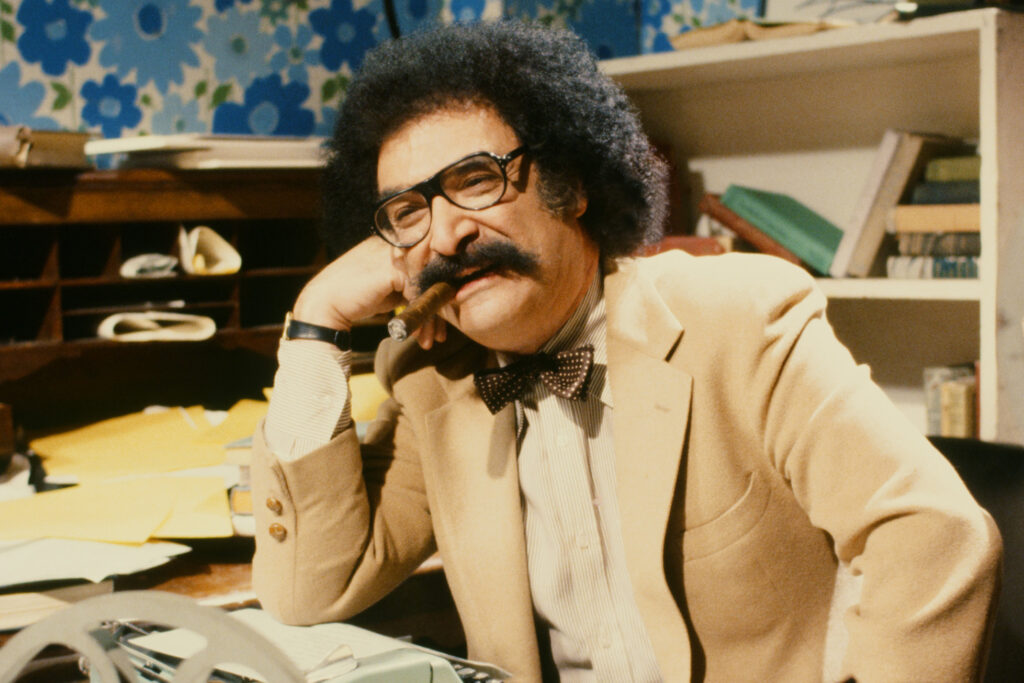
Gene Shalit, the “Today” show film critic and arts commentator whose pouf of ebony hair, bushy mustache, funhouse eyeglasses and floppy bow ties — not to mention his groan-inducing puns — made him a kooky and welcome presence on morning television for decades, died on June 12. He was 100.
His family confirmed the death in a statement to NBC, where he had worked on “Today.” No other details could immediately be confirmed.
During Mr. Shalit’s 40 years with “Today,” anchors came and went, the mix of news and entertainment changed and the show grew from two hours to four. Mr. Shalit became an emblem of lively constancy amid shifting lineups, delivering ample helpings of Borscht Belt humor to sleepy viewers and serving as a harmonizing presence on a show known for backstage rivalries.
Mr. Shalit was a public-relations specialist and magazine writer before joining “Today” around 1970 as a culture critic, reviewing jazz and literature. According to journalist Stephen Battaglio’s book “From Yesterday to ‘Today’: Six Decades of America’s Favorite Morning Show,” Mr. Shalit’s reviews were known to vault books into bestseller territory, but his bosses urged him to focus on film.
On “Today,” Mr. Shalit delivered his two-minute opinions from a campy setup called the “Critic’s Corner,” sitting among movie projectors and reels of film. His reviews were cluttered with puns and other wordplay. A sampling:
● “Two words: ‘Ishtar’ ish-tarrible.”
● “Don’t forgo ‘Fargo.’ ”
● “‘X-Men’ should not be taken seriously. In fact, it should be taken with two aspirin.”
From his plot summary of the surrogate-mother comedy “Baby Mama” (2008) starring Tina Fey and Amy Poehler: “Fey, who is inflexible and controlling, and Poehler, who is her polar opposite, share an apartment. And they become wombmates.”
He considered himself a serious critic, capable of making an informed argument against the prevailing sentiments of audiences or other powerful reviewers. Such was the case with his 1980 pan of Stanley Kubrick’s “The Shining.”
“ ‘The Shining’ is a horror picture,” he began. “It cost $18 million; that’s part of the horror.” The biggest problem with the movie, Mr. Shalit said, was that Kubrick had confused shocking imagery with horror: “Horror is in the mind. Horror is suspense. . . . You must be made willing to discard reality, but Kubrick keeps reminding us that this is only a movie.”
“Stanley Kubrick,” he concluded, “is responsible for the dulling of ‘The Shining.’ ”
In a measure of his cultural reach, he appeared or was satirized on shows as varied as “SpongeBob SquarePants,” “The Critic,” “Family Guy” and “The Muppet Show.”
“Saturday Night Live” cast member Horatio Sanz, reporting as an embedded Mr. Shalit from the Iraq War in 2003, lampooned the critic as he used movie puns to describe the scene: “Saddam better ‘Patton’ down the hatches, or he’s gonna get ‘M*A*S*H’-ed.” Unable to stop making movie references and puns, he says of the unit with which he was embedded, “These men are officers and gentlemen. Their tanks are in high Richard Gere when it comes to bravery.”
The real Mr. Shalit shrugged off his critics, who found his punning too distractingly silly. “Even if they make fun of me,” he told the St. Petersburg (Fla.) Times in 2010, the year he retired, “they remember me, too.”
Eugene Shalit was born in New York City on March 25, 1926, and grew up in Morristown, New Jersey. He wrote a column called “What Shalit Be?” for his college newspaper at the University of Illinois at Urbana-Champaign.
After graduating in 1949, he worked in many jobs. Among them was press agent for “American Bandstand” host Dick Clark in the 1950s, but Mr. Shalit stopped representing him when Clark became the target of a congressional investigation of payola, or bribes, paid to disc jockeys in exchange for airtime. Clark, who was never charged with a crime, later told the New York Times that Mr. Shalit was a “jellyfish.”
A writer for various periodicals, Mr. Shalit also was a film critic at Look magazine before becoming a “Today” contributor. He became a permanent member of the cast in 1973, succeeding panelist Joe Garagiola.
Besides his reviews, Mr. Shalit gamely bantered with celebrities, often losing composure when force-of-nature entertainers such as Carol Channing and Robin Williamslaunched into ridiculous anecdotes and comedy routines.
Mr. Shalit, a far cry from the more serious-minded approach to reviewing by such TV personalities as Gene Siskel and Roger Ebert, was not to everyone’s liking. Although “Today” host Bryant Gumbel called Mr. Shalit a “stabilizing force” during behind-the-scenes skirmishes among the show’s stars, he nevertheless panned him in a 1989 memo to senior executives, saying that his reviews “are often late and his interviews aren’t very good.”
In the end, he outlasted Gumbel on “Today” by more than a decade.
Mr. Shalit compiled and edited two books, “Laughing Matters: A Celebration of American Humor ” (1987) and “Great Hollywood Wit” (2002). He also was an amateur bassoonist. His official NBC biography reported that he performed with major symphony orchestras in Boston, Pittsburgh and elsewhere in concerts of classical music. “In none of these venues has he ever been invited back,” the network deadpanned.
His wife, Nancy Lewis Shalit, died in 1978, and their daughter, Emily Shalit, died in 2012. Survivors include five children.
On the occasion of Mr. Shalit’s retirement, Cleveland Plain Dealer TV critic Mark Dawidziak noted that the competing ABC morning show “Good Morning America” decided to hire its own movie critic, Joel Siegel — who also sported a mustache and eyeglasses — in 1981, at the height of Mr. Shalit’s popularity. And it wouldn’t be the first imitation.
“A few generations of movie and show-business programs, as well as thousands of websites,” Dawidziak wrote of Mr. Shalit, “should recognize that here is their pioneer — Daniel Boone in a bow tie and Groucho glasses.”
The post Gene Shalit, ‘Today’ movie critic and purveyor of puns, dies at 100 appeared first on Washington Post.