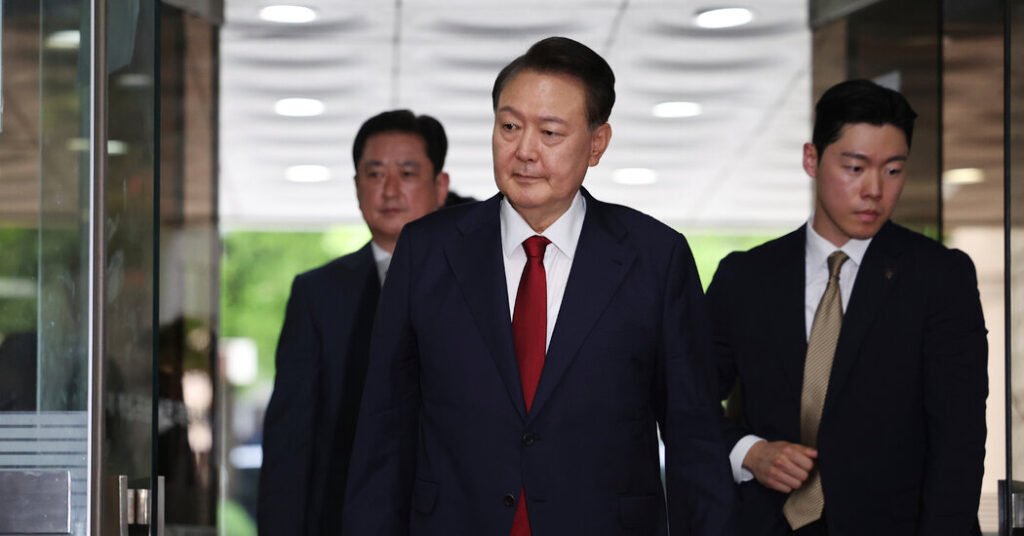
Former President Yoon Suk Yeol of South Korea was convicted on Friday of ordering military drones to fly over North Korea in an attempt to escalate tensions on the divided Korean Peninsula and manufacture a pretext for declaring martial law.
Mr. Yoon, 65, has faced an array of criminal charges across eight separate trials since he was impeached and removed from office last year for illegally imposing martial law in late 2024. A court convicted him of masterminding an insurrection, and he was sentenced to life imprisonment in February.
He was sentenced to 30 years in prison for the drone operation, which represented the second-most-serious charge against him — “undermining South Korea’s military interests or providing military benefit to an enemy state.” It carries a maximum sentence of life in prison. Mr. Yoon was the first former president convicted of this crime in South Korean history.
On Friday, a three-judge panel of the Seoul Central District Court found that Mr. Yoon and his collaborators had dispatched drones across the inter-Korean border — the world’s most heavily fortified frontier — in late 2024, with the aim of stoking military tensions with North Korea, which he could then use to justify a declaration of martial law.
A special prosecutor had sought a 30-year sentence for Mr. Yoon, describing the drone operation as “an anti-state and anti-national crime.”
Two of Mr. Yoon’s co-conspirators in the drone operation were also convicted and sentenced on Friday: his former defense minister, Kim Yong-hyun, received 30 years, and his former counterintelligence commander, Lt. Gen. Yeo In-hyong, received 15 years. Both men had previously received lengthy prison terms for their roles in Mr. Yoon’s martial law declaration.
“The defendants used the guise of a military operation to induce provocation by North Korea for the purpose of creating a state of emergency,” the presiding judge, Lee Jeong-yeop, said in the ruling on Friday.
Mr. Yoon’s attorneys said they would appeal the ruling, arguing that the drone operation was a legitimate measure taken by his government to counter the balloons North Korea had released in 2024 to scatter trash across the South.
“The special counsel’s indictment and today’s verdict will be remembered as an episode that inflicted a profound wound on South Korea’s security capabilities and its liberal democratic foundations,” they said in a statement.
But the court ruled that Mr. Yoon directed the drone operation “for a private purpose unrelated to national security or national defense.”
In October 2024, North Korea accused South Korea of flying unmanned drones over Pyongyang, the North Korean capital, and threatened military retaliation if the incursions continued. According to the North, the drones scattered “numerous leaflets full of political propaganda and slander” against its leader, Kim Jong-un.
At the time, South Korea neither denied nor confirmed North Korea’s allegation.
South Korean military officers later told investigators that they had been ordered to conduct drone flights over Pyongyang between October and November, though they said they were unaware that the missions were linked to Mr. Yoon’s plans to impose martial law.
Although North Korea did not respond militarily to the drone operations, Mr. Yoon pressed ahead with his plans, investigators said. On the night of Dec. 3, he declared martial law, plunging South Korea into its most serious political crisis in decades. Armed troops stormed the National Assembly, with Mr. Yoon insisting that the drastic measures were necessary to root out what he called “anti-state” forces and “a den of criminals” in Parliament, which was controlled by the opposition party.
The move caused an immediate backlash.
Thousands of citizens rushed to the National Assembly, blocking troops from seizing the building and preventing the arrest of opposition leader Lee Jae Myung and other political rivals of Mr. Yoon. Their intervention gave lawmakers time to convene and vote down the martial law decree, forcing Mr. Yoon to withdraw it after just six hours.
Mr. Lee, who won the presidency a year ago, said in December that he felt South Korea should apologize to North Korea for Mr. Yoon’s drone operations. But he said he feared that it would spark controversy in the South’s polarized political climate.
The post Drones Flown Over North Korea Were Part of Martial Law Plot in the South appeared first on New York Times.