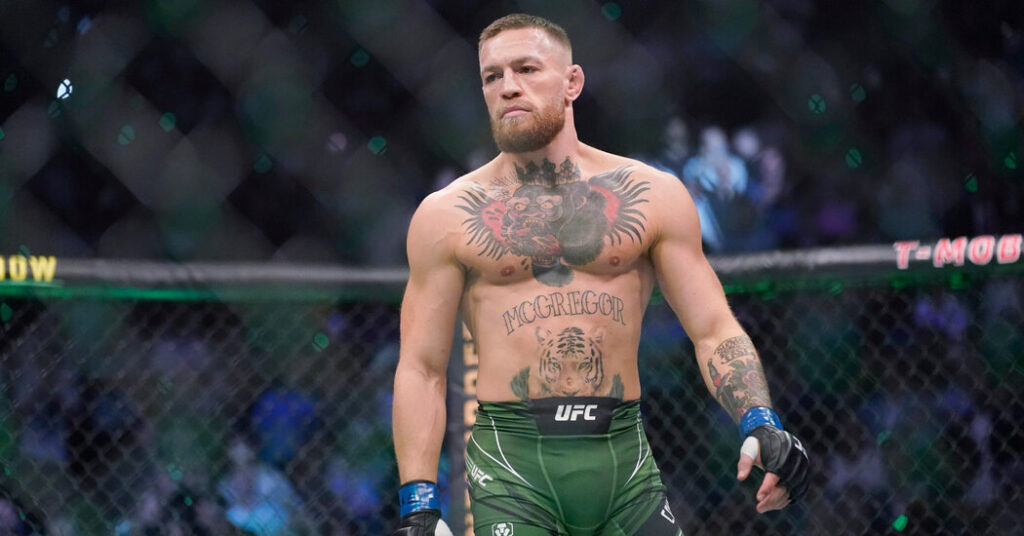
When the Ultimate Fighting Championship star Conor McGregor was battling his opponent during a bout in Las Vegas in July 2021, he snapped his own left leg in two — a gruesome spectacle that shocked the national pay-per-view audience and threatened the career of the U.F.C.’s biggest draw.
Almost five years later, having made a seemingly miraculous recovery, McGregor is returning to the octagon for the first time. He is bigger and more chiseled, flexing and preening for cameras as he prepares for his highly awaited bout next month, again in Las Vegas.
McGregor’s startling physical transformation has been the subject of speculation among U.F.C. fans, fighters and commentators like Joe Rogan, who have repeatedly claimed that he skirted the U.F.C.’s antidoping rules to use performance-enhancing drugs while recovering.
McGregor has never been tied directly to the substances. But a New York Times investigation reveals that he did take powerful, banned drugs, according to two people with direct knowledge of the matter. And he did so with the support of one of the most prominent sports doctors in the world, according to the doctor himself. McGregor then engaged in an active effort to evade scrutiny from antidoping officials, the two people said. They spoke on the condition of anonymity because they did not want to be identified discussing matters that were supposed to remain confidential.
The doctor, Neal ElAttrache, oversaw the surgery to repair McGregor’s leg. He is a widely celebrated figure and has treated a litany of Hollywood actors and baseball and football stars. He is also the head physician for the Los Angeles Dodgers and the Los Angeles Rams.
In response to questions from The Times, ElAttrache said by text that after he had repaired McGregor’s broken leg he sent him to specialists in bone healing and “explained that I don’t prescribe hormone or steroid treatment.” He was referring to drugs banned by nearly all major sports because they help athletes build muscle far faster than the human body can by itself.
ElAttrache said that after McGregor saw a specialist, he wrote a letter supporting McGregor’s application for a special exemption that would have allowed him to use performance-enhancing drugs without facing a penalty.
Officials overseeing the U.F.C.’s drug testing program believed that in seeking the exemption, McGregor — with the imprimatur of ElAttrache — was trying to exploit a loophole to use banned drugs, the two people said. It was the beginning of a split between the U.F.C. and the United States Anti-Doping Agency, known as USADA, the entity that was overseeing the U.F.C.’s drug testing program.
The exemption was never granted. McGregor quietly withdrew from the U.F.C.’s antidoping program, which meant he was no longer subject to drug testing. The speculation about McGregor peaked during this period, part of a two-year span during which he wasn’t tested.
Having built a global fan base, the U.F.C. is a major force in the sports business. Last year, Paramount agreed to pay $7.7 billion over seven years for exclusive streaming and broadcast rights in the United States. And President Trump has strong ties with its chief executive, Dana White; their alliance will be plainly visible on the South Lawn on Sunday as the White House hosts fights to commemorate Mr. Trump’s birthday and America’s 250th birthday.
But the U.F.C.’s credibility depends, in part, on applying the rules equally, which is why competitors must submit to regular screening for performance-enhancing drugs to ensure fair fights.
McGregor, 37, is considered the most recognizable fighter in U.F.C. history. His rise to stardom, based on taunting opponents before matches and then knocking them out in the octagon, paralleled the explosion in growth of mixed martial arts.
In a written response to The Times’s questions, McGregor’s manager, Audie Attar, did not say whether McGregor’s had used performance-enhancing drugs. He said that “even with surgery there was a real risk Conor might not walk again, a high likelihood he would face numerous lifelong side effects that would limit his mobility and serious doubts he would ever return to the octagon.”
Attar said McGregor withdrew from the U.F.C.’s drug-testing pool “to focus fully on his recovery” under the care of “his team of world-renowned physicians.”
“They oversaw a combination of a gruesome surgery, intense physical therapy and appropriately prescribed medicines,” Attar said. “It is an unfathomable breach of health and privacy protections that my client’s purported personal medical records would be disclosed.”
The U.F.C.’s chief business officer, Hunter Campbell, also did not directly address whether McGregor used performance-enhancing drugs. He said McGregor “maintained proper communication with our team” and remained “in full compliance with the rules of our comprehensive drug program.”
Over the past two decades, ElAttrache has cultivated an image as a medical savant who can repair the shoulders, the knees and the broken bones of elite athletes and Hollywood stars. Tom Brady, Shohei Ohtani and Leonardo DiCaprio have all been surgical patients. ElAttrache operated on, treated or examined 18 of the 29 baseball players who won the Cy Young or Most Valuable Player Awards in the last 10 years.
Before McGregor’s 2021 match, ElAttrache, who had also operated on McGregor in 2013, diagnosed him with a bone bruise in his left leg.
ElAttrache was sitting just outside the octagon in Las Vegas when McGregor, then 32, broke the same leg during his bout with Dustin Poirier. The next day, in Los Angeles, ElAttrache assisted an orthopedic trauma surgeon as they repaired a complex fracture of McGregor’s tibia and fibula by inserting a rod, plates and screws into his leg.
In his exchange of texts with The Times, ElAttrache said that after the surgery he was concerned that McGregor’s bones would fuse slowly or not at all.
“I felt it would be appropriate to consult other physicians with expertise in bone healing/bone metabolism,” ElAttrache said. “I recommended the consultations but not the course of treatment.”
ElAttrache said he had told McGregor he should check with U.F.C.’s drug testers about whatever prescriptions the consultant gave him.
“I purposely wasn’t involved with his evaluation by the consultant nor with prescribing medication,” ElAttrache said.
ElAttrache said the “expert opinions” McGregor received had showed “he could optimize his chance of solid union and healing of his fractures and decrease the chances that he would be left with incompletely healed fracture lines.”
ElAttrache said he had then written a letter supporting McGregor’s application for what is known as a therapeutic use exemption that would permit him to use banned substances. He said he had based his support on science, but he declined to cite what research endorsed the use of performance-enhancing drugs to heal a broken bone.
Ten sports doctors, antidoping experts, sports officials and trauma surgeons interviewed by The Times said they knew of no example of a professional athlete who had ever been granted a special exemption to use a performance-enhancing drug for that purpose. They said they were surprised to hear that ElAttrache had endorsed something antidoping officials would almost certainly question.
Many of the experts spoke on the condition of anonymity because they feared publicly criticizing ElAttrache and did not want to be identified discussing matters related to banned drugs.
When asked by The Times why he believed it was appropriate for McGregor to take banned drugs, ElAttrache defended athletes’ need to obtain therapeutic use exemptions.
“You are acting as if ‘banned drugs’ are somehow ‘illegal drugs’ or that they have no legitimate therapeutic use and only have performance enhancement use,” ElAttrache said. “There are many ‘banned drugs’ on the list which are necessary to medically treat various conditions which occur in people. That is why a therapeutic use exemption application exists.”
Because athletes in Major League Baseball, the Olympics and the U.F.C. have tried to exploit these exemptions to use banned drugs, antidoping officials have set a high bar for granting them. Athletes must prove that they have an acute or chronic medically diagnosed condition and must show there are no other reasonable alternatives for treating it.
Therapeutic use exemptions are intended for athletes with conditions like attention deficit disorder, asthma and testicular cancer, which may require drugs to make up for a deficiency in the body, according to Dr. David Gerrard, a physician, antidoping expert and former Olympian. Gerrard helped the World Anti-Doping Agency create the standards for Olympic athletes to receive the exemptions. Before granting one, he said, antidoping officials must be sure that the substance will not provide additional performance enhancement, like helping the athlete bulk up.
Dr. Gerrard said he had reviewed thousands of applications for therapeutic use exemptions in his 25 years working in antidoping.
“I could not recall ever seeing a case or agreeing to any performance-enhancing drug to help heal a broken bone,” he said, adding, “I cannot think of any banned substance that’s proven to help heal bones.”
Dr. Jason Lowe, a trauma surgeon in Arizona, said that surgeons would sometimes refer an orthopedic patient to a bone health specialist like an endocrinologist or rheumatologist to determine whether the patient has a condition that could slow healing. The specialists occasionally identify a deficiency, like low levels of vitamin D. In rare cases, they will identify a hormone deficiency that can be treated with a drug banned in some sports.
McGregor’s request for permission to take banned drugs caused complications for USADA, which is best known for policing drug use in American Olympians. The U.F.C. had hired the agency in 2015 to oversee its antidoping program as part of efforts to clean up its image with the public and with broadcasters investing in U.F.C. events.
(USADA declined to answer questions about McGregor and ElAttrache.)
As an active U.F.C. fighter, McGregor was in a pool of athletes required to provide urine and blood tests to USADA.
Fighters who retire or no longer compete for the U.F.C. may leave the testing pool. But even as McGregor was saying publicly that he would be returning to the octagon, he quietly came out of the pool.
In 2022, close followers of the U.F.C. noticed that USADA’s website, which tracks when athletes are tested for drugs, showed that McGregor had not been tested since around the time of his fight the previous July.
Photos of McGregor posted on social media showed that he had bulked up, leading to speculation that he was using steroids or another powerful performance-enhancing drug. That November, another fighter publicly implied that McGregor had left the testing pool so he could dope.
“There’s only one reason you would do that,” the fighter, Anthony Smith, said. “You keep seeing videos of him flexing in front of mirrors and screaming, and he’s huge. He’s healed really fast. Like, really fast.”
Replying on X, McGregor called Smith a “loser” and said he’d had no choice but to take extreme measures to heal.
“When a serious injury with a high % of never recovering occurs, it is just simply not the same,” he wrote.
“The % of the bones joining back after a break like this is so low,” he wrote in a post that has since been deleted.
He continued: “Everything was fully disclosed before I began. The state of allowance for athletes to recover from injuries as horrific as the one I overcame must be assessed.”
McGregor did not say who was treating him, what had been disclosed or to whom.
That December, Rogan, the podcaster and U.F.C. commentator, pointed out on his show that McGregor was “taking his shirt off and posing constantly” and looked as if his urine “would melt that USADA cup.”
“The weird thing is that there’s a loophole in USADA that allows you to get out of the testing pool,” he added. “You could just juice up.”
During the next year, tensions between the U.F.C. and USADA grew.
White, the U.F.C. chief, repeatedly hinted that McGregor would soon be ready to fight. In July 2023, he said he expected him to return by the end of the year. The next month, a mixed martial arts veteran, Michael Chandler, said he wanted to fight McGregor within that time period.
But under USADA rules, fighters had to be back in the testing pool for six months before they were allowed to fight. This provided enough time for the agency to ensure that a fighter was not taking drugs before a bout. It also meant that there wasn’t enough time for McGregor to rejoin the testing pool and fight before year’s end.
USADA told the U.F.C. that if it allowed McGregor to fight anyway, the relationship between the two organizations would be over, according to the two people familiar with the matter.
To re-enter the testing pool, Mr. McGregor had to disclose any banned substances he may have taken. Athletes are encouraged to do this because if they test positive for those drugs — and have disclosed them — they cannot be sanctioned. During that process, officials learned that McGregor had indeed taken banned drugs while outside the pool, according to the two people.
McGregor officially re-entered the testing pool on Oct. 8, 2023.
That day, the U.F.C. told USADA that it did not plan to renew its contract when it expired on Dec. 31, 2023. Travis Tygart, USADA’s chief executive, announced that USADA would no longer be involved in the U.F.C. antidoping program.
“The relationship between USADA and U.F.C. became untenable given the statements made by U.F.C. leaders and others questioning USADA’s principled stance that McGregor not be allowed to fight” without six months of testing, Tygart said.
At a news conference, U.F.C. executives called Tygart’s statement “garbage” and implied that he was lying, saying the U.F.C. had parted with USADA because the agency managed the program poorly, not because of McGregor.
During the news conference, the U.F.C. officials, Campbell and Jeff Novitzky, laid out a scenario that appeared similar to McGregor’s situation.
Campbell posed a hypothetical in which an athlete who had been out of competitions for a year took substances “for 10 days under the supervision of the best surgeon in the world.” He added: “My question is, does he gain any performance-enhancing benefit by the time he returns to competition? If the answer is no, and he doesn’t retain any, and it helped him recover faster, I’m open to that conversation with the best experts in the world. To just blanketly say absolutely not, that’s ignorant.”
Novitzky also addressed the issue.
“So take, for instance, if you have world-class surgeons and physicians saying, ‘Look, when my next-door neighbor, or my wife, or my kid, has this injury, you know, in the initial healing stages of this injury, I’m giving them these prohibited substances to help them heal,’” Novitzky said. “And then we’re looking at a scenario where you’re going to withhold that from a high-level athlete.”
With the U.F.C. now overseeing its own drug testing program, McGregor was again subject to testing. Six months after the news conference, the U.F.C. announced that he and Chandler would fight on June 29, 2024, only to cancel the event when McGregor broke a pinkie toe.
The same day that the U.F.C. announced that the fight was off, drug testers tried to find McGregor to administer an antidoping test but were unable to locate him. In September, McGregor missed two more tests.
In October 2025, the U.F.C. suspended him for 18 months for violating its testing rules. In announcing the penalty, the U.F.C. said it had reduced McGregor’s suspension to 18 months from 24 months in part because he was recovering from an injury.
The suspension was backdated and is set to expire this month, in time for McGregor’s July fight in Las Vegas — the same city where he sustained the broken leg in 2021.
Sheelagh McNeill, Kristen Noyes, Matthew Cullen, Susan Beachy, Kitty Bennett and Nina Agrawal contributed research.
The post Conor McGregor’s Comeback: A Tale of Banned Drugs and a Famous Doctor appeared first on New York Times.