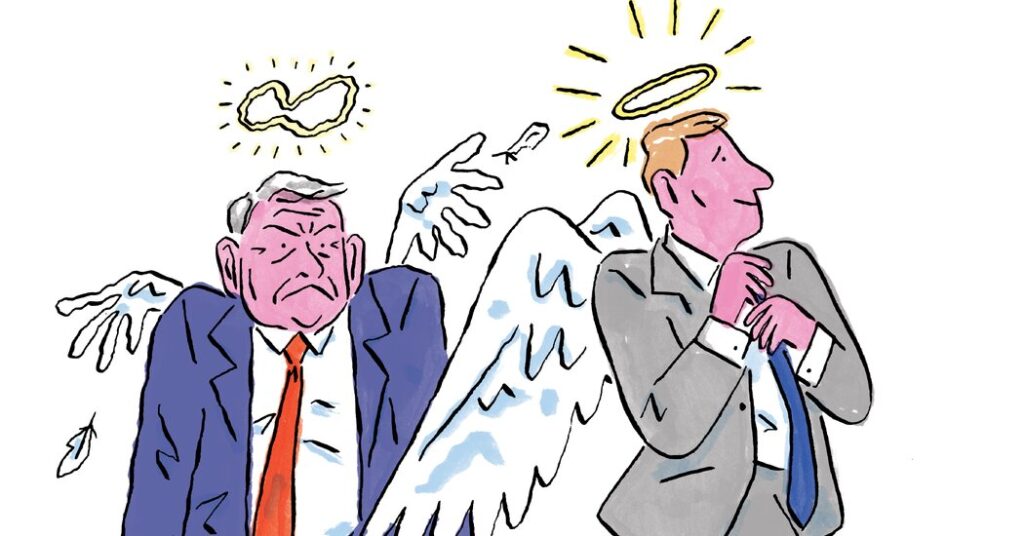
The “values voter” became a hot political commodity some two decades ago. A catchy rebranding of the religious right, the label was inspired by a controversial exit poll question in the 2004 presidential election finding that 22 percent of voters cast their ballots on the basis of “moral values,” and 80 percent of them supported George W. Bush. The assumption took hold that Americans who cared about “values” were conservatives animated by opposition to abortion and same-sex marriage.
The 2026 campaign is reminding us that this narrow view of how voters think about values is out of step with a long American tradition that gave rise to moral appeals for improving society as a whole, particularly at times of great economic and technological change. We are witnessing the return of a politics of morality organized around the injustices of the economic system and an array of related problems: the costs of technological change, the unraveling of community, civil rights, and financial and work-balance issues confronting families.
These themes are powerful in the campaigns of Democrats this year across the party’s philosophical spectrum — and it’s about time. In his 2022 history of the Democratic Party, “What It Took to Win,” the Georgetown professor Michael Kazin argues that “the most fruitful strategy for Democrats over time” has involved criticizing the failures of the status quo in the name of an alternative “moral capitalism.” The underlying causes of the country’s unease speak to the demand for a larger moral argument.
The rapid development of artificial intelligence raises big questions about the future of work and the nature of being human that have begun to seep into conversations at dinner tables, taverns and over back fences. Early in his searching encyclical on A.I., Pope Leo XIV offered a query that is on many minds: “Where are we going?”
Moral engagement with the economy, social justice and technological revolution has deep American roots, both secular and religious. At the high tide of the Progressive Era, Walter Rauschenbusch, a Protestant pastor and theologian, gave voice to the “social gospel” movement in his 1907 book, “Christianity and the Social Crisis.” The civil rights movement of the middle of the 20th century, like the abolitionist movement before it, highlighted the moral urgency of equal rights and linked their defense to religious values. This tradition has been kept alive by religious progressives and the Black church.
In 2026, the resurgence of a Christian left is most explicit in James Talarico’s Senate campaign in Texas. Mr. Talarico, a Presbyterian seminarian, speaks often about his faith and regularly invokes scripture. He is inspired by Jesus’ overturning of the money changers’ tables outside the temple, described in all four Gospels. The top of his campaign website features Mr. Talarico’s signature line, “It’s time to start flipping tables.”
His campaign against the Republican nominee, Ken Paxton, will provide the starkest contest between the old values debate and the new one. Mr. Paxton has denounced Mr. Talarico’s theology and issued familiar attacks from the religious right, notably around trans issues. The scandalous personal baggage weighing down Mr. Paxton will complicate his talk about morality. But it won’t stop him from using it to appeal to the remnant of the old values voters who helped Mr. Trump win in 2024.
Mr. Talarico is far from alone among Democrats in thundering against Trump administration policies in biblical terms.
The list of possible 2028 presidential contenders who make religiously inflected arguments for social change is long. It includes both of Georgia’s senators, Jon Ossoff and Raphael Warnock — Mr. Warnock is a Baptist minister — former Transportation Secretary Pete Buttigieg, Gov. Josh Shapiro of Pennsylvania and, increasingly, Gov. Gavin Newsom of California. In September, Gov. Andy Beshear of Kentucky will publish a book about faith, “Go and Do Likewise,” with a title and message inspired by the parable of the good Samaritan.
President Trump’s corruption and self-dealing have provided a new foundation for arguments inflected by appeals to values. The president’s close (and often remunerative) ties to some of the nation’s wealthiest individuals and interests lead naturally to a broader assault on “oligarchy,” a word popularized from the left by Senator Bernie Sanders and Representative Alexandria Ocasio-Cortez but now in common use across the party.
The closest thing to a manifesto for the Democrats’ new values offensive is Senator Chris Murphy’s book published last month, “Crisis of the Common Good: The Fight for Meaning and Connection in a Broken America.” Mr. Murphy, a Connecticut Democrat, links a left-populist critique of the economy with the imperative of responding to “America’s spiritual unraveling.”
Defeating Mr. Trump is necessary, Mr. Murphy argues, but the president’s rise is also a symptom: “A deeper rot festers in the American soul.” Its elements, he writes, include “a callousness toward our neighbors” and “a me-first selfishness,” along with what he sees as the worship of “false cults,” among them “profit at any cost, consumerism instead of citizenship” and “a blind faith in technology.”
The Democrats’ new moral language suggests an understanding that the backward-looking “again” in Mr. Trump’s MAGA slogan was about more than a return to reactionary approaches to race and immigration. It also spoke to many who yearned for, as Mr. Murphy put it, “a time when Americans felt more connected to community and neighbor.”
Former Gov. Roy Cooper, a Democrat battling for a Senate seat in North Carolina, is one candidate who has translated these larger ideas into the shorthand of the political spot, narrating an ad about his childhood on a family farm.
“I grew up working on this farm,” Mr. Cooper says. “Mom was a teacher. Dad, a small-town lawyer and farmer. Fridays were football. Sunday was church. I’m Roy Cooper. Life felt easier back then. I’m running for the Senate to make life easier today, to go after insurance companies ripping you off, to make sure you can retire with dignity, and to build an economy that finally values working people.”
In a different key, Mr. Ossoff, who is the only Democratic senator up for re-election in a state Mr. Trump carried in 2024, called down the judgment of the prophet Amos as he addressed “the political and moral crisis that we face in our nation” at Elizabeth Baptist Church in Atlanta last month. “Amos attacked the moral corruption of his time,” Mr. Ossoff declared, adding that “the people struggled to survive while the wealthy and the powerful lived in luxury and opulence.”
Americans have quarreled over Prohibition, birth control, abortion, sexuality and other aspects of individual behavior. But we have also confronted the corruption of political and economic systems and our responsibilities to put things right.
We are in a transition in how we talk about values because now is a moment to tend to the demands of our common life — and our obligations to one another.
E.J. Dionne Jr. is the author of “Why Americans Hate Politics,” “Our Divided Political Heart,” “Why the Right Went Wrong” and, most recently, “100% Democracy,” with Miles Rapoport.
The Times is committed to publishing a diversity of letters to the editor. We’d like to hear what you think about this or any of our articles. Here are some tips. And here’s our email: [email protected].
Follow the New York Times Opinion section on Facebook, Instagram, TikTok, Bluesky, WhatsApp and Threads.
The post A Different Kind of ‘Values Voter’ Will Power the 2026 Midterms appeared first on New York Times.