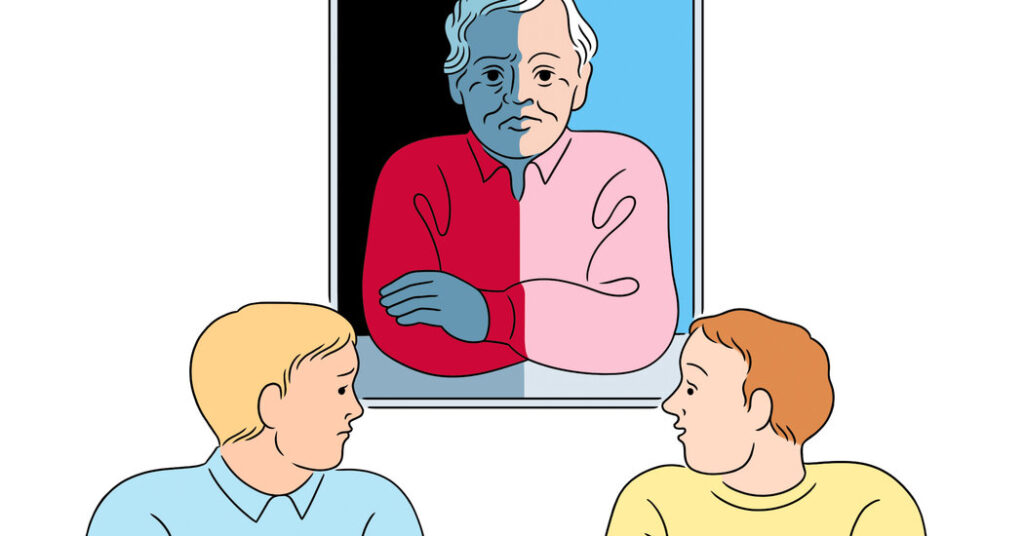
For years I suspected that my father sexually abused my sister, but I confirmed it only recently. His treatment of her led to her abusing me the same way when I was just 7.
When my father divorced my mother, he already had his new life lined up. He and his mistress married and immediately had two sons, whom he treated far better than he treated my sister and me. My stepmother got him to stop drinking (which had played a major role in his abusive history) and greatly changed him for the better. I respected him for cleaning up his life and her for making him do it.
When my father died, my half brothers wanted me to stay the night at their home. I couldn’t do it. They were persistent, and eventually out of frustration I slightly raised my voice and said: “Guys, I can’t do it. I had a very different relationship with him than you did.” Needless to say, they were taken aback.
Since then, I have wanted to share the history that they don’t know. For one thing, if the tables were turned, I personally would want to know. For another, I think it would be a great example to follow should they ever reach a “Can people really change?” crossroads in their own relationships. And finally, I want them to grasp the differences between the two families he created, so they can understand my reservations.
I know my stepmother would deny that the abuse ever happened; my half brothers might also refuse to accept it, causing even more distance between us. I still think they should know, but maybe I’m being selfish and not fully understanding how much the bad might outweigh the good. — Name Withheld
From the Ethicist:
The fact that you’re bringing this up now suggests that you may currently be coming to grips with this dark past in some new way. You may think that sharing what happened with other family members will help with this process. That doesn’t make it a selfish impulse. Given that you were also a victim of abuse, you’re entitled to take care of yourself. And however much your half brothers’ feelings about their father may be disrupted — assuming they don’t simply reject what you have to say — they’re better off living with important truths. Just bear in mind that they may not see it that way.
Bear in mind, too, that this is a story, first and foremost, about your sister. You don’t say what your relationship with her is like now, but it seems likely that it was through a conversation with her that you confirmed the abuse. If that’s the case, talk to her now and see how she feels about the disclosure you have in mind.
As for the “Can people really change?” question, you don’t say your father ever apologized to your sister, which perhaps complicates the arc of transformation you invoke. This may be another truth you’ll want to come to grips with.
Readers Respond
The previous question was from a reader whose ex had been diagnosed with cancer and expected him to become her caregiver. He wrote:
I’m a disabled veteran in a relationship with someone who has just been diagnosed with Stage 4 breast cancer. We first met about 10 years ago, as I was getting divorced, and we became friends. Eventually we started dating and moved in together, but it soon became apparent that we were incompatible. … I moved into my own house one city away with my daughter. … About a year and a half ago, my ex got a job in my city. She needed somewhere to live, and I needed someone to help me. We decided to live together with a clear agreement over roles and responsibilities. … Within six months, it was clear that our incompatibilities remained. … We agreed to part ways when the lease was up. Relationshipwise, though, things have remained blurred. … Now, six months from the end of our lease, she has been diagnosed with cancer. She is now expecting me to care for her full time until she dies. … I care deeply about her, and I am currently committing all my resources to her. But I don’t have the financial or physiological capacity or, if I’m being honest, a compelling personal interest in taking on this role. … Will you offer guidance? — Name Withheld
In his response, the Ethicist noted:
Treat this as a stark “either-or” and you can give yourself permission to walk away without a backward glance. You’re obviously in no condition — physically, monetarily or emotionally — to be this person’s everything. … Yet the choice isn’t, or shouldn’t be, all or nothing. Given your concern for her, there are all sorts of ways you can be helpful without being any kind of partner to her. … What worries you, at least in part, seems to be your own difficulty in remaining resolute when you’re with her. … But I wonder whether your failure to stand up for yourself in the past is leading you to take an excessively absolutist stance today. You say that when you started cohabiting again, you realized she hadn’t really changed. The question now is: Can you? Husbanding your resources and protecting your own welfare doesn’t have to mean walking away. See if you can’t find a way to be firm but kind.
(Reread the full question and answer here.)
⬥
The letter writer has made it very clear that he will put others first, at his own expense, even when he knows it won’t be good for him. And this woman has clearly taken advantage of that. They will both continue on that track, and it will end up being terrible for him. He needs to maintain their agreement to split, and insist that her family step up. — Lindsay
⬥
I may be old–fashioned in this regard, but to me, if you live together and you’re still having sex, the relationship is current — especially when we’re hearing only one side of the story. Even so, one can only give what one can give. I agree with the Ethicist’s advice to assist, with limits. As a breast cancer survivor myself, I can attest to the immense value of a roof over one’s head and help in arranging rides to any treatment she elects to pursue. — Mary Lou
⬥
I am far more concerned for your well-being than hers. I agree that you should look into oncology social services for her, and she must find a different place to live. You should also speak with a V.A. social worker to see if you can obtain necessary support services, group therapy and transportation services so that you are no longer homebound. Find a mantra — such as: “I deserve to first take care of myself.” — Cali
⬥
I agree with The Ethicist. It is fine for the letter writer to help in ways that he can, but he is under no obligation to take care of this woman full time. After all, she did agree to help him with his physical limitations, signed a lease with him on that promise and then did not deliver. She sounds very selfish. Once the remaining months of the lease are up, I would recommend that he live separately from her and only provide help that is within his means. This may be hard, as it sounds as though he has let her take advantage of him in the past. He’ll need to get stronger to put himself first. — Zoe
⬥
Drawing from my own personal experience, I suggest that the letter writer schedule breaks from caregiving: short periods of time (a couple days or a week), planned in advance, that are completely for himself. This will lead the other person to figure out how to secure outside help on her own, and allows for a resetting and re-establishing of boundaries that otherwise would inevitably soften. — Linda
The post My Father Abused My Sister When We Were Kids. Should I Tell My Half Siblings? appeared first on New York Times.