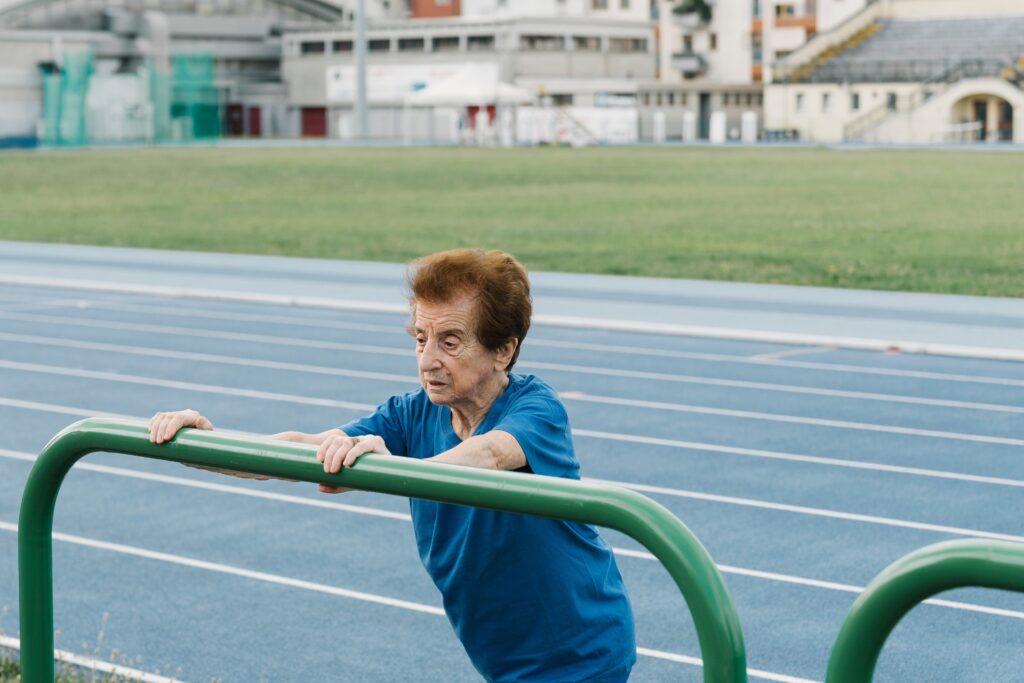
Want a long and healthy life? Then you might want to follow the example of Italy’s Emma Maria Mazzenga.
But following her won’t be easy.
Almost 93, Mazzenga may be the fastest female nonagenarian on Earth. She holds the 90-to-94 age-group world records in the outdoor 200 meters and the 60-, 200- and 400-meter indoor events.
When she set the 200-meter outdoor record of 50:33 in 2024, she bested the then-world benchmark by more than a second. She’d set that record, too. As a world-class sprinter, her primary competition these days is herself.
But scientists in the United States and Italy recently began to wonder just how singular she might be. So, as part of a major, ongoing study of elite older athletes, they began measuring her cardiorespiratory fitness and muscle function.
The goal of their research is to tease out which aspects of growing older are inexorable and which might be open to slowing or other change, especially if people exercise.
Delving into that topic, two studies of Mazzenga, one published last month in the Journal of Applied Physiology, and the second in the same journal this month, find her aging to be both exceptional and commonplace. In many ways, her body works as well as that of an active 20- or 30-year-old. But not in all ways.
“What we are learning is that, definitely, exercise training is a major thing we should focus on to change the aging process,” said Simone Porcelli, an exercise physiologist at the University of Pavia in Italy and a senior author of the new studies.
In that context, he added, “Emma is quite inspiring.”
The making of a champion sprinter
Mazzenga, who lives in Padua, Italy, first tried sprinting at the University of Padua when she was about 20 and studying biology, Porcelli said. Enjoying the sport, she continued to train and compete after graduation off and on for another decade, until work and family responsibilities intervened.
For about 15 years, she didn’t race or formally exercise much, until, at about age 45, with her children grown, she decided to start sprinting again.
Today, at 5’1” and 128 pounds, she typically trains about three times a week, warming up with a few minutes of gentle jogging, followed by challenging sprints of various lengths. Sometimes she runs hard for 60 meters (about 200 feet), rests for around three minutes, and sprints another 60 meters, repeating the whole sequence until she tires. Other days, she lengthens the intervals to 400 meters or more, with six or seven minutes between each.
The bulk of these workouts involve high-intensity interval training, meaning the exercise effort is draining, but the duration short. Her training sessions rarely last more than an hour, and she almost never goes for long runs or completes other sustained aerobic exercise. She does walk outside almost every day and occasionally performs light resistance exercise.
“She’s mainly been a sprinter for most of her adult life,” said Christopher Sundberg, a professor of geriatrics and medicine at the University of Wisconsin at Madison and co-senior author of the new studies. “That’s unusual. It’s partly what makes her” — and her aging body — “so interesting.”
How Mazzenga is aging
In 2024, a month after she set her 200-meter indoor record and two weeks before she lowered the 200-meter outdoor world mark, Mazzenga, then 91, visited the University of Padua’s exercise lab. There, Porcelli and his colleagues used a bicycle, knee extension machine, muscle biopsy and other tests to check her aerobic capacity, cardiac output and leg muscles’ size, strength, power and underlying function.
Then they compared her numbers against similar data from younger people. (There’s little information from other athletic 90-year-old women, because few have been studied.)
The results suggest Mazzenga is aging admirably. Her overall aerobic fitness resembled that of athletic women almost half her age, and her ability to take in oxygen and start passing it along to her muscles was even better, comparable to what’s seen in active 30-year-olds.
Her muscles also teemed with healthy connections to nerve cells in the spinal cord. These connections often wither with age, reducing the ability of muscles to receive and respond to messages from the brain. But few of Mazzenga’s nerve connections had died. Just as impressive, her muscles’ mitochondria — the tiny organelles inside cells that absorb oxygen and transform it into energy — were exceptionally robust, functioning like those of 20-year-olds.
It’s never too late to start.
But in some ways, Mazzenga showed her age. Her legs’ muscle mass was somewhat diminished, as would be expected in a woman of her age, and her ability to generate force while lifting weights was similar to that of people in their 70s or 80s. There also was substantial atrophy in her fast-twitch muscle fibers, a condition often seen during aging.
At the same time, her slow-twitch muscle fibers, which are involved in sustained aerobic activity, were unusually large and healthy for someone her age.
The fiber results are somewhat baffling, Sundberg said. Why didn’t Mazzenga’s intense sprint training, which activates fast-twitch fibers, protect those fibers from atrophy? Why did it, instead, seem to bulk up her slow-twitch fibers? Are those enlarged fibers compensating for the atrophied fast-twitch ones? “We just don’t know right now,” Sundberg said.
The study raises other questions, too. Are Mazzenga’s talent, durability and longevity due primarily to her training or to her genes, personality or other factors, such as her diet or social network? (She eats lightly, mainly fish, eggs and vegetables, but has steak if she wants.)
Also, is her training, which consists almost exclusively of brief, hard sprinting, the ideal approach to successful aging? The researchers are also studying older champion distance runners, who spend many hours every week doing prolonged aerobic exercise and only occasional sprinting. Is their route to aging comparable or better?
“We’re testing different types of exercise interventions,” Sundberg said. “The aim is to identify the golden combo of exercise that will help the most” with healthy aging. “I don’t know if we’ll ever have the full answer, but I think we’ll get closer to the truth. That’s the goal.”
The scientists recently invited Mazzenga back to the lab and repeated all of the tests from 2024. They want to see whether and how her physiology has changed from ages 91 to almost 93. Results should be published soon.
Until then, “one of the best things” that such studies “show the general public is that it is not too late to start exercising,” said Hirofumi Tanaka, director of the Cardiovascular Aging Research Laboratory at the University of Texas at Austin. He studies older athletes but was not involved in the new research.
Mazzenga, like many athletes he studies, didn’t begin or return to regular exercise until relatively late in life, Tanaka said, and then bloomed. There’s inspiration and promise in that arc. “Masters athletes stand as living proof that passion, perseverance and discipline know no age limit,” he said, “and demonstrate to us what is possible in the aging process.”
Do you have a fitness question? Email [email protected] and we may answer your question in a future column.
The post At 92, she’s as fit as someone half her age appeared first on Washington Post.