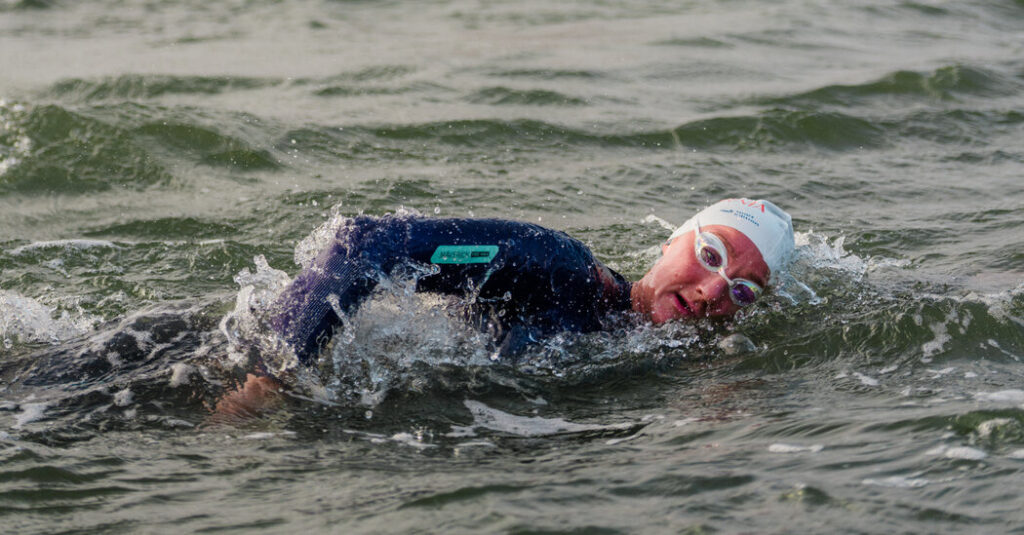
Early one morning next month, Catherine Breed, 33, will walk into the ocean just north of the California-Oregon border and start swimming south. Between 80 and 126 days later — if things go as planned — she will reach the California-Mexico border, becoming the first person ever to swim the entire length of California.
To attain this audacious goal, she will have to swim about 900 miles along rugged coastline in the open Pacific, vulnerable to great white sharks, elephant seals, venomous jellyfish, storms, currents, hypothermia and rhabdomyolysis, a dangerous condition in which muscles disintegrate from overexertion. Amy Gubser, one of Breed’s open water swimming mentors, said of Breed’s plan, “It would be the equivalent of somebody running a marathon every day for months, only in a very remote area, with moose or polar bears.”
Like a lunar mission, Breed’s expedition, called Swim California, has a flexible, weather-dependent launch date. Breed and a crew of four will eat, sleep and live aboard a 52-foot sailboat, sheltering at night in coves and harbors when possible. Except on periodic rest days, she will swim for five to eight hours each day, starting where she stopped the previous day. On clear, calm days, with a neutral current, she’ll cover 10 to 15 miles, beginning early to avoid strong afternoon winds. To have the swim ratified by the World Open Water Swimming Association, the crew will upload a daily observer’s log that records air and water temperature, wind speed and direction, Breed’s stroke rate, wildlife incidents and geotagged photos for every 30 minutes she’s in the water.
I met Breed during her lunch break on a recent Wednesday outside the Parnassus campus of the University of California, San Francisco. In her day job at Intuitive Surgical, which she will quit to make the swim, she trains doctors to use a robotic surgical system. One of these physicians is Dr. Jonathan Carter, who is acting as a consulting physician for Swim California.
The three of us walked to one of Breed’s favorite lunch spots. Breed was tired, and as she told us about her schedule, between bites from a steak-topped salad bowl, I could see why: Each week, she lifts weights three times, swims roughly 40,000 yards (more than 22 miles), works a full-time job and spearheads the logistical planning for her expedition.
“Yeah, long days,” she said. “I’m not having, like, any crazy meltdowns, but I definitely have moments.” She paused, searching for the right words. “You know when you see a frayed power line? That’s how I feel on the inside sometimes.”
Breed likes to describe Swim California in the first-person plural: Not I’m swimming California, but we’re swimming California. In addition to Dr. Carter, her support team includes an athletic trainer, a nutritionist, a lawyer, a fund-raiser, a publicist, a logistics coordinator, a kayaker and a boat pilot who has circumnavigated the world. Her boyfriend, Dave Monachello, a ski patroller near Lake Tahoe, will shadow the boat’s southward progress in a sprinter van, resupplying the crew at sea with fresh vegetables, good paperbacks, pints of ice cream, spare boat-engine parts and whatever else they need. At a dozen key locations, Breed will come ashore for public education events meant to raise money for and awareness of ocean conservation issues, including kelp forest health, offshore oil drilling and collisions between whales and boats.
As we walked back to the hospital after lunch, Breed gave herself a sort of pep talk.
“When I get to think about it, it’s such a big, stressful thing,” she said. “But I’m also like, I get to take four months where all I really have to do is put my face in the ocean for five hours a day and then hang out on a boat — like, that’s not the worst way to spend four months.”
That evening, Breed held a fund-raising event at the private, 166-year-old Olympic Club in downtown San Francisco. Those present were from a wide range of ages, including seniors and elementary schoolers who had written about her for a school project
Wearing a long white dress with a maritime pattern of corals, starfish, mussels and nautiluses, Breed walked the audience through some basics of her biography. She was born and raised in the Bay Area, and her childhood was full of sailing and swimming (“Water is my happy place”). She got a scholarship to swim at the University of California, Berkeley, where she was a pre-med major, a two-time all-American swimmer and a member of the U.S. national team.
After graduating in 2015, friends introduced her to the Dolphin Club, an open water swimming and boating club in San Francisco. It soon became clear that she could maintain the speed she had honed in college for many miles. In 2017, she completed her first long swim attempt, 21.3 miles across the long axis of Lake Tahoe, in 8 hours and 56 minutes, breaking a record set by a man that had stood since 1987.
More successful marathon swims followed: 20.8 miles across the English Channel, 21.7 miles in the North Channel between Scotland and Ireland (in 50-degree water without a wet suit), the 28.5-mile 20 Bridges Swim Around Manhattan. Soon, she began hearing from strangers who were inspired by her feats, including a man who told her that he started swimming again and had lost 50 pounds.
Instead of pursuing medical school, she decided she would make her impact as a swimmer.
When people learn what Breed is doing, they want to know the expedition’s cost (around $500,000, from individual donors and corporate sponsors), what she will she eat for breakfast (chia pudding, overnight oats), whether they can join her for part of the swim (no), and if she will be posting and livestreaming any of the swim (yes, on Instagram and YouTube.)
But perhaps the two most common questions are: Why are you doing this? And what about the sharks?
Pacing the Olympic Club stage, with two large screens projecting scenic shots from her different swims, Breed described multiple motives: to promote ocean conservation, to inspire others, to set a record, to have an extraordinary adventure. “I’m getting to experience parts of the coast that have never been experienced in this way before. No one goes slowly down the California coast,” she said.
Breed presented her marathon swims not just as physical feats, but as stages in an unfinished journey of self-knowledge. After her record-smashing swim at Lake Tahoe, she expected to set a record during the North Channel crossing. Instead, windy conditions slowed her down, and it took far longer than she expected.
“A really important lesson on this swim was, you cannot bring hubris to the ocean,” she said. “You can’t bring your plan to the ocean, because she’s going to be like, ‘Ha-ha, that’s funny.’”
Her longest swims have often blended the sublime and the terrifying. While crossing Monterey Bay, each stroke agitated bioluminescent algae, creating an otherworldly blue glow. Passing a partially submerged shipwreck by the pier at Sea Cliff state beach, a known hot spot for great whites, she felt a transcendent fear. “I’ve never been as scared as I was swimming past the sharky waters in Aptos,” she told the crowd.
Shortly before the Monterey crossing, while swimming near Aptos with a paddle boarder, she felt an overwhelming sense that something was near her in the water. She looked over and saw the paddle boarder pointing to a spot less than 10 feet away from his board. The fin of a great white shark was gliding along beside them. They made it safely back to shore, but looking at a graph of her heart rate and stroke rate afterward, she knew exactly the moment the shark appeared: both lines had shot upward.
Just before the talk that night, I chatted with Catherine’s mom, Robin Breed. While she said she worried about Swim California, she suggested that people often think about risk in a gendered way. “When boys climb trees, everybody goes, ‘Oh, look how high they are,’” she said. “And when a girl climbs a tree, it’s ‘Oh, be careful now, don’t fall, don’t scrape yourself.’”
Near the end of her talk, Breed drew a distinction between risk takers and risk “technicians.” The former act on impulse and hope to get lucky; the latter strategize to minimize risks. During Swim California, Breed will wear a small device that creates a magnetic field meant to confuse a shark’s sensory system. Someone in a kayak or a small boat will always be near her, and at known hot spots, multiple scanners will watch for sharks and sea life. “So I promise I’m not going to get bit by a great white shark,” she said at one point, provoking nervous laughs.
But even risk technicians can get unlucky.
One of Breed’s worst swimming experiences happened in 2025, when she was attempting a crossing of about 30 miles between the Farallon Islands and the Golden Gate Bridge. She started at 10:45 p.m., swimming through the night to avoid ships and catch an assist from the tides.
She swam through masses of jellyfish so dense they got inside her swimsuit, forcing her to change suits midswim. She spent hours in a “bait ball,” a cluster of small fish that can attract birds from above and predators from below. With her hands hitting creatures on nearly every stroke, she began to imagine things, even confusing the soft inside of a moon jelly with the guts of a seal freshly killed by a shark — a real, terrifying possibility.
Near the Golden Gate Bridge, having already swum over 25 miles with no wet suit in 56 degree water, she was shivering, miserable and borderline hypothermic. There, she got stuck in a reverse current and barely made progress for almost 90 minutes.
She talked with her support crew only during the “feeds” that marathon swimmers are allowed each half-hour by the World Open Water Swimming Association. She could not touch the boat, but her support team could toss her liquid nutrients and talk briefly. On the boat was Amy Gubser, who in 2024 became the first person to swim the same crossing in the opposite direction. Gubser was unfazed by the intensity of Breed’s emotions during her feeds.
“There were tears, some cursing, but she was never really disrespectful,” Gubser recalled. What distinguished Breed was not the absence of doubt, fear and frustration, but her capacity to continue despite these emotions. “We’re just like, all right, that’s how you feel,” Gubser said. “In half an hour, we’ll talk about it again.”
Breed finally escaped the current, but by her next feed, she felt ready to quit. She looked at the Golden Gate Bridge, a few miles away, and thought about Swim California. If she could not complete this swim, people would have questions about a vastly longer one. Suddenly, she dove below the water, and as she resurfaced, screamed.
She completed the swim, breaking the previous record by three minutes.
In late April, Breed let me join her on a training swim.
We met just after sunrise on the boat ramp of Horseshoe Bay, near the base of the Golden Gate Bridge. Along with three support-boat volunteers, we climbed into a red 14-foot Zodiac — a rigid inflatable boat with an outboard motor. Life jackets, thermoses of coffee and water, dry bags, bananas, towels and other gear were piled at our feet. I’d need help keeping pace with Breed, so I brought fins to boost the power of my kick.
I’ve been an open-water swimmer for a few years, dipping into the Bay several times a month near Berkeley in the East Bay. But I’d never swum beyond the Golden Gate Bridge. Where the Bay meets the open ocean, the waves get larger, the currents stronger and the wildlife more abundant.
We motored out of Horseshoe Bay just after 6:30 a.m., as the sun rose behind us over Alcatraz Island, casting a mellow glow over the smooth water. Shadows still covered the western slopes of the green and brown hills in the Marin Headlands. Across the water, sunlight was hitting the cliffs and houses of Pacific Heights. Our boat’s hand-held radio crackled with updates on the locations of cargo ships and oil tankers.
Soon Breed slipped off her parka and donned goggles and a custom swim cap featuring a blue California-shaped strip down which a slender figure dives. She wore a black-and-purple wet suit, one of six she will bring on the expedition for use as needed.
Breed swung her feet over the edge of the bobbing Zodiac, stretched both arms overhead and dropped into the water.
“Swimmer in!” called Radha Tomassetti, one of the volunteers.
Breed swims for hours at a pace faster than most people could manage for the length of a pool. Sachi Cunningham, a friend who helped teach her big-wave surfing, told me that when she first saw Breed in the water, she was amazed. “I had never seen anyone move through the water like that, with such grace and strength,” she said. Watching Breed swim away from the Zodiac, I saw what Cunningham meant. Her stroke is smooth, fast and seemingly effortless.
A kayaker stayed near Breed, while we watched for other vessels in the Zodiac, sometimes looping quick circles around her so fishing boats noticed us. Tomassetti had piloted support boats for many marathon swimmers, but escorting Breed felt different.
“Most of the time with swimmers, you’re just sort of bobbing beside them waiting,” she said. “With Cat, we actually have to use the motor.”
A few moments later, we saw two whale spouts — shimmering columns of exhaled air and water — dissolving in the sunlight about a half-mile away. Much closer to the boat, the dorsal fins of dolphins arced above the water.
I slipped on fins, goggles and swim cap just over a thousand yards outside the Golden Gate Bridge and dropped over the side of the boat to join Breed in the water.
It’s one thing to notice, from the safety of a boat, just how small a human swimmer looks against a backdrop of whales, cargo ships, sea lions and an infinite horizon of water. It’s another to plunge yourself into a cold and vast realm in which you are slow, small and vulnerable.
Even with the Zodiac and the kayak nearby, I felt far more exposed in the ocean than in the Bay. The currents were unpredictable and strong, and it was hard not to think about the creatures all around us. Swimming in wild, cold water is not just a physical challenge; it’s also a psychological immersion in your own fears and doubts — some idiosyncratic and personal, others ancient and universal.
Just before we reached the Golden Gate Bridge, Breed suggested we switch from freestyle to backstroke. So we flipped over and swam beneath the bridge while looking up at its intricate lattice of huge orange girders.
After roughly a mile and a half of swimming, about an eighth of the distance she plans to cover nearly every day for months, we got back to the boat launch at Horseshoe Bay. After dropping me at the cove, Breed swam out again, planning to loop around Angel Island. She would have liked to swim longer, but she still had a full workday ahead of her in San Francisco.
The post She’s Set to Swim the Entire California Coast (Sharks Permitting) appeared first on New York Times.