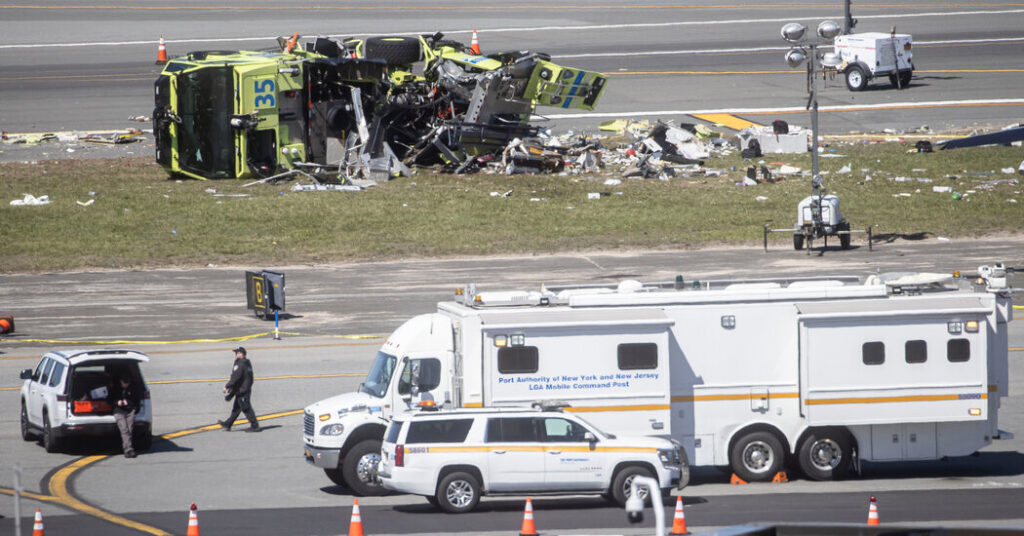
Rescue trucks at the three major airports that serve New York City now have a critical piece of equipment that was missing from a fire truck involved in a fatal crash with a plane at LaGuardia Airport in March.
The Port Authority of New York and New Jersey, which operates the airports, installed transponders in its rescue and firefighting vehicles this summer, after a federal investigation into the crash of an Air Canada Express jet that killed two pilots faulted the agency for failing to have the devices. The Port Authority said the transponders in rescue vehicles at LaGuardia and Kennedy International Airport were turned on Monday morning.
The transponders send signals to air traffic controllers in the airport towers that identify the vehicles whenever they are on runways, taxiways or other parts of the active airfield.
The Federal Aviation Administration has been advising airports to equip rescue vehicles with transponders for 15 years. About 10 months before the crash at LaGuardia, the F.A.A. said it was “actively encouraging” airport operators to install transponders “to improve airfield safety.”
In the March 22 crash, an arriving Air Canada jet slammed into a fire truck operated by officers of the Port Authority Police Department on one of LaGuardia’s two runways. The truck had received permission from the control tower to enter the runway. Then, seconds before the collision, a controller called out to the officers, “Stop, Truck 1, Stop.” But the truck, which was leading a convoy of vehicles responding to reports of smoke on a United Airlines plane, continued into the path of the Air Canada plane as it touched down.
At the time, the Port Authority had just begun a pilot program to test the use of transponders at Newark Liberty International Airport in New Jersey, but it had not taken similar steps at LaGuardia or Kennedy.
Investigators at the National Transportation Safety Board have not released their conclusions about what caused the Air Canada crash. But in a preliminary report issued in April, the safety board highlighted the fire truck’s lack of a transponder that would have constantly sent signals about its location to LaGuardia’s control tower, which uses an automatic warning system.
Without transponders, the “system could not uniquely identify each of the seven responding vehicles or reliably determine their positions, or tracks,” investigators wrote in the report. “As a result, the system was unable to correlate the track of the airplane with the track of Truck 1.” So the system “did not predict a potential conflict with the landing airplane,” the report added.
After that report, Port Authority officials decided to install transponders on their rescue vehicles at all of the airports the agency operates in the metropolitan region: LaGuardia, Kennedy, Newark Liberty and Teterboro Airport in New Jersey. The agency said it purchased all 34 of the transponders that were available, and it has ordered about 700 more. The cost of procuring and installing them was not immediately available.
Airports in several other big cities also have transponders in their rescue trucks. In May, the Phoenix City Council approved spending more than $500,000 for the installation of 85 additional transponders at Phoenix Sky Harbor International Airport.
The first batch was installed in 25 rescue and firefighting trucks and some other vehicles used for maintenance and operations on the active airfield, an agency official said. The transponders installed at Newark Liberty were put into use first, in mid-July, because that airport’s active airfield had already been mapped for the pilot project, the official said.
After the installation, the rescue crews and the air traffic controllers had to be trained on how to use the trackers. Instead of appearing as an unidentified blob on the controllers’ screens in the towers, as Truck 1 did on the night of the Air Canada crash, each vehicle is identified by a distinctive code.
The F.A.A. said that it commended the Port Authority for equipping its vehicles with transponders. “This equipment enables air traffic controllers to see vehicles on an active airfield from their radars,” the F.A.A. said in a statement. “We encourage other airports and airlines to equip their vehicles and have reminded them to apply for federal grants to help install them.”
Last week, the F.A.A. was taking steps to fire two controllers who stepped away early from their posts in the tower at LaGuardia the night of the Air Canada crash, people familiar with the matter said.
By the end of July, the airfields at LaGuardia and Kennedy had been mapped and the Port Authority had obtained licenses from the Federal Communications Commission to start having the trucks send signals to the towers. By late 2028, the official said, the Port Authority expects that about 200 vehicles at each of its major airports will be equipped with transponders.
The post Rescue Trucks at LaGuardia and J.F.K. Get Trackers After Fatal Crash appeared first on New York Times.