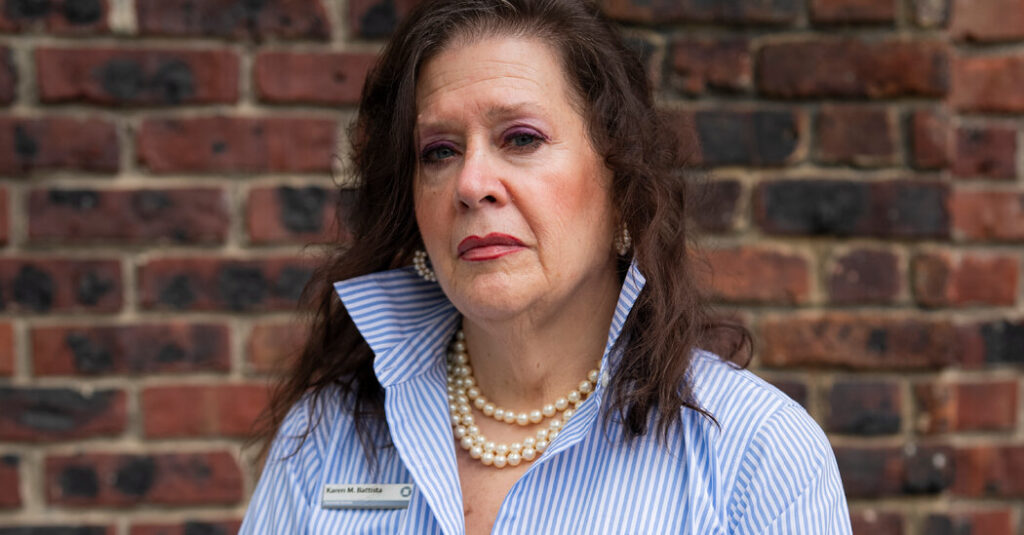
Karen Battista and Angela Castaldo have spent a combined 47 years behind the teller counter at a Chase branch in Scarsdale, N.Y., an affluent suburb just north of Manhattan. They know which customers just returned from vacation, whose children were recently married and who just lost a beloved dog.
Just before closing time on a cold February afternoon, one of their longtime customers, then 81 and recently widowed, walked up to Ms. Battista’s station. The woman needed to transfer $9,000 into a new account. She slid her debit card into the reader on the counter, but when Ms. Battista searched for a new account under her name, nothing came up.
What the customer shared next provided some clues: Before coming in, she said, she received a call from Chase — at least that was what it said on her cellphone’s caller ID. The caller asked if she had made three transfers for $1,000 each via Zelle, the bank’s digital payment service, something she had never used.
The caller then transferred the customer to a man who called himself “Michael” and who said he would open a new account for her to safeguard her money from fraudsters. But she’d have to go into a branch to transfer $9,000 into the new account.
After digesting the details, Ms. Battista asked for the new account number and plugged it into the bank’s system. A man’s name appeared. “Hold on a second,” Ms. Battista recalled saying. “If you take this money out and put this money in his account, then that’s it for your money.”
“So I should hang up with him?” the customer asked.
Ms. Battista didn’t realize this, but “Michael” had been listening on the woman’s cellphone the entire time — many criminals in these schemes are known for coaching their victims through their cons.
“Yes, hang up the phone!” Ms. Battista said. She had prevented the customer from falling for a bank impersonation scam. Ms. Castaldo, her co-worker, had also assisted another branch employee with a $22,000 save.
Many others don’t have the benefit of trusted tellers to stand between them and their scammer — and even when they do, many people still become embroiled in these schemes. In 2025, cybercrime losses of $21 billion were reported, up more than 25 percent from 2024 and nearly five times the $4.4 billion reported in 2020, according to the Federal Bureau of Investigation’s Internet Crime Complaint Center. Many more cybercrimes go unreported.
The Scarsdale bankers and many of their colleagues at teller windows and call centers across the country have taken on new roles. They’re often detectives, psychologists and, when everything goes right, even fraud-fighting superheroes, saving customers from losing their hard-earned money to criminals.
Interrupting Scams
Financial institutions have always dedicated substantial infrastructure to fighting fraud, but cybercrime has become so pervasive that many are increasing their investments or experimenting with new strategies. JPMorgan Chase, the nation’s largest bank, is training staff to address the fraudsters’ psychological tactics head-on.
Chase realized that the most effective way to fight back may be to better understand the emotional and psychological dynamics, so it hired Elizabeth Huppert, a behavioral scientist, roughly two years ago. Since then, she has been leading experiments with so-called scam interruption teams to develop strategies to assist call center staff and branch employees. These specialists swoop in when they determine that a criminal is stringing someone along based, for example, on data and behaviors tracked behind the scenes or “tells” given inside a branch.
Their jobs are often fraught — they may be the first to break the news that a customer’s investment returns are entirely illusory, or that a new girlfriend isn’t who she seems. Many scammers, who are often trained in criminal syndicate compounds overseas, develop deep relationships with their victims, often over many months.
Targets may be prodded into a heightened emotional state, which is often compared to being entranced under a spell. Dr. Huppert is trying to develop ways to put those spells “in flux,” as she said in a recent interview.
She studied calls with customers to try to better understand why they’re receptive to the scammers’ stories, and learned that they are often conditioned to distrust the bank. The scam specialists are being trained to flip that script, largely by raising questions and casting doubt, then finding ways to change the customers’ behavior.
“I’m trying to lower the trust in the scammer,” Dr. Huppert said. “I’m trying to elevate the trust in us — enough that they have some doubt that they’re going to do these action steps.”
To test these strategies, specialists in call centers made calls to customers who they suspected were transacting with fraudsters. Chase said there was early evidence that the efforts were working: Specialists using a newly developed call guide have been able to reduce the number of scam transactions among customers they have worked with — for example, by preventing them from resubmitting a canceled wire to a known fraudster.
This year, Chase is experimenting inside branches, where it puts scam interruption specialists on the phone with customers who it suspects are being defrauded.
“We have a new pilot team that the branch manager can get on the line in real time, which is great, because you might be able to intervene before the money is even sent at all,” Dr. Huppert said.
More broadly, Chase and more than 1,500 other financial institutions have adopted a 30-minute course from AARP’s BankSafe Initiative. Told through the eyes of a teller, it trains financial industry employees to recognize red flags and how to react.
Banks are also analyzing customer behavior behind the scenes, often with sophisticated software that can tell when customers are acting atypically — pausing in places when entering a password where they normally don’t, or maybe hesitating, or doing a lot of backspacing, when adding a new payee. The banks can also tell if customers are sharing their screen with another party (like a potential fraudster) or are on a call while making a transfer, for example.
“There’s a lot of sort of deep behavioral tells that we can look for around whether or not you’re acting in your account the way that you normally do,” said Sharell Barshishat, director of global advisory at BioCatch, which uses behavioral analysis to detect and prevent fraud for financial institutions. “Or if you’re showing signs of hesitation, duress, coercion, coaching, panic and so on.”
Those “tells” are often flagged and packaged with other behavioral data, translated into a risk score and other insights that are sent to a bank. Then the bank decides what happens next: It may block a transaction altogether or freeze it — and reach out to the customer to investigate.
The Customer Is Not Always Right
Bank employees aren’t always able to break through. Ms. Castaldo — an associate banker with Chase for 26 years — had a longtime customer who came in to withdraw $15,000, far more than the $500 she typically withdrew.
She may have had a valid reason, as the vast majority of customers do. But the challenge is sussing out when all is not as it seems, which skilled bankers can try through casual conversation.
When Ms. Castaldo asked what the money was for, the customer said home repairs. A banker who was sitting nearby overheard the exchange and asked the customer if the work had been completed and whether she was happy with the results.
“Yes, I just have to pay him,” the customer said.
The customer walked out with her $15,000 in cash — which would soon disappear in the back of an Uber that the criminals sent to her home. “As soon as he left,” Ms. Castaldo recalled, “she realized something was wrong.”
The customer returned to the branch with her daughter to report the scam. Fraudsters had convinced the customer that her daughter had hit someone with a car and that she needed to pay them.
These incidents used to be much rarer at the Scarsdale branch, but frauds of all types have been on the rise there and more broadly, the associate bankers said.
“You have to be on high alert, all the time,” Ms. Castaldo said.
But even with their defenses on high, financial institutions can’t solve the problem on their own.
“We are not seeing this as the massive threat to the United States and to the global world economy that it is,” said Erin West, a former prosecutor and founder of Operation Shamrock, a nonprofit focused on fighting transnational cybercrime. “We are expecting banks to clean up a mess,” she said, that was created on technology and social media platforms elsewhere.
Ms. Battista’s customer, the widow who managed to hold on to her $9,000, was fortunate. When she told “Michael,” the impostor, that she would visit the branch where she knew the tellers, he tried to talk her out of it. “It could be an inside job,” the bankers recalled him warning.
She went to see the tellers anyway. Even though she avoided being defrauded, she’s still deeply embarrassed. The scammer, she said, was smooth as can be. She did not want to be identified because she had not shared her story broadly and wanted to maintain her privacy. She never even told her family.
That was something that happened to her, she said, for a couple of hours.
Tara Siegel Bernard writes about personal finance for The Times, from saving for college to paying for retirement and everything in between.
The post Customers Are Giving Billions to Scammers. Tellers Are Intervening. appeared first on New York Times.