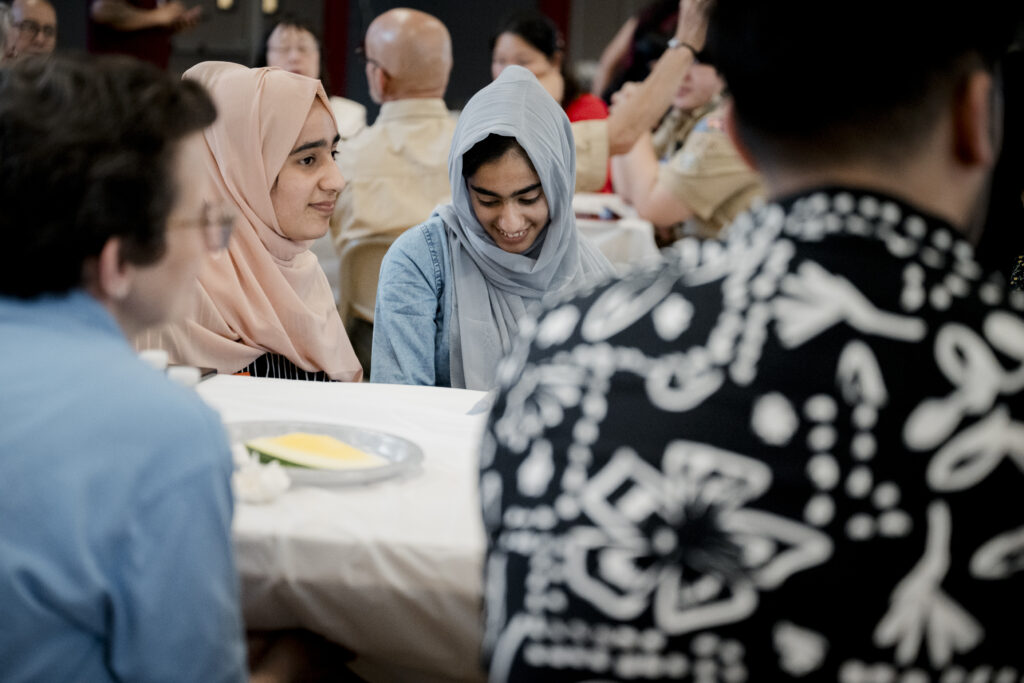
PHILADELPHIA — The sound of 100 voices speaking various languages bounced around the Catholic school gymnasium like a basketball.
The diverse group of Northeast Philadelphia residents — some whose families have been here for generations, others brand new to the country — gathered for dinner to discuss how to unite communities. The conversations, many carried out through interpreters, were designed to coincide with the nation’s 250th birthday in a city where immigrants helped build the nation and officials believe they are needed now more than ever.
“We are here to break bread together at a time when the nation is deeply divided over immigration, diversity and citizenship,” Harris Sokoloff, the event moderator, said as residents dined on food from local Pakistani and Colombian restaurants. “Good food leads to good conversation … and we believe what you have to say about being a good neighbor is important.”
The “Breaking Bread, Breaking Barriers” dinner is one of 22 community meals scheduled in seven of Philadelphia’s most diverse neighborhoods this year. A hundred people from each neighborhood are invited to attend three dinners in their area, plus a final event that brings together all 700 participants. The Welcoming Center, a nonprofit that supports Philadelphia’s immigrant community, sponsors the events, which are funded by $575,000 in city grants.
The events are tied to the July 4 anniversary of the signing the Declaration of Independence in the city. But they’re also designed to showcase Philadelphia as an antidote to the Trump administration’s immigration policies that have made it harder for both legal and undocumented immigrants to move to the United States.
As they watched Immigration and Customs Enforcement step up arrests in U.S. cities, communities in Philadelphia have been on edge. But especially this year, a time when the city is celebrating its history and heritage, local leaders also want to focus the dialogue around unity instead of division.
People at each of the 10 tables at last week’s dinner in Northeast Philadelphia were asked to discuss their cultural differences as well as how to construct a “Philly-flavored recipe for citizenship.” Families from China, Ukraine, Latin America, South Asia and the U.S. talked about their struggles, being neighborly and how to help others feel like they belong.
Rashad Shafaq, 21, who immigrated to Philadelphia from Afghanistan seven months ago, said he came to the dinner to feel closer to the community. “Everything is new to us,” he said.
Shafaq was seated with the Amirzai family, who arrived from Afghanistan last year, and two people born in Philadelphia: Jack Tomczuk, 32 and Lisa Cross-Shustack, 61.
When asked by a moderator to describe being a good citizen, Friba Amirzai, who spoke in Dari through an interpreter, initially thought the question was about the naturalization process. The moderator refocused the question to inquire about Amirzai’s neighborhood in Afghanistan. She quickly opened up.
“You want to respect each other, have good communication and keep a clean neighborhood,” she said.
Shamriz Amirzai, her 19-year-old son, added in English, “It means you need to respect the law.”
That resonated with Cross-Shustack, who is White and works at a local nursing home. She and Shamriz smiled and nodded in agreement that “respect for the law” and “looking out for each other” were important traits of good citizens.
Anuj Gupta, the Welcoming Center’s president, said it can be difficult for strangers to talk about building community and civic engagement, which is why they wanted to use the dinners to spark those conversations.
“Food is the primary tool to get people to understand that they have a strong foundation in common with one another,” Gupta said. “Once you establish that, you can collectively go into more complicated topics.”
Gupta said he envisions Philadelphia becoming a model for other cities trying to create vibrant neighborhoods where people from all different backgrounds look out for one another. The number of people living in Philadelphia who were born overseas is the highest it has been in almost a century.
Twenty-five years ago, Gupta notes, fewer than 6 percent of Philadelphia residents were foreign-born. Today, about 16 percent of residents are from other countries and are credited with halting the steep population losses the city experienced during the second half of the 20th century.
The influx of new residents transformed sections of the city, creating predominantly Spanish-speaking neighborhoods in North Philadelphia and African enclaves in Southwest Philly. Some neighborhoods, especially in Northeast Philadelphia, now rank as some of the most diverse areas of the country.
Students in the city’s public school system come from households where about 160 different languages are spoken.
The community dinners have been held in a variety of venues where participants can learn about each others’ customs. One in West Philadelphia brought residents from several countries and religious backgrounds to a mosque, where they shared a meal on the floor.
Last week’s dinner at St. Martin of Tours Catholic School was the third of four for the 100 guests invited to attend. The first, which was considered a “foundation builder,” focused on food and how ingredients in ethnic cuisines cross many cultures. At the second, residents talked about being better neighbors, which included lessons on the informal rules of wintertime in the Northeast: Don’t take the shoveled parking spot from your neighbor after a snowstorm.
As the dinner conversation broadened to becoming better national citizens, Shafaq and others at his table agreed, over plates of chicken biryani and beef empanadas, that being respectful and kind, picking up litter and staying away from drugs or excessive alcohol use were traits of good citizens.
The next time they meet, they’ll join hundreds of residents who had similar dinners in their neighborhoods. Suggestions from all those events will be presented during the final dinner in front of Independence Hall on Sept. 17: Constitution Day and Citizenship Day.
Until then, researchers will study the dinners to see if they can serve as a model for building community in other cities.
Keith R. Brown, a sociology professor at Saint Joseph’s University who is leading that research, said he was skeptical going into the project that the dinners could yield “logical outcomes.” Since then, Brown said he’s become more optimistic after seeing participants’ desire for building community.
“You really do feel like people are clamoring to have their stories shared with each other,” said Brown, adding that he suspects residents are seeking human connections in the post-pandemic era.
Still, Brown cautions that more people across the country are self-selecting their networks and isolating themselves among those who share similar ethnic, political or economic traits.
“It is not just race. It’s age, it’s ethnicity, class, really heavily class,” Brown said. “There is not many spaces left where people come together on an even playing field.”
Mingchu Pearl Huynh, president of the Northeast Philadelphia Chinese Association, said she sees that happening in her community. The dinners have inspired her to work to build better relations with her neighbors, she said.
Beth Wood, the administrator of the Catholic Charities of Philadelphia’s northeast service center, said the dinners serve as a bridge for immigrants who want to assimilate but also have a strong desire to “hold on to their own cultures, own ethnicities and beliefs.”
But Wood, who is of Italian and Irish descent, said she still wonders whether the events will have a lasting difference. She noted that many of the native-born residents who attend the dinners already tend to be sympathetic to hardships immigrants often face.
“I think we could try harder to get others [to attend the dinners] that are not as receptive,” Wood said.
Those who attended last week’s dinner were exchanging phone numbers as they got up from their tables.
Many also grabbed to-go containers of food to take home — and some said they planned to give it to a neighbor.
The post Over shared meals, Philadelphians write a recipe for citizenship appeared first on Washington Post.