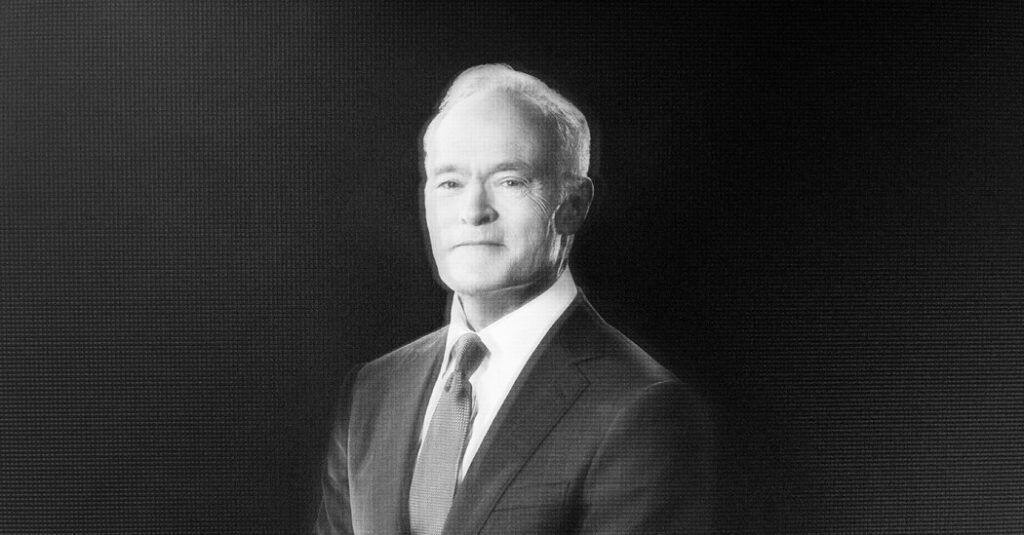
It’s hard to overstate the impact of “60 Minutes” on journalism. It’s the most-watched television-news program in America. Since its debut on CBS in 1968, it’s been the home of some of the most-storied broadcast journalists, from Mike Wallace and Ed Bradley to Lesley Stahl, Anderson Cooper and, until this past week, Scott Pelley.
Pelley, who was at the network for 37 years, including as White House correspondent, anchor of the “CBS Evening News” and “60 Minutes” correspondent, was fired after an explosive series of events and much turmoil over the past few years at CBS. These events include a controversial financial settlement with President Trump over a “60 Minutes” segment; the sale of the network to David Ellison; and the appointment of Bari Weiss, a former New York Times Opinion staffer and founder of The Free Press with no television-news experience, to lead CBS News.
Pelley’s firing came after Weiss dismissed several of his colleagues and hired a new “60 Minutes” boss, Nick Bilton, whom Pelley then clashed with in a staff meeting. Pelley, along with a number of other “60 Minutes” correspondents who were fired, have now accused Weiss of editorial interference and bias, charges that CBS News and Weiss deny.
In his first sit-down interview since he was fired, Pelley told me about the specific incident he viewed as interference, about his experiences at CBS News over the past weeks and months, and about what he hopes will come of this very tumultuous time at the network where he spent most of his career.
Subscribe: Apple Podcasts | Spotify | YouTube | Amazon | iHeart
A few days before your firing, several high-profile “60 Minutes” correspondents and leaders were fired. Leading up to that, there’d been a lot of reporting about changes that were coming to the show. Was that the sort of change you were expecting? No one saw the Black Thursday massacre coming. This is our entire senior staff. Tanya Simon, our boss, she’s the first woman ever to be executive producer of “60 Minutes.” And she concluded this season with a growth in our audience of nine percent, which is unheard-of in broadcast television, and a growth of our online presence of 190 percent. Last season, we had 2.5 billion views. That’s a third of humanity! So we’re riding high.
The night before, Tanya and I were at the Emmy Awards, and we won two Emmys. Within hours, all of those people have been wiped out, and one-third of our correspondents have been fired. At the same moment, we are informed of our new executive producer. His name is Nick Bilton. I’m sure he must be a wonderful man, but no one had ever heard of him. He has zero experience in television news and no experience in management. So imagine how we feel when someone like that comes into a shop like “60 Minutes.”
Explain to me exactly how you felt. Shock, dismay, impossible to believe, searching desperately for an explanation, knowing that an explanation would be forthcoming and then not seeing that. No executive at CBS News, our editor in chief, Bari Weiss, coming over to explain, to talk with us, to sit with us. That’s a family at “60 Minutes.” My colleagues and I have worked together 10, 20, 30 years. We travel together. We dine together. We go into literal combat together. My former boss and former producer Bill Owens saved my life in a firefight in Iraq. So, these bonds are pretty tight, and when somebody wipes out, murders, a large number of your family members, people are desperate for some explanation, and as you and I sit here today, there still has been none.
CBS leadership says that they tried to get in touch with you to talk about all of those changes before Bilton’s first day and you didn’t speak to them. Why not? I’m almost 69 years old, and if I’ve learned one thing in life, it is not to reflexively react when you feel that way. I thought, I’m going to give it a day. I’m too emotionally wrought up. I am going to say the wrong thing. I am not going to hear what they have to say. This isn’t the moment. So we got through the weekend, and I learned that Nick Bilton was going to speak to the “60 Minutes” staff that next Monday morning. My wife and I had a hiking trip in the Canadian Rockies planned, and I wasn’t going to be able to be at the meeting and she and I talked about it, realized that this was an existential moment for “60 Minutes” and canceled the vacation so I could be there. That was the first time that I had an opportunity to meet Nick Bilton.
At that meeting, you spoke up very forcefully. You asked him why he’d taken the job “knowing that you will never be welcome here.” Why did you decide to have that first interaction with your new boss in public and not behind closed doors? It was behind closed doors. I was with my family in a closed room. None of this was meant to be public. Imagine I’m walking into this room with these people who have devoted their lives to “60 Minutes.” They have not received any kind of explanation. They are waiting for Bari Weiss to walk in the room in the hope that she’s going to explain why this tragedy has occurred and why it was so necessary. I’m waiting to see who comes in and it’s Nick Bilton and one of Bari’s deputies. No Bari. People are a little shocked by this. As we’re standing in there, Nick makes his way to the front of the room and does something absolutely jaw-dropping to me. He pulls out his phone and begins reading a statement off his phone in a room full of 50 heartbroken people. The callousness, the tone deafness of that, you could hear the groan in the room. They put out a big spread of bagels like we were all going to feel better. And also, if I can give you a little bit of context.
Please. What happened a couple of days before the meeting was so critical. Nick Bilton wrote an email to the staff, introducing himself. And it was so insulting. He told us that it wasn’t 1968 anymore, and he helpfully noted that gasoline doesn’t cost 32 cents anymore, suggested that we had all been frozen in amber in 1968 when the program first went on the air, and that nothing had improved. He said in his email that it was “strange” that “60 Minutes” is only on the air at 7 o’clock Eastern time on Sunday once a week, when we’ve been on the air 24-7 globally, online, for well over a decade. It betrayed the fact that Nick Bilton didn’t know anything about us, didn’t know anything about our culture, and yet was being imposed on us as our new leader.
Why did you feel that you were the person that needed to get the answers at that meeting? First of all, our entire senior staff had been wiped out. They’re not there. I looked around the room. I’m the only correspondent there, which surprised me very much. I learned that my colleagues were out shooting stories, as they should be in the month of June, but I’m the only correspondent. And I looked at my friends and colleagues in the room and realized I was the senior person. So when I saw Nick Bilton’s email and then saw him reading to my brokenhearted people off his phone, I felt that somebody had to stand up not just for the broadcast but for the people. There are people in that room who go to war zones when they are pregnant. [Tears up] Newsrooms are sort of like the military or the police or the beautiful people at the FDNY down the street. It is a life-threatening job in many instances. And to have people running CBS News, who don’t know that, have never felt that, and don’t understand it, is a tragedy.
You know, Bari Weiss came into a job with a mandate to evolve and modernize CBS News, to reinvent legacy media. In that meeting, you said Weiss was “murdering ‘60 Minutes,’” language that you’ve used here. Can you explain what you mean? It was the wholesale nature of it. Senior staff wiped out after a triumphal year. One of the things Nick Bilton said in that ill-fated email to the staff was that he was excited — I’m paraphrasing here — to tell the staff about the new crop of correspondents. And when I saw that, I thought, “They’re going to fire all of us, eventually.” So that’s why I use these admittedly, for a journalist, hyperbolic terms. They capture the scale of what happened.
You then have a meeting with CBS leadership after this very contentious interaction [with Bilton]. Did you go in expecting to be fired? Oh gosh, furthest thing from my mind. It hadn’t occurred to me. The president of CBS News, Tom Cibrowski, sent me a note and said, can you come by and talk to us? And I said, absolutely. I scheduled about an hour on my calendar for the meeting. I didn’t know who was going to be there.
It really didn’t occur to you that you could be fired after so many of your colleagues had been let go, and after you’d had this very contentious interaction with your new boss? Some reporter I turned out to be. I just didn’t connect the dots. I mean, was this meeting [with Bilton] contentious? Yes, but “60 Minutes” is known for two things: a ticking stopwatch and hard questions.
There was a screening once with Mike Wallace, and Mike and the executive producer and founder of “60 Minutes,” Don Hewitt, got into a big argument about a script. Wallace jumps up in the middle of the screening, throws his script up in the air and yells at Don, “Well then you write the effing thing!” One of those pieces of paper comes down and slices an associate producer across the face. He’s bleeding now. He’s got a paper cut on his face. That was about a story. The meeting that I was in was about whether “60 Minutes” was going to even survive.
So, you walk in and what was the energy of the room? Hostile, dismissive. Before I can take my seat, Tom Cibrowski said, this is a firing offense. So I sit down, like, OK, let’s talk about it. Tom accuses me of physically abusing Nick Bilton. This is a lie. I didn’t come within 10 feet of Nick Bilton. In my life, I have never put my hands on anyone in anger. And when he was caught in that lie, he said, well, OK, I take that back. And I said, great.
So I’m thinking that the meeting’s going to carry on. We’re going to have a long conversation. Very quickly after the meeting began, Tom Cibrowski said, this conversation is over. I was stunned. I didn’t have a 60-minute stopwatch in that room. I don’t know how long it lasted really, but I think it was about 10 minutes. Cibrowski tells me, you’ll have our answer in a few minutes. I went over to my office, and much to my surprise, all of my guys on my team were still there. They wanted to know what happened in the meeting. What was that all about? Did they explain why our people were fired? And I sat down in my office, it has a big plate glass window that looks out on the newsroom, and there were a whole bunch of people standing out there. I didn’t think anything of it. I’m waiting to find out what my fate is. I explained to my team, “I think I just got fired, but they haven’t told me that.” And then I look up and all those people are still out there, and then it hits me. This is a vigil. Four hours go by, and I go outside and said, “I’m leaving.” I packed up and left just so those people would go home. And not long after that, the email came through and said that I’d been fired.
I want to take a step back because this didn’t happen in a vacuum. The saga at CBS News began when David Ellison, the son of Oracle billionaire Larry Ellison, took over CBS as part of his purchase of Paramount. There was a lot of turmoil around that sale. The longtime previous owner of Paramount and CBS, Shari Redstone, told my New York Times colleague that she sold the company to Ellison in part because, after Hamas’s attack on Israel on October 7, she wanted to devote herself to causes around Israel. I’m sure there were other reasons as well. Did you ever speak to Ms. Redstone about the sale, and how did you feel about it? I didn’t speak to Shari Redstone about the sale. I felt the sale was very necessary. The company was in financial trouble. It wasn’t clear what our path forward was going to be. Mr. Ellison came in with a lot of money, a young man of vision, and I thought this was going to be very good for all of us.
The very last thing that the previous ownership did was pay a multi-million-dollar bribe to the president to settle this frivolous, ridiculous lawsuit. And very shortly after that, somehow the Trump administration approved the sale. That lawsuit against “60 Minutes” had caused a great deal of concern. Paying the bribe broke our hearts. No lawyer thought that was necessary, but they did it to get the sale through. [At the time, Paramount denied any link between the settlement payment and the deal being approved.] At that point, my colleagues and I thought, great, that’s behind us. We have bright new leadership with financial resources. We’re in better shape than we were before. That was the theory.
Ellison then hires Bari Weiss to run CBS News. Weiss is a former opinion writer at The New York Times who left to start her own publication after claiming bias in the Times Opinion section. I never worked with her, for the record. The Free Press, which she launched, is generally pro-Israel and bills itself as pushing against what it sees as the mainstream media. What did you make of her appointment? I was not familiar with her name, so I did some research and discovered those things that you just outlined. What concerned me was that she had zero television experience and had never managed a large global operation like CBS News. Those were red flags to me, but I thought, David Ellison thinks she’s the right person for the job. We are absolutely going to welcome her, listen to her, and give her the benefit of the doubt.
When Bari comes in, she has a meeting with senior “60 Minutes” staffers, and in that meeting she asked, “Why does the country think you’re biased?” I wasn’t there, but that is what I’ve been told by my colleagues, and they were shocked.
What was the feeling about that opening salvo? “Uh-oh.” She didn’t offer any kind of a metric. Do you have a poll? Is there market research? What are you talking about? We felt that she was making statements that she couldn’t back up and was coming into the news division with hardened preconceived notions that didn’t seem to be thought through.
You’ve now accused Weiss of injecting “falsehoods and bias” into at least one of your politically sensitive stories. What did she specifically ask for? What story? That’s February, and my team and I are doing a story about the protests in Minneapolis against the ICE crackdown there. We’ve interviewed Senator Rand Paul, Republican, because he’s going to hold hearings into this, and the fact that a Republican was going to do that was quite newsworthy. So, we interviewed Senator Paul and then built out a story about what had happened — the killing of Renee Good, the killing of Alex Pretti, the protests. I felt it was very important to identify that the protesters themselves were being very aggressive and that they were half of these confrontations, and so I instructed my producers to find images in which we see the protesters acting aggressively. We found a picture of a protester chest-bumping an officer. We found a picture of an officer being hit in the head with a snowball. We culled together a lot of video of protesters screaming in the faces of officers because we were going to talk about the killing of Pretti and the killing of Good, and it seemed to me important to tell the audience about the entire context. I thought we’d done a really good job with this. We also included a picture of Alex Pretti before he was killed kicking out a taillight on a police car and made a point of saying, this is Alex Pretti and this is what he did.
So, the story goes through screenings. It’s very well received. There are notes as always and we do rewrites as always. But this is on a very tight deadline. It’s Sunday; we’re going on the air that night. And in the case of stories that are, as we say, crashing, our deadline on Sunday is noon. So, we work on all of these things. We get the piece approved by everyone. And about four hours after our deadline, Bari Weiss sends an email to my boss, Tanya Simon. Two of the things in the email include, can we make the protesters look more violent? Now, I’m paraphrasing. I don’t have the quote, but that’s what was communicated to me. And the other thing, Renee Good’s car. You need to describe her as driving toward the officer.
This is not what you see on the video. On the video, you see the officer standing slightly off the front of the car. And you clearly see Ms. Good’s wheels turned completely as far as they will go, away from the officer. But he shoots her in the head, kills her, and says something about her that I can’t repeat in polite company.
We have gone out of our way in our plan from the very beginning to show the protesters for the responsibility that they had. We had already scrubbed the video archives, looking for those scenes. Somehow that wasn’t enough for Ms. Weiss. The video showed that the officer wasn’t standing in front of the car and she wasn’t driving toward him, but that’s what the president said about that, and that’s the way she wanted it described.
Did you do as she asked? I asked my producers, “Did we leave anything out that’s important? Did we make a mistake here? I don’t think so, but go back and look.” And then I sat down with a video editor, and I went over the video of the Renee Good killing over and over again, and realized that the event was not as the president said and not the way Bari Weiss remembered it. And it’s late. Our deadline was noon. It’s now almost 5 o’clock. That’s dangerous as hell. So I decided that I wouldn’t do those things. I wasn’t going to get in a debate about it. I wasn’t going to call Bari Weiss about it. I was just going to refuse to make those changes.
Did you change any language in the broadcast? Anything? Not that I recall based on her notes, but as you probably are aware, when you’re doing a story, especially on deadline, a lot of things happen, there’s a lot of input, and you’re just scrambling to save everybody’s skin because you’re going to have a crash, which is what happened.
Next day I didn’t hear anything. Nobody called, nobody said anything. It occurred to me that maybe Bari Weiss didn’t see the broadcast and didn’t realize that those changes hadn’t been made. But that’s how that happened. There was a thumb on the scale for the president’s version of events that I felt was a level of political influence that I had never seen in 37 years at CBS News. [When asked about this incident, a CBS News spokesperson wrote, “In an email, Bari made four points in the course of editorial back-and-forth. They had no political motivation and were proposed solely to make the piece as strong, fair, and accurate as possible. As is frequently the case in any newsroom that operates with collaboration, not everything she raised made it into the final piece.”]
Could she not have been trying to be fair to the administration at a moment of very high tension? She could have been trying to be fair to the administration, except I felt that the story was abundantly fair to administration and to the ICE officers and to border patrol officers who were caught in that moment.
Is it possible to see this as the system working? She had notes, you felt they didn’t make sense to take, the piece ran, and there was no retaliation. Well, it was the interference that’s a problem, especially in a story that’s been approved by the top editors. And the bigger problem, Lulu, frankly, is not any kind of political influence. The problem was the incompetence. You don’t break a deadline. That episode came within 19 minutes of not making it to air. The entire hour of “60 Minutes”! It was the night of the Grammys. “60 Minutes” was the lead-in to the Grammys, and we almost didn’t have a broadcast. I pledged to myself that no matter what Bari Weiss wanted to do in a story, I would never break the deadline again because we put the entire network in jeopardy.
Why did you think she was asking for these things? I need to be a little bit careful here because I don’t want to be hyperbolic. My impression at the time was that she was putting a thumb on the scale on behalf of the administration. Constantly looking out for the views of the president. We’re reporting those views. There’s nothing wrong with reporting those views, but it was never enough. [A CBS News spokesperson disputes this characterization, writing, “There is no credible argument to suggest Ms. Weiss was ‘putting a thumb on the scale on behalf of the administration’ in any instance over the past seven months.”]
Cecilia Vega, who was recently fired, also alleged interference after she was let go. Sharyn Alfonsi as well, and you are now doing the same. CBS has denied any bias or interference, saying in a recent statement that changes and disputes were “the normal back and forth between editor and correspondent that happens in every newsroom.” A more generous interpretation of Weiss’s tenure might be that her missteps have been due to a lack of experience. Could inexperience be the real problem? I think inexperience is the larger part of the problem. The most difficult thing for the staff is trying to make up for all of these missteps in terms of our production and the technical aspects of television. It’s been enormously stressful.
Another high-profile “60 Minutes” host, Anderson Cooper, declined to renew his contract this year. And at the end of his final show, he went on air and said, “I hope ‘60 Minutes’ remains ‘60 Minutes.’” That was seen as a swipe at Bari Weiss. Did you talk to Anderson about why he did not renew his contact and his reasons for leaving? I did not.
How did you receive that news? Correspondents don’t resign from “60 Minutes.” It’s the greatest job in the world. There is nothing else to aspire to. So, if a person of Anderson Cooper’s stature decides that he has to leave the broadcast, that’s an indication that he has found his role there untenable.
It’s been reported that Bari Weiss was upset that Anderson Cooper’s comments had aired in that way. That’s my understanding.
Do you think that was part of the reason executive producer Tanya Simon was let go? Yes. My understanding from people directly involved in that interaction is that Bari Weiss was quite livid that Anderson Cooper was allowed to say those things and that she, Bari, was not consulted beforehand, which in our normal course of business would not have been done anyway. I believe that was part of the reason Tanya was let go. But she wasn’t let go for cause. She was let go to create a space for the new person, Nick Bilton, to come in.
Tanya was completely blindsided by this. She was told that she was coming into a meeting to discuss the past season and the next season. She walks in; she sits down. And Tom starts the meeting with, the nature of this meeting has changed. We’re letting you go. And told her she was fired and had to get out of her office by 5 o’clock.
Can I give you a little bit of background? The Simon family is legendary at CBS News. Her father was a famous Vietnam correspondent and then Bob Simon covered every single war, everywhere in the world throughout his entire career. I was with him in Kuwait during the Gulf War in 1990. We would stand on the roof of the hotel and watch the missiles come in. He taught me how to be a war correspondent. And then Tanya Simon comes in. She’s at the broadcast 30 years. There is no respect for that. Get out of the office by five o’clock? What company in the world treats their precious people that way? [Tears up] Tanya Simon spent her whole childhood waiting for the call that her father was dead, never knowing if she would ever see him again. Her whole childhood. Get out by 5 o’clock. Make of that what you will.
I can hear how much this has hurt you. Yes, it’s like your spouse being murdered. I don’t care about me. It’s not about me. I am not emotional about this because I have lost this job. I’ve done it for a long time. I’ve had the greatest experiences. But the people I leave behind, treated in this way? That breaks my heart, and it’s going to take me a long time to get over it.
One of the arguments that Bari Weiss has made about “60 Minutes” and CBS News is that they need to be brought into the modern era. Nick Bilton also said in that staff meeting with you that “broadcast is an ice cube that is melting.” Do you think they have a point, even if “60 Minutes” is reaching a huge audience now? Does its metabolism, the kinds of correspondents that it has have to change to reach a younger audience that interacts with media in a completely different way? Of course we have to reach out to a younger and younger audience, but their argument about joining the internet age is just disingenuous. It’s almost as if Bari Weiss and Nick Bilton were sealed in a time capsule in 1990, and it just cracked open. They’ve just discovered the internet, and they’re running around telling everybody how important it is. At CBS News, yeah, join the fight. We started our first “60 Minutes” online show, “60 Minutes Overtime,” in 2010. I shoot TikTok verticals, or I used to shoot TikTok verticals on every assignment. We’re there. We’re everywhere.
Nick Bilton sent a very conciliatory note to the staff this past week. At last.
He promised editorial independence. He praised some of your longtime colleagues, Lesley Stahl, Bill Whitaker, Jon Wertheim. And while we’ve been talking, those three released a statement that they are staying at “60 Minutes.” How does that make you feel? Same reason I was staying. I haven’t talked to them. I assume it’s the same reason. And we have had conversations before this about staying to maintain the principles of the broadcast. If we leave, we can’t help. There have been other times — when Anderson left, when others were fired — that we could have stormed into a meeting and quit, but those very distinguished correspondents and myself did have conversations about this and decided that we were better working on the inside, and that we could influence things for the better. And we did. And it was my intention to stay and do exactly that.
Do you think they can trust those assurances? No. I would venture to say that trust is broken.
Do you think Bari Weiss needs to be removed? Oh, gosh, yes. Look, she’s a lovely person. And her Free Press organization that she founded has been very successful. But television’s not her thing. This is like somebody walking up to me and saying, “There’s a 747, there are 400 people on it, we need you to fly it to Paris.” I’m going to decline because I don’t have a clue. And it would have been so much better if Bari Weiss had been offered this job and said, “Oh, that’s not for me, I don’t know how to do that.”
President Trump reacted to your being fired. Did he?
He went on a podcast and called you a stiff. I’m surprised that the president of the United States would bother to notice, but please tell me. I’m not aware of this.
He said you were part of this gang of “stupid, crooked people that don’t care about your country.” Stupid? I can take that. Stiff? Yeah, probably. Don’t care about the country? I’ve never worn the uniform. But I’ve been in combat for this country, in Afghanistan and Iraq, Kuwait. I’ve been shot at, spent nights in foxholes filling up with water in the desert. I’m not aware that the president of the United States has ever done any of those things for his country. Please correct me if I’m wrong. You become a journalist because you love the First Amendment. You become a journalist because you love the country. And while all the other descriptions that the president used about me might be applicable, not that one. [Tears up] There is no democracy without journalism. It can’t be done. That is why I am a journalist.
Last few questions. Fox News is going to just run the parts where I’m crying and say I’m a lunatic. [Laughs]
Scott, you joined CBS as a reporter in 1989. As I was preparing for this interview, I was thinking about how the story of modern CBS is the story of your own career, too. When you look back, what do you hope your departure does? What do you hope will happen now? My hope is that the leadership of Paramount will say to themselves, this isn’t working. We have broadcasts that almost don’t get on the air. We have respected journalists saying that there is a thumb on the scale for one political party over another. We have a broadcast that is among the most important in America. The most successful in the history of all television. It was doing great, so why are we making these changes? We need adult supervision and at the moment we don’t have it. We have people who’ve been installed in these jobs who through no fault of their own have no experience in television. They don’t know what they’re doing. And there’s a subtle political bias that I’ve never seen at “60 Minutes” before, or at CBS News before. So that is my hope: a return to sanity. We can save this. It’s possible to land this plane. But right now, CBS News is on fire.
This interview has been edited and condensed. Listen to and follow “The Interview” on Apple Podcasts, Spotify, YouTube, iHeartRadio or Amazon Music. Follow us on Instagram and TikTok.
Source photograph for photo illustration above: Michele Crowe/CBS News, via Getty Images
Lulu Garcia-Navarro is a writer and co-host of The Interview, a series focused on interviewing the world’s most fascinating people.
The post Scott Pelley on the Bari Weiss Era and His Last Days at ‘60 Minutes’ appeared first on New York Times.