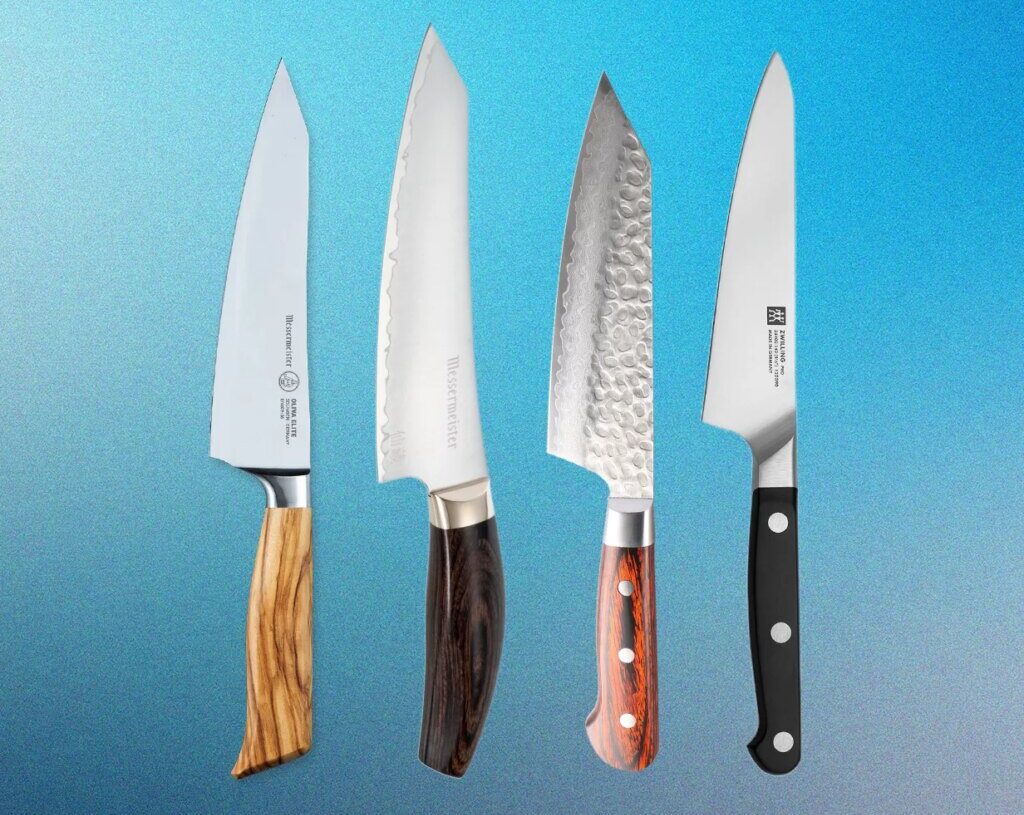
Kitchen knives are so personal. You can do almost everything you need in a kitchen with a chef’s knife, paring knife, and a bread knife. But the more time you spend in the kitchen, the more you develop preferences, and soon it becomes a bit of an n+1 thing, and there you are, pondering a cleaver.
There’s a lot of space between most chef’s knives and paring knives. What’s in that space—often called petty, prep, or utility knives—is often pretty weird. Consider the knives that you never use from a set and you’ll likely think of the short, serrated knives or the petty knives with no room for your fingers between the handle and the cutting board.
What if you’re a smaller person, or have smaller hands, or just think a smaller but still high-functioning all-around knife might be your jam? What if the right version of those midsize knives turned out to be really useful?
To my delight, the good ones are. With equal parts luck, research, and trial and error, I found both new and existing-but-flying-under-the-radar examples of midsize knives that were wonderfully functional, in part because of their size. The right ones are incredibly useful and the great ones are prep monsters.
Recently, I had seen signs at my favorite trade show that I might be on to something. At the Messermeister knives booth, a midsize blade stood out thanks to an olive wood handle and intriguing geometry. It felt balanced and comfortable with room for hands of any size to move back on the handle, or further forward in a pinch grip. Importantly, there was plenty of clearance, so knuckles don’t hit the cutting board at the bottom of the stroke. Keeping my eyes open, I saw more potential from Cangshan, Tarrerias-Bonjean, and Zwilling. This got my mind going. I remembered the Wusthöf Classic chef’s knife that comes in a 5-inch size. Similarly, I hoped I could find a short version of a nimble Japanese knife called a kiritsuke and put in a call to the good people at Seisuke Knife in Portland, Oregon.
Soon, I had a pile of beautiful knives on my cutting board. I tucked my own knives into my knife roll for storage and, for weeks, used the new, smaller specimens as my daily drivers.
The more I used them, the more I understood what I wanted. First, I threw their unhelpful names out the window: petty, utility, prep … whatever. Next, I decided my lovely Tadafusa santoku, the shortest of my longer knives, would be the longest I’d go at roughly 6.5 inches. Having these knives “do it all” felt like a stretch, but they definitely needed to be able to do a lot. I was willing to work with the knife to find its strengths, but preferred something that could handle different cutting styles and all kinds of food. They had to be prep monsters.
I pulled out some new cookbooks and recipes I’m excited about, starting with Down South + East by Ron Tsu with Hugh Amano, and made their stir-fried collard greens with bacon and soy-braised chicken, swapping knives in and out as I went. This practice, it turns out, drags dinner prep to a near halt, but it told me a lot about the knives.
A few blades got the heave-ho right away. They crushed the food as much as they were cutting or slicing, a likely combo between a bad edge and a thick blade. (Think of how a dull knife mushes an onion into translucence beneath the blade before beginning to cut.) Others, like a rough-mannered Henckels simply weren’t that comfortable.
Yet some were quick standouts. Messermeister’s Oliva Elite presented as a nice workhorse, mincing garlic well enough, capably slicing stacks of raw bacon into matchsticks, and making parsley-chopping fun as the swoop of the blade makes for a wonderful rocking motion. It stemmed the collards easily and later made surprisingly quick work of chopping up the stems to make Tamar Adler’s garlicky stem and core pesto from The Everlasting Meal Cookbook. The Zwilling Pro 5.5 Inch Prep Knife performed admirably thanks in part to an angled bolster, the metal collar where the handle meets the blade. Using pinch grip, the handle nestled neatly into my palm.
The most notable knife for the moment was the other Messermeister, the six-inch Kawashima utility knife. With a smaller blade and gherkin-shaped pakkawood handle, it outperformed the other knives by mixing precision, comfort, and capability. It was great at garlic, but thanks to a ripping edge and thin blade, it easily cut through stuff for which you’d normally grab a bigger knife. Carrots bent to its will. Potatoes in a lemon potato recipe from Gus Constantellis’ My Greek Mom’s Recipes were dispatched by rocking or with a push cut. And despite the small size, it did great separating the raw chicken quarters into drumstick and thigh. It was impressively capable, doing tasks for which I’d normally grab a larger or smaller knife.
I was curious, though, about the difference between the two Messermeister knives, since they are both sharpened to a fine 15-degree angle, yet the made-in-Japan Kawashima feels notably sharper. This comes down to factors like the type of steel each is made with, how it’s sharpened, and even the form of the edge. The Kawashima is made of a harder steel, which can make a blade more brittle, but allows you to put and hold a precise edge on there. The Oliva, made in Germany, uses a German steel which is softer and more forgiving.
On the questionable side, the Wusthöf struggled. The 5-inch blade is a scaled down version of the company’s classic chef’s knife, but the rocking motion that should be the bread and butter of this style wasn’t there. The belly of the knife (the curve toward the front of the blade) felt right, but every stroke ended with a thud at the back of the blade.
The more I used these knives, the more their personalities came through. As I made Ham El-Waylly’s zucchini poached in yogurt from his excellent new Hello, Home Cooking, it was a good reminder of how helpful test-driving a knife is before committing to it. Some of their traits will work better for some people than others. Peoples’ physiology, their height, the size of their hand, their strength, and other factors play into it.
In a fun twist, I thought the field had been whittled to four or five knives when a knife from Seisuke in Portland, Oregon, made a last-minute entry.
I unboxed the 160-millimeter kiritsuke made by Sakai Takayuki and boy howdy, I immediately knew this was a winner. A kiritsuke is a style similar to a santoku, but seen from the side, the tip comes to a notably sharper angle. This makes the tip of the blade (seen from above) narrower, giving it more maneuverability and making cutting easier. This knife also had a wonderful edge with a sweep that made for excellent rocking and push cutting. With length, maneuverability, feel, and knuckle clearance, it checked all the boxes.
Now, it was time to bring in the chicken. I’d recently seen a Chris Young video about using Costco rotisserie chicken to make a nice stock, which struck me as a fun excuse to chop up a bunch of birds and their accompanying stock vegetables, so I went to Costco and got six chickens.
First, I sliced carrots into coins. I used a rocking cut at the skinny end and a push cut where it got thicker. Here the Wusthöf rewarded me for keeping it around as it’s really made for something like this. Rock or push, the Messermeister Kawashima excelled like always, which also highlighted a slight extra effort needed by the Oliva. The Zwilling skated through the round nicely, and the Takayuki kiritsuke worked so well it made me laugh out loud.
Quartering then slicing onions was eye opening. This test turned out to be one of the best at highlighting strengths and weaknesses in sharpness, blade design, and blade length. The Wusthöf struggled with a tendency to wedge more than slice; I could feel it veer off course on the way down through the onion and it started squishing more than cutting in the thickest portion. Having had bladesmith Bob Tate sharpen my own 9-inch Wusthöf chef’s knife with wonderful, lasting results, it’s clear the company needs to put a bit more effort in here. (Tate is retiring, but as luck would have it, Seisuke is launching a knife-sharpening service.) The Oliva and Zwilling also skied around on their way through the onion instead of slicing through it neatly. The sharp and narrow Messermeister Kawashima had no trouble here, and the kiritsuke, slightly larger and heavier and wicked sharp, gave me the giggles again.
For the grand finale, I went to Costco, bought six rotisserie chickens–one per knife–and carved each one. Chicken carving is a sort of art form where you follow the line of the muscles around the bird, delicately coaxing them away from the bone, and occasionally applying a bit of leverage or force. There’s interplay between your hands and the knife, and a good feeling when it comes out well.
Normally, I carve birds with both a chef’s knife and paring knife, and I wondered if this style of knife could be perfect for the job. I started with the Wusthöf, and it struggled at yet another job where I felt it should have excelled, leaving lots of meat on the carcass. Efficiently breaking down the bird, the Messermeister Kawashima did well, not flinching when cutting the leg quarters into drumstick and thigh. The Takayuki kiritsuke did very well, though the polished handle felt just a little slippery at one point and realistically, this is probably a nicer knife than I’d normally use for a messy job like this.
It was a perfect job, though, for the Oliva, where the knife became an extension of my hand. With the Wusthöf, I wondered if I was barking up the wrong tree with this chicken idea. But choking up on the Oliva’s handle for some precise work, or making a longer slice, it felt like the perfect chicken chopper.
Now, friends, get ready for some brain scrambling as we conclude and bring price into play. The Zwilling and Wusthöf are both around $120, so I’d suggest the Zwilling for most people as the “budget” model. While that sounds like a lot, cheaper models I’ve seen so far for this style of knife don’t merit the addition to your collection. The Oliva is $180. The Messermeister Kawashima is $200, and the Takayuki kiritsuke is $220. If you’re an accomplished home or pro cook, the two more expensive ones will likely suit your needs best. The Oliva is excellent if you’re a home cook who’s looking for your first nice do-it-all knife or want something modern and really good looking. Compared to the competition, the Oliva feels a little overpriced, but if it sported a better edge or cost $150, I’d say this would be the best knife for most people. Maybe watch for a sale then pounce?
Really, this underscores how personal knives are and how helpful it is to go to a cookware store or a knife shop and try these puppies out. Use my criteria and add some of your own. Practice on a potato. Buzz your way through a pile of parsley.
I went into this story wondering if I was on to something and came out knowing these are great options for people who, for whatever reason, want something shorter than a traditional chef’s knife and longer than a pairing knife, while doing much of the work of both. I’m happy to report that these little monsters exist.
The post You May Not Need a Giant Chef’s Knife When a Midsize Knife Does the Trick appeared first on Wired.