A tech investor who shaped the Trump administration’s pro-industry artificial intelligence policies will depart the White House at the end of the month.
Sriram Krishnan has informed administration officials that he plans to leave his post as the White House senior policy adviser for AI to start an outside institution that will influence technology policy, according to a person familiar with his plans, who spoke on the condition of anonymity to describe the private discussions. Planning for the new initiative is in nascent stages, but it is intended to allow the tech leader to continue to play an active role in the Trump administration’s response to the development of AI.
Krishnan was an architect of the administration’s “AI Action Plan,” which provided a blueprint to roll back regulation of the emerging technology and promote the build-out of data centers across the country. He also was among Trump’s tech advisers who crafted an executive order limiting states’ ability to regulate AI.
The efforts to advance a light-touch approach to AI often put Krishnan and his close ally David Sacks at odds with Trump’s populist supporters. Trump’s advisers from Silicon Valley have sought to promote policies that would accelerate development of AI, at a time when other Trump allies are increasingly alarmed about the technology’s potential to displace American workers and are advocating greater regulation.
Trump has recognized AI as a powerful economic force, especially as investor optimism about rapid advances in AI drives record stock market highs. He has frequently publicly praised Krishnan for his role in promoting the technology.
People “ask me who the hell he is,” Trump said during a holiday party at the White House, according to a video shared on social media. “And yet without him things, certainly on AI, would not function well.”
Top administration officials, including Chief of Staff Susie Wiles and Treasury Secretary Scott Bessent, have grown increasingly concerned about Anthropic’s Mythos and other advanced AI models. The models have shown themselves adept at finding security flaws in software, creating concerns that adversaries could use them to launch cyberattacks on government agencies, banks and critical infrastructure.
Those advances prompted some in the administration to reevaluate the approach that Krishnan and other advisers with Silicon Valley ties have promoted. This month, Trump signed an executive order that would allow the government to review the powerful new artificial intelligence models before they are released to the public.
The push and pull ahead of the order’s signing highlighted the continued influence of some prominent Silicon Valley leaders who have left posts in the Trump administration. Outside of the government, they do not have the same ethical constraints to prevent conflicts of interest.
Sacks announced in March that his tenure as the White House AI and crypto czar had ended. But he persuaded Trump to delay signing the executive order, raising concerns that the voluntary system it envisioned could lead to a de facto mandatory regime where companies would need to seek a green light from the government to release AI systems.
Trump ultimately signed the order weeks later, adopting a compromise dictating that the government would receive access up to 30 days before a system is released, rather than 90.
Elon Musk also continues to play an active role in shaping the administration’s policies, speaking to the president by phone about the AI executive order and participating in Trump’s May trip to China. He left his formal role as a special government employee a year ago, and he was briefly alienated from the president following a public fight.
Before entering the government, Krishnan was a general partner at the venture capital firm Andreessen Horowitz and worked at Facebook and Twitter. He is a close ally of Musk and advised the tech billionaire on his 2022 takeover of Twitter, which was renamed X.
Trump’s 2024 announcement that he had tapped Krishnan sparked a public feud between his tech advisers and right-wing influencers like Laura Loomer, who criticized the pick. Krishnan was born in India, and Loomer pointed to Krishnan’s previous support for removing some caps on green cards and easing the ability of skilled foreign workers to come to the United States.
That position was “in direct opposition” to Trump’s agenda, Loomer wrote.
Sacks, Musk and other tech leaders came to Krishnan’s defense online, but the episode prompted death threats against him.
Krishnan quickly became a visible player in the administration, traveling as part of the White House delegation to international summits in France and India and joining trips where Trump highlighted tech deals, including to the Middle East and Britain.
He also was involved in drafting a series of executive orders last summer that sought to facilitate exports of U.S. technologies, boost the build-out of data centers and target “woke” artificial intelligence. The latter order was an answer to Trump’s Silicon Valley supporters who alleged that companies had built tools and chatbots showing a liberal political bias. The order specifically barred federal agencies from procuring AI models that promote diversity, equity and inclusion, or DEI.
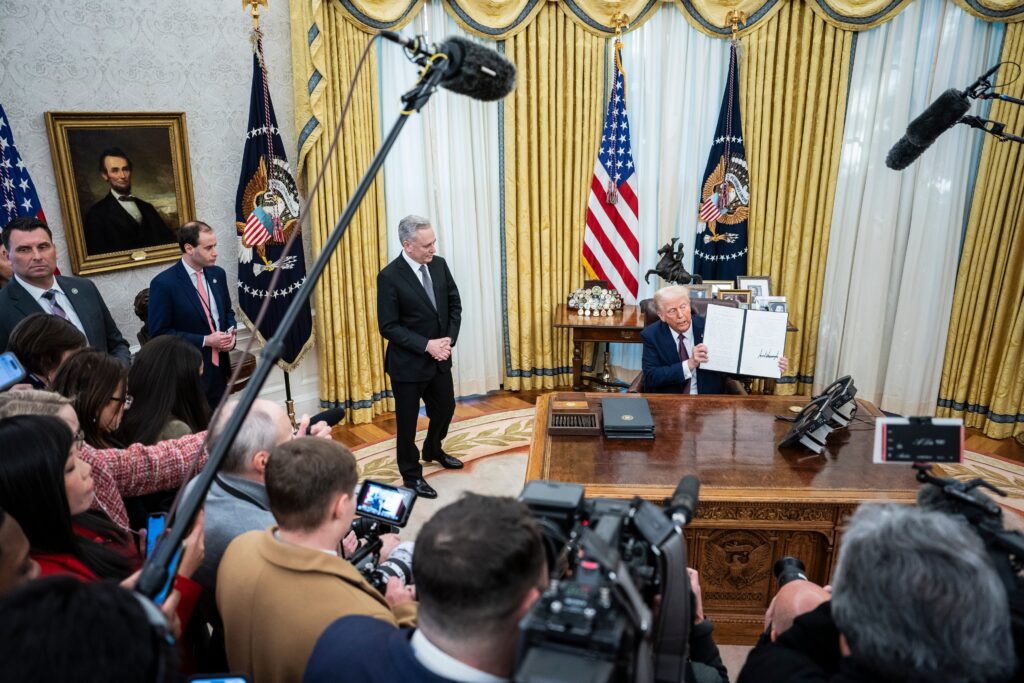
Krishnan also stood smiling behind the Resolute Desk as Trump signed an executive order that would limit states from regulating AI. A draft of the order had leaked and sparked a weeks-long debate, with prominent MAGA leaders arguing that it would hamstring states from passing laws that could protect children online and regulate the construction of data centers.
Ultimately the language was watered down to address those concerns, but the episode jump-started the administration’s work with Congress to pass legislation that would prevent a patchwork of new state AI laws from emerging, a longtime priority of companies worried about the costs of complying with different rules in each state.
When Trump signed the order, he handed the black Sharpie to Krishnan.
The post Top Trump artificial intelligence adviser to leave the White House appeared first on Washington Post.