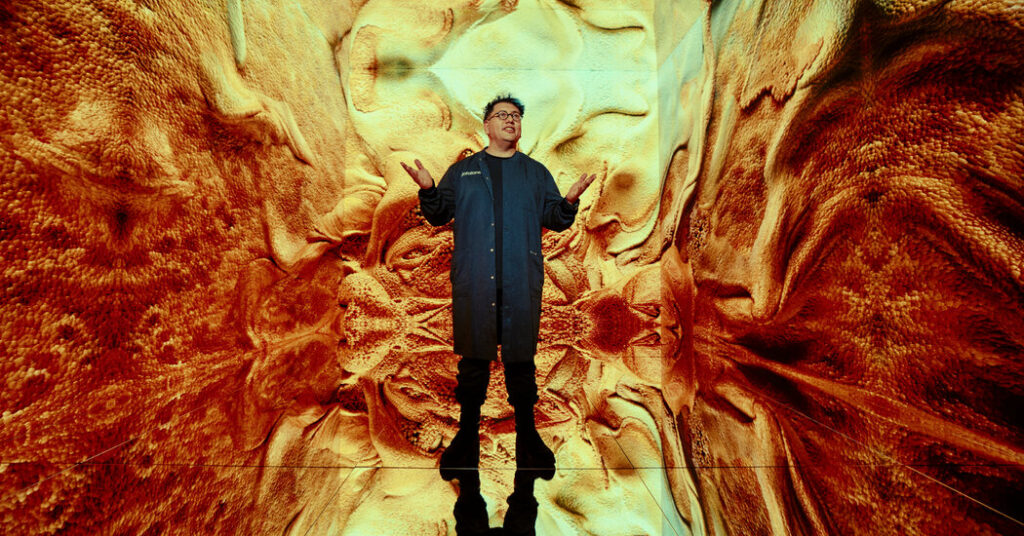
“This is crazy,” one of the students said under his breath.
“Really crazy,” the guy next to him muttered. “Crazy” being an extreme form of “awesome.”
We were in downtown Los Angeles at Dataland, the soon-to-open museum dedicated to art generated by artificial intelligence, and yeah, it was pretty crazy. The students, from an A.I. class at the University of California, Los Angeles, were getting an advance look at the invitation of their professor, the digital art star Refik Anadol.
Founded by Anadol and his wife, the painter Efsun Erkiliç, Dataland is a highly anticipated addition to the city’s burgeoning art/tech scene — and arguably the most ambitious museum for A.I. art to date. But for now Anadol’s 20-odd students and I were the only visitors in a vast, black-walled, 22-foot-high gallery awash in light, color and sound.
One moment, brightly colored photographs of flora and fauna from Brazil’s Amazon were sliding down the wall and across the floor; then, similar photos drifted toward us in 3-D before abruptly speeding up and slowing back down; strips and circles of white light appeared in intricate patterns; abstract streaks of green and yellow, red and yellow splashed across the room.
“Beautiful patterns from butterfly wings,” Anadol explained.
Butterfly wings? Well, yes. The A.I. that he and his studio have built for the new museum is transforming data about rainforest butterflies into the constantly moving imagery his students call “crazy.”
“Data is not just a number,” Anadol pointed out. It used to be, but with the information explosion that began in the 1960s, almost anything can be considered data — photographs, video, audio, even butterfly wings. Anadol’s data on butterflies — their origins, their life spans, their color patterns, their behavior — comes mainly from The Encyclopedia of Life, an online repository compiled by the American Museum of Natural History.
Using this information, Anadol said, “We were able to model algorithmically how butterflies move.” By feeding this into the extraordinarily sophisticated software that powers Dataland itself, and the artificial intelligence that makes it work — software that Anadol said is made up of more 10 million lines of code — he ends up with a hyperkinetic work of art.
Anadol started to make a name for himself a decade ago with much smaller, meditative displays of abstract patterns — waves of color surging across a screen, their eddies and swirls reflecting weather data and other phenomena. His breakthrough came in 2018 with a commission from the Los Angeles Philharmonic to project its newly digitized archives — every performance of every symphony, every trumpet, every oboe, every note the orchestra ever played — onto the billowing steel roof of its Frank Gehry-designed home, the Walt Disney Concert Hall.
No longer baby-faced at 40, but still irrepressibly bubbly and clad all in black, Anadol rarely stands still. His work has been all but ubiquitous on the museum circuit: the Guggenheim Museum Bilbao, the Serpentine Galleries in London, the Hammer Museum at U.C.L.A. and others in Spain, France, Belgium, South Korea and his native Turkey. But his first big museum commission, at the Museum of Modern Art in New York, left him enmeshed in controversy.
“Unsupervised,” his 2022-23 installation in MoMA’s lobby, was so popular that it was held over for nearly a year. Museum-goers, and their kids, were transfixed by the ever-changing display of fluid dynamics that played out on its 24-by-24-foot screen. In The Washington Post, Sebastian Smee declared it “an early masterpiece of A.I.-generated art.” Other critics were not so impressed. Writing in The New York Times, Travis Diehl concluded that it was “only a screen saver.” In New York magazine, Jerry Saltz dismissed it as “a massive techno lava lamp” that offered “psychedelic slush and bacterial blobs.”
If blobs aren’t your thing, Anadol can make an easy target. Yet “Unsupervised” has joined MoMA’s permanent collection, a gift from three of Anadol’s collectors.
And the brickbats have landed him — and Dataland — squarely in the center of the art world’s digital divide. On one side are several prominent critics; on the other, leading museum curators and directors. “There’s not going to be a future in which this kind of work is not happening,” Michael Govan, who heads the Los Angeles County Museum of Art, said in an interview. “It’s like Marcel Duchamp — if you know what’s behind it, you’re open to understanding it.” And if you don’t, you aren’t.
WITH “UNSUPERVISED,” IT may have been unclear whether Anadol had lost the plot or his critics just couldn’t find it. Dataland’s inaugural exhibition, “Machine Dreams: Rainforest,” puts the story front and center.
Five years ago, Erkiliç urged him to come with her to the Amazon for inspiration. After a trek that involved planes, cars and 10 hours in a motorized canoe, they ended up among the Yawanawá, an Indigenous people whose main contact with the outside world comes through Starlink and WhatsApp. Anadol and Erkiliç were welcomed with sacred music, sacred dance and ayahuasca, a sacred hallucinogenic brew. Soon Anadol was collaborating with his new friends on “Winds of the Yawanawá,” a data-driven artwork whose 2023 unveiling in Greece was accompanied by a sale of 1,000 NFTs to benefit the tribe.
“I was so inspired,” he recalled. “The Yawanawá people, how they live in the forest — I just can’t forget that feeling. But of course, we should not go to the rainforest every single day. The question was, can it come to us?”
In Dataland, some version of it does. The centerpiece of “Machine Dreams: Rainforest” is its Infinity Room — a large cube in which an eight-minute, A.I.-generated film plays continuously on the walls, reflected by a mirrored floor and ceiling. The film features a glass hummingbird and a “wisdom tree” that’s modeled on one in the Amazon.
“I was seeing this glass hummingbird in my dreams,” Anadol said. “I asked the chief, why am I seeing this bird? He said this is a special bird that can only sing in the forest when it’s flying to take the last breath of the wisdom tree.” In the Infinity Room, you zoom in on its eye and enter a fantastical dreamscape of flowers, pipes and data. “Algorithmic folklore,” Anadol called it. “Some form of new storytelling.”
Butterflies, birds, fireflies, every type of tree in the Amazon — the data that goes into “Machine Dreams: Rainforest” has been collected by Anadol himself in the field or by the team of artists, scientists, architects and engineers in his lab, Refik Anadol Studio, through partnerships with the Cornell Lab of Ornithology, the Natural History Museum in London and other such outfits.
A lot of data will be collected from the visitors themselves. Lidar sensors in the walls calibrate your movements. The electronic bracelet you get when you enter is a medical-grade device that monitors your heartbeat and galvanic skin response — are you excited, calm, enjoying yourself, getting goose bumps? — and feeds them into Dataland’s computer systems, allowing the displays to respond in real time. A.I., with human intervention, is used to generate Dataland’s scents, created in partnership with L’Oréal’s Luxe division, and its tastes — chocolates created with a local partner, Valerie Confections. “We can look at a Rothko and feel incredible emotions,” Anadol said, “but that artwork will never feel us back.” Unlike the artworks in Dataland.
The data that Dataland collects will be deleted unless you ask for it as you leave. Even so, this spurred an awkward memory. When I was a little kid, I used to wonder as I was watching TV if the TV was watching me back. Now that I’m all grown up, I don’t feel any better knowing that these days, it actually can. But in Anadol’s universe this is no paranoid fantasy; it’s a marvel, like much else in his eyes.
ONE MORNING AT REFIK ANADOL STUDIO, the font of all this gee-whizzery, Erkiliç and I went for a walk. The studio occupies most of a former window factory in the Frogtown district of Los Angeles, between the I-5 freeway and the concrete banks of the Los Angeles River. We took an asphalt path along the riverbank past a motley collection of buildings. Railroad tracks on the other side carried lumbering freight trains. A flyer on a telephone pole read, “MISSING: Have you seen my robot?” All around us we saw nature trampled. I could see the appeal of the rainforest.
If its opening exhibition was inspired by their trip to the Amazon, Dataland itself is a product of the pandemic. Normal life suddenly stopped. The hiking trails were closed. Even the beaches were closed. There was much chatter about the metaverse, a full-on digital world you could have access to through a virtual reality headset.
“But we were thinking, nobody’s going to ditch their physical life and move into the digital space,” Erkiliç said. “It’s not going to happen. We need to find something to bridge the digital and the physical. That’s how Dataland was born.”
Dataland is a for-profit institution. Anadol came up with the idea when they were on vacation in Mexico, after their initial rainforest trek. Then they thought up a name — but that was all they had. “I’m a realist,” Erkiliç said. “He’s a dreamer. He was communicating the dream to me, and my mind was like, how can we realize this?” They would need money — a lot of it. Then things started to fall into place.
The space, in a massive new hotel and apartment complex designed by Frank Gehry, became available when a multiplex fell through because of the pandemic. Nvidia contributed chips. LG and Epson offered deep discounts on electronics. Google Arts & Culture funded four $25,000 residencies for artists who wanted to explore A.I. L’Oréal Luxe paid to partner on the scents. Private investors came in. After 19 months, construction ended in April.
And now, for all the data in Dataland, your experience takes place in the physical world. There is no V.R. headset between you and fantasia. There are even artifacts to take home, including chocolates with rainforest scents. An edition of 1,000 “living paintings” that come with an archival print could be bought for $5,000 each, but they sold out online in 34 minutes. For $15,000, V.I.P.s can get a robot arm named Qualia to paint an abstract canvas that’s guided by your personal data — but there’s already a wait list. Let’s hope you emitted good vibes.
THE NEXT EVENING I WAS INVITED to Anadol’s and Erkiliç’s home, high in the Hollywood Hills. The house is sleek and unfussy and — at Erkiliç’s insistence — all white. Large glass doors and windows yield views of a canyon overrun with trees and chaparral. The pair bought the place three years ago for more than $3 million. But they haven’t had much time to furnish it, which is why the dining room boasts a minimalist table but no chairs.
I mentioned the Infinity Room. At one point you’re standing in a shallow, rocky stream; I half expected my feet to get wet. And I’d been affected by the glass hummingbird in ways I didn’t quite understand. It felt unexpectedly wondrous — especially that moment when you zoom into its eye and find yourself in a universe of flowers and pipes. “I call them memory tunnels,” Anadol said. “They are to me this magical transformation that shows how interconnected nature is”— with itself, with everything.
At the end of the film the hummingbird sings a different song: The mating call of a now-extinct bird in Hawaii. The last known recording of its call, the one you hear in the Infinity Room, was made in 1987.
“It’s a very sad story,” Erkiliç said. “ You see a bird calling and calling endlessly, and it doesn’t receive a reply. What makes it go on?” Then she realized, “That was this bird’s mission — to sing the last song. The bird was honoring its duty. That’s why it touches me so much.”
In a sense, Anadol and Erkiliç see Dataland as their duty. It sounds naïve, but they’re both dreamers, and they’ve gotten some very important people — including Govan, Gehry and the former MoMA director Glenn Lowry — to dream with them.
Soon we found ourselves talking about the speed of change and the resistance it encounters. “We spend so much effort to keep things as they are,” Erkiliç said. “The energy is stagnant. And now as a civilization we are being forced to change things, and it creates a crisis. That’s why we need some crazy people giving crazy examples just to shake the world a little bit. Dataland can be that little shake.”
Dataland
The museum opens June 20 at the Grand LA, 100 South Grand Avenue, Los Angeles; dataland.art. Entry fees range from $49 to $79.
The post At the Ambitious New A.I Museum, You Feel the Art, and It Feels You Right Back appeared first on New York Times.