Before the Declaration of Independence was an icon of national identity, it was an urgent message, which the founders wanted to get out to the public — as fast as possible.
On July 4, 1776, the text was rushed from Independence Hall to the Philadelphia print shop of John Dunlap, who worked overnight to print about 200 copies. From there, its ringing words spread through the colonies and beyond, through letters, newspapers and large format single-sheet printings called broadsides.
For this year’s 250th anniversary of American independence, institutions across the country are pulling out their rare early copies of the Declaration, along with the sometimes colorful stories behind them. But the New York Historical is taking a slightly different tack, and emphasizing a whodunit. Or rather, who printed it?
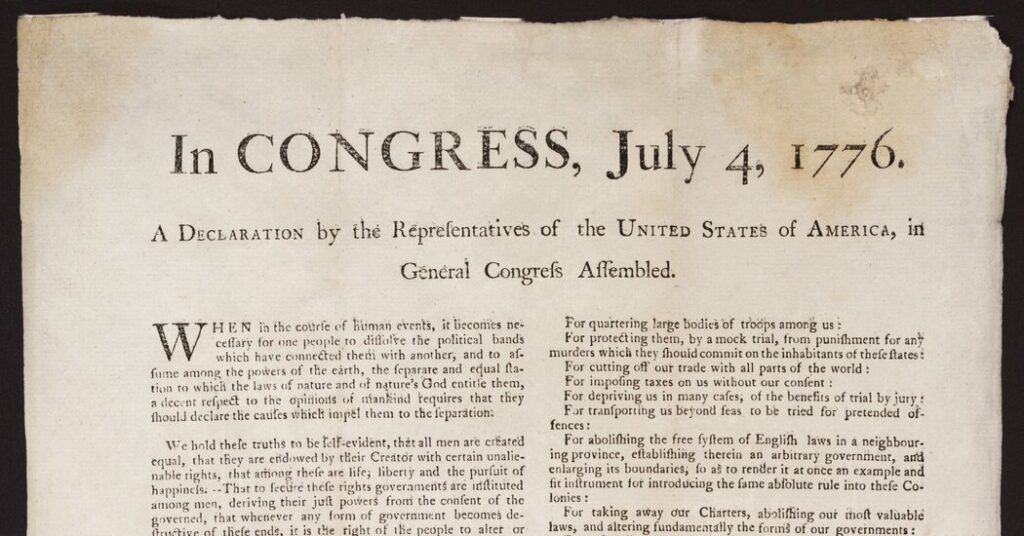
For generations, the institution (formerly the New-York Historical Society) has quietly held a rare, unattributed broadside of the Declaration, one of only a handful with no printer’s name attached. From June 18 to July 5, it will be on public display for the first time, along with a tentative attribution, to a New York City printer named Samuel Loudon.
That claim is based on analysis of tiny typographical clues. But the bigger point, according to Louise Mirrer, the Historical’s president and chief executive, isn’t about Loudon. It’s the collective nature of declaring independence, which involved the men who drafted and approved the document, the printers who set it in type, and the crowds of people who gathered to hear it read aloud from printings like this.
“It was about wrapping everyone into the collective fervor around getting free from the British,” Mirrer said.
The New York Historical, which describes itself as the country’s oldest museum, was founded in 1804 by prominent citizens who had lived through the tumult of the Revolution.
It is not known when or how the anonymous broadside came into the collection. But it has been there at least since 1949, when it was recorded in the first scholarly census of surviving early broadside printings.
Today, scholars have identified about 17 distinct broadside editions created in print shops across the colonies in July and August 1776, usually in runs of hundreds of copies.
The one at the Historical is one of only a handful of editions that lack any printer’s name. It’s also one of only a few that survive only in a single copy.
“There’s a tremendous value that comes just from the act of surviving,” said Emily Sneff, an independent historian and the author of the recent book “When the Declaration of Independence was News,” who consulted on the research. “These broadsides were not intended to survive for 250 years, but just to communicate the news.”
Over the decades, the anonymous broadside attracted little scholarly attention. The attempt to identify the printer began about a year ago, as part of planning for the museum’s 250th efforts, which include the opening this month of its new Tang Wing for American Democracy.
To start, Nina Nazionale, the director of library curatorial affairs and research, scoured the institution’s records and decades-old publications for fleeting references to the document. She also searched other archives, including the George III papers in Britain, for any previously unnoticed copies, which might hold clues.
Nothing turned up. Ultimately, the only real evidence lay in minute details of the document itself.
The broadside is laid out in two columns, unlike the Dunlap and most other known examples. The paper bears the watermark of A. Rogge — a Dutch papermaker, which makes it unlikely it was printed in Britain (where some printers redacted the word “tyrant”).
At the bottom, it bears the printed signatures of only two men: John Hancock, the president of the Continental Congress, and Charles Thomson, its secretary. (The names of the other signers first appeared on the handwritten parchment signed in early August, which is now on display at the National Archives.)
The word “secretary” is abbreviated as “sec’ry,” despite there not being any need to save space. That abbreviation is not unique to Loudon, Nazionale said. But it also appears in a version of the text he printed in his newspaper, The New-York Packet, on July 11, 1776, as well as on other broadsides he printed in the 1770s.
Nazionale also pointed to another echo between the broadside and Loudon’s newspaper printing: two sets of long S’s — those S’s that look like F’s — in the words “Congress Assembled.”
Outside experts agree that the broadside likely dates to the weeks after July 4, but emphasized the uncertainty of the attribution to Loudon. David Armitage, a historian at Harvard and author of “The Declaration of Independence: A Global History,” called it “speculative, but not implausible.”
Sneff said the case for Loudon was “as likely as any other you could put together,” given the limited clues available. While there’s “no smoking gun,” she said, the “sec’ry” abbreviation “does seem like something he did with enough frequency to be treated as potential evidence.”
At the Historical, they are leaning not just into the Loudon attribution, but also the drama of the revolutionary moment, when colonists were divided over independence and even accepting a printing job could be dangerous.
In March 1776, a Patriot group stormed Loudon’s shop and destroyed his work on an anonymous loyalist rejoinder to “Common Sense,” Thomas Paine’s famous pro-independence pamphlet.
In the aftermath, Loudon asserted his patriotism, while also defending freedom of the press. But, depending on the outcome of the war, who knew what fate might await a printer who published the Declaration?
“This was a treasonous document,” Nazionale said.
By July 9, a copy of Dunlap’s broadside had reached New York, where George Washington ordered it read aloud to Continental Army troops who had arrived from Boston to defend the city. Some citizens who heard it were so fired up that they paraded to Bowling Green and toppled a statue of George III on his horse.
The Historical owns a piece of the horse’s tail. And this year, on July 9, visitors can watch as a life-size replica is ceremonially pulled down in the lobby.
“We really own that story,” Mirrer said, with a laugh. “This is our moment to tell it.”
Jennifer Schuessler is a reporter for the Culture section of The Times who covers intellectual life and the world of ideas.
The post For America’s Birthday, a Declaration of Independence Whodunit appeared first on New York Times.