In April 2021, JPMorgan Chase found itself in the midst of a storm.
A plan for a breakaway Super League featuring the richest soccer clubs in the world, which would have unmoored the century-old structures of the sport in Europe, had folded in less than a week. Fans of rival clubs had poured onto the streets in protest, and their governments joined the condemnation.
JPMorgan had offered to provide the financial underpinning to the arrangement.
Chastened, the Wall Street titan issued an unusual apology for its role in the fiasco. The bank pledged to learn from how it had “misjudged” the effect the plan would have on the feverish world of global soccer. Even Jamie Dimon, the bank’s outspoken and all-powerful chief executive officer, acknowledged that the company had misunderstood the passions that would be aroused.
A half decade later, the largest bank in the United States again finds itself at the center of a major crisis in global soccer. This time, European nations threatened to boycott the biggest sporting event on the planet, the FIFA World Cup, and FIFA’s president, Gianni Infantino, is facing down demands that he resign.
JPMorgan was one of the key players in a plan that Mr. Infantino had worked on for more than a year with the venture capitalist Joshua Kushner, the brother of President Trump’s son-in-law Jared Kushner. All of the commercial assets of FIFA, a Zurich-based nonprofit that runs global soccer, would be placed in a separate company. Mr. Infantino was looking to sell roughly 20 percent of the new business, which would include rights to the World Cup, to private investors for $4.2 billion, a deal that would value all of FIFA’s commercial business at $20 billion.
JPMorgan’s role was to find other investors to join the deal with Thrive Eternal, a subsidiary of Mr. Kushner’s firm, Thrive Capital, to make up the $4.2 billion private investment.
The plans had been kept secret until last week, when The Times of London published a detailed account. The reaction was almost immediate and bore striking similarities to the Super League debacle five years earlier. European soccer’s governing body said its teams — among the main drivers of the value of the World Cup — would boycott the tournament should the proposal go forward. Other regional soccer bodies issued their own damning rebukes. Even world leaders weighed in. Britain’s new prime minister, Andy Burnham, slammed the plans on social media, saying the World Cup was not a product that could be sold.
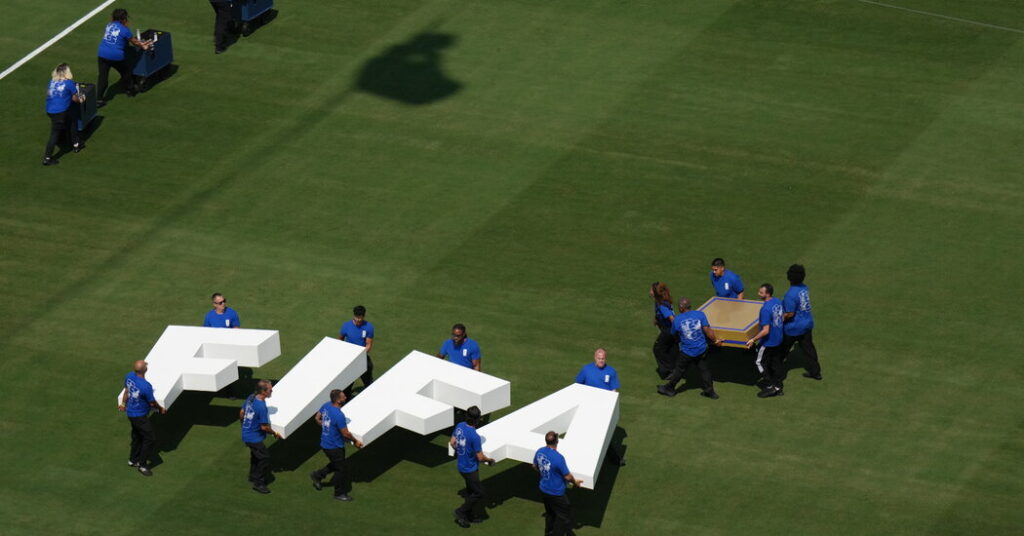
Soccer was at risk of being fractured in ways that seemed unimaginable just a few weeks ago, when Mr. Infantino triumphantly celebrated the close of the most lucrative sports event in history, for which FIFA is expected to make more than $15 billion in sales. Late on Friday, FIFA pulled the plan before it could be voted on by its 211 members.
Mr. Infantino is now fighting for survival as some of his most senior lieutenants have publicly criticize his conduct, saying he had blindsided them. Some national soccer federations, mainly in Europe, are now working to remove Mr. Infantino from office or put up a rival to challenge him in an election next year.
Although JPMorgan quickly admitted its missteps after the Super League backlash, it has not yet spoken about its role in the FIFA flop.
“That JPMorgan seems to have misread football twice says more about football governance than about finance,” said Ronan Evain, executive director for Football Supporters Europe, an umbrella body for fan groups. “The recurring mistake is to assume that fans are a captive audience. The Super League proved we are not.”
JPMorgan declined to comment.
JPMorgan’s efforts to reshape global soccer go back further than the ill-fated breakaway league of 2021. The bank provided financial guidance for another secretive breakaway effort in 1997. Proposed by the late Italian media tycoon and former prime minister Silvio Berlusconi, and code-named Project Gandalf, it also failed.
The bank’s involvement in the FIFA project did not emanate from JPMorgan’s investment division, which advises on structuring transactions and financing deals, but from Mary Erdoes, the head of the bank’s asset and wealth management division, according to two people with direct knowledge of JPMorgan’s interactions with FIFA, who declined to be identified because they were not authorized to speak publicly.
Mr. Infantino and Ms. Erdoes moved in the same circles after Mr. Infantino relocated to the United States following the 2022 World Cup. Both have spoken at some of the same business summits, notably the FII Priority conference in Miami, where Mr. Infantino now lives. Ms. Erdoes also introduced Mr. Infantino when he spoke at a town hall at the bank, one of the people said. Members of the bank’s sports investment banking division also worked on the project.
JPMorgan declined to say if it managed money for Mr. Infantino or Mr. Kushner.
The depth of JPMorgan’s involvement in the plan was underlined by its logo appearing on a FIFA sales deck that leaked to the news media, which The New York Times obtained. The bank, according to one of the people with direct knowledge, had analyzed the reputational risks associated with the project before going ahead. The deal being proposed was for the investors to own a slice of the new company, as they would a professional sports team, and hope for the valuation to increase in years to come rather than to expect regular dividends.
“If FIFA is a predatory commercial entity feeding off the game’s popularity, JPMorgan are the chief financial enablers and seem only too happy to lend their credibility,” said Nick McGeehan, of FairSquare, an advocacy group that has published a report on FIFA’s governance standards.
What is not clear is why JPMorgan would not have immediately seen the potential for trouble. In 2018, early in Mr. Infantino’s tenure, he was forced into an embarrassing about-face when he tried to create a similar spinoff business for FIFA’s commercial assets with the Japanese conglomerate SoftBank, which would have been backed by Persian Gulf sovereign wealth.
For that deal, Mr. Infantino attempted to raise $25 billion. It too collapsed because of angry opposition from European soccer’s governing body and other stakeholders. However, that proposal was less explicit that the World Cup would be part of the package, even though the fine print suggested that the investors would have an option over the commercial rights to it.
Unlike many sports organizations, FIFA is cash rich. “The organization sits on billions of dollars in reserves and no debt,” said Carlos Cordeiro, who had been a senior adviser to Mr. Infantino, in a statement Friday in which he signaled his resignation. “Against that backdrop, selling a permanent stake in football’s most valuable asset to raise $4.2 billion makes little sense.” Mr. Cordeiro, who was once Goldman Sachs’s vice chairman for Asia, said he too found out about Mr. Infantino’s plans in the news media.
On the same day that Mr. Cordeiro resigned, Mr. Infantino suffered another major blow. FIFA’s chief operating officer, Kevin Lamour, issued a statement in which he effectively said Mr. Infantino had deceived staff over the nature of the plans and that they deserved “better than contempt and intimidation.”
On Friday evening, Mr. Infantino finally announced in a statement that his plan would be scrapped. “Having listened carefully to all the views, it has become clear that the project has created divisions of a nature that, regardless of the level of support, are no longer in the interest of the objective set out in the first place,” he said.
For everyone involved, there could be more discomfort ahead. Lawyers for European soccer’s governing body wrote to FIFA demanding the retention of all documentation related to the deal, including any exchanges with JPMorgan.
The post JPMorgan Finds Itself in Another Global Soccer Fiasco appeared first on New York Times.