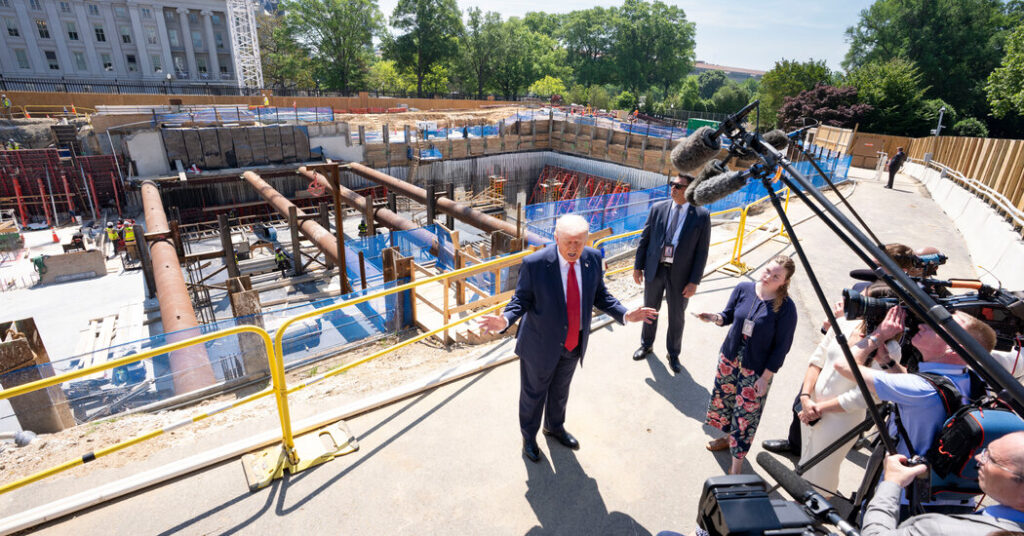
For seven months, construction to replace the 123-year-old East Wing with what President Trump hopes will be a legacy-defining ballroom has been underway without interruption, in spite of a federal lawsuit.
On Friday, a federal appeals court panel will once again consider whether any of it has been legal.
At this point, with the project surging forward, the case may serve as a test of whether courts will assert Congress’s powers to rein in Mr. Trump’s ambitions to rebuild federal Washington as much as it is an obstacle to the ballroom itself.
At issue before the three-judge panel will be what legal authority, if any, Mr. Trump had to unilaterally bulldoze part of the White House without input from lawmakers.
The Trump administration appealed the case in April, after Judge Richard J. Leon, an appointee of George W. Bush, issued a blunt order in March concluding there was no legal path to building without congressional authorization.
“Unless and until Congress blesses this project through statutory authorization, construction has to stop!” he wrote. “But here is the good news. It is not too late for Congress to authorize the continued construction of the ballroom project.”
But even as the projected cost of the ballroom doubled to $400 million and courts have questioned the project, construction has proceeded.
Andrea Katz, an associate professor of law at Washington University School of Law in St. Louis, said the appeals court must decide whether to uphold Judge Leon’s order, all while Congress has not exercised the authority he insisted it holds.
Professor Katz said that the continuing construction meant the court would face a “fait accompli dynamic” in which the administration is expected to argue that the project cannot be left half-finished.
In filings, the Justice Department has also said that Congress gave passive approval to the project after the National Capital Planning Commission and Commission of Fine Arts, both of which were filled out with Mr. Trump’s appointees, voted to approve the design.
On Thursday, six Republican senators joined with Democrats in voting to block construction of the ballroom until it is specifically authorized by Congress, though the proposal fell eight votes short of the 60 needed to be adopted.
Professor Katz said the Trump administration has taken advantage of an inactive Congress to rush ahead on a variety of goals, including construction of the ballroom, but also immigration restrictions and other areas. By the time the government is defending itself in court, she said, it is often offering justifications for transformative actions that took hold months earlier.
“Courts are aware of this problem,” she said.
She said the court had ample reasons to uphold Judge Leon’s order in the interest of “proper enforcement of the law,” even if that resulted in an enduring open pit at the White House and an appeal to the Supreme Court.
The National Trust for Historic Preservation, a nonprofit group chartered by Congress to oversee preservation of historic places, brought the lawsuit in December raising concerns about the project.
It argued that Mr. Trump’s decision to accept donations for the project from corporations with business before the federal government and redesign the historic complex without input usurped the traditional power Congress has over federal property and spending.
At first, Judge Leon prodded the National Trust several times to refine their arguments to focus narrowly on whether the president has authority to change the White House however he wants.
Throughout that legal maneuvering, Mr. Trump kept building.
Then, 110 days after the lawsuit was filed, Judge Leon ruled for the preservation group.
But soon after, the president and his allies threw a curveball.
The ballroom, Mr. Trump said, was not even the primary purpose of the renovation. Rather, the planned structure would be a capstone, he said, on a sprawling underground military bunker designed to modernize security at the White House.
Throughout April, Mr. Trump spoke less of the ornate columns and neoclassical touches that he would later showcase for reporters, and more of drone-proof roofs and bulletproof windows. The president and his allies also cited an attempted assassination at an annual press gala in May, asserting that the attack vindicated efforts to build a secure event space within the White House. Mr. Trump has referred to the structure as a “shed” atop a new complex that would entirely replace the existing Presidential Emergency Operations Center.
Hesitant to interfere with work involving presidential security, Judge Leon clarified his order, saying that it applied only to aboveground construction and not underground security features. Even so, the appeals court panel chose to pause Judge Leon’s order entirely until after the judges consider arguments at the Friday hearing.
That meant that throughout April and May, Mr. Trump kept building.
Lawyers representing the National Trust are expected to argue on Friday that the months of construction have all grinded ahead in spite of both federal law and the constitutional separation of powers, which both give lawmakers a clear say in major changes to the White House grounds. “This case is about who controls federal property,” lawyers for the group wrote in a brief.
“The answer is Congress, as the Constitution, numerous federal statutes and longstanding Supreme Court precedent regarding the president’s supposed emergency powers all make clear,” they added.
Andrew Mergen, a professor at Harvard Law School who spent more than 20 years in the Justice Department’s Environment and Natural Resources Division, said that Congress reserved “incredible authority” over federal properties that it delegates to federal agencies to help manage.
“It’s something that the branches do hand in hand,” he said. “And to have taken a project like this on without consulting with Congress is really, I think, to push the outer limits of the president’s authority.”
The panel consists of Judges Patricia A. Millett, an Obama appointee; Bradley N. Garcia, a Biden appointee; and Neomi Rao, a Trump appointee.
The panel had previously expressed confusion about Mr. Trump’s shifting descriptions of the project, sending the case back to Judge Leon to clarify what parts of the project he thought required approval.
But the panel has not seemed eager to halt the construction. All three judges signed off on allowing work to until now; Judge Rao noted in a dissent that she would have preferred to pause Judge Leon’s order for the duration of the case.
Regardless of the outcome in front of the appeals court, the case could ultimately be decided by the Supreme Court.
At the end of several hearings, Judge Leon predicted that unless Mr. Trump took steps to resolve the dispute, it would likely fall to the justices to decide the president’s power to transform the White House.
Zach Montague is a Times reporter covering the federal courts, including the legal disputes over the Trump administration’s agenda.
The post Appeals Court Panel to Hear Arguments Over Trump’s Ballroom appeared first on New York Times.