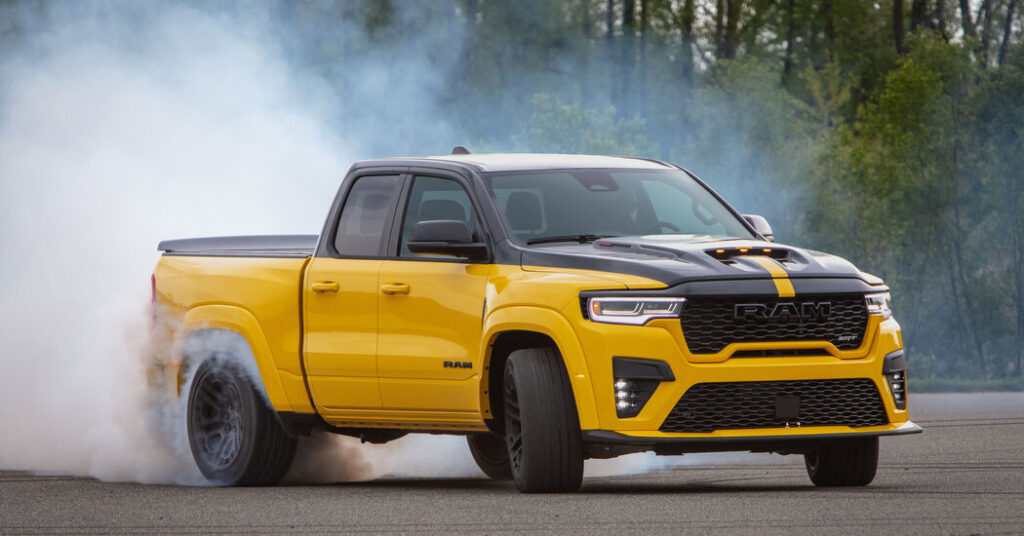
With fuel prices stubbornly high, it would seem a bad time to unleash new gas guzzlers. But Ram, Stellantis’s badge for brawny pickups, has introduced a line of muscle trucks, betting that most buyers are more concerned about their manliness than the price of gas.
It’s not a bad bet. At the risk of turning off some, Ram knows its buyers: American men (mostly) whose taste — reflected in ads — runs toward the Ultimate Fighting Championship, comely cowgirls on mechanical bulls, a Guns N’ Roses soundtrack and unapologetically large, loud trucks.
Ram loyalists fled when Stellantis, for the 2024 model year, phased out its Hemi V8 engine in its light-duty, full-size pickups, replacing it with the six-cylinder twin-turbo Hurricane I-6. The I-6 packed more horsepower than the Hemi and had better gas mileage with lower emissions, to boot.
But buyers rebelled. Ram’s market share plunged to 16.3 percent in 2025 from 20.4 percent in 2024, said Sam Fiorani, vice president for global vehicle forecasting at the automotive analyst AutoForecast Solutions. “Ram buyers like other people to know that they are driving a Ram truck, and the Hemi made a lot of noise,” he said. “And while the six is plenty loud, it’s not as loud as the Hemi,” he said.
The Hemi is back for the 2026 model year as a $1,200 option on most Ram models. In what may be seen as an additional mea culpa, Stellantis introduced two 777-horsepower juggernauts, the yellow-and-black 1500 Rumble Bee SRT and the Ram 1500 TRX SRT, which the company claims are the fastest production trucks ever built.
The trucks can clock zero to 60 miles an hour in 3.4 seconds. Tim Kuniskis, Ram’s chief executive, said premium models would cost north of $100,000, with gas mileage “that will be terrible.”
“The person who is going to spend six figures for a truck isn’t going to care if it’s $5, $6, $7 a gallon,” Mr. Kuniskis said. Nevertheless, the hope is that prices come down before these trucks hit showrooms in November.
Development of these muscle trucks began two years ago, before the war in Iran and the subsequent stalemate over the Strait of Hormuz, which has driven oil and gas prices to uncomfortable levels. We’ve been here before, Mr. Kuniskis said. “Go back to 2022, the prior war, they came in even higher,” he said, referring to the war between Ukraine and Russia.
The giants in pickups are Ford, Chevrolet and Ram. In addition to Ram’s slice of the market, Ford had 36.2 percent market share last year, and Chevy was at 25.4 percent. (Ford’s F-150 is regularly the best-selling vehicle in America, followed by Chevy’s Silverado.) To woo back buyers, Ram is leaning heavily into machismo in its ads.
“Ford and Chevy are bigger players in this marketplace, they can’t take as extreme a position as Ram can. When you have market share, you have to protect it,” said Kelly O’Keefe, chief executive of the advertising and marketing consultancy Brand Federation.
It’s not at all odd for Ram to scoff at gas prices, he said, because practicality is beside the point. “These are not vehicles meant to haul plywood, they are meant to haul ass,” he said. “It’s like boasting about an F1 car with the biggest trunk. It’s not what it’s there to do. It’s not about efficiency, workload or practicality. They are about raw power.”
The point isn’t even to sell muscle trucks, Mr. O’Keefe said, but to enhance the brand, a strategy seen before with Dodge’s 1992 model-year introduction of the rakish Viper. A limited-production sports car, the Viper was listed for a then-outrageous $52,000, but dealers routinely refused bids of less than $150,000 (about $350,000 today). They didn’t want the car to sell, they wanted it as a lure on the showroom floor. “The Viper got dad into the showroom to see it, and he went home with a minivan,” Mr. O’Keefe said. “It worked for them.”
Ram is descended from Dodge, which has never shied away from over-the-top vehicles. Recall the Challenger R/T 440 Six Pack, Charger Daytona, Dart 440 or the Li’l Red Truck. But those were all one-offs, Mr. Kuniskis said. This new crop of muscle trucks will come in slightly less strapping, midpriced versions as well. “No one has done a whole line of them,” he said.
But the big companies have all dabbled in this space. “We’ve had muscle trucks forever,” said Tyson Jominy, senior vice president for customer success at JD Power, an analytics firm focused on cars. “Put the biggest engine in the smallest vehicle and magic happens.”
Earlier examples include the 1976 Dodge Warlock, the 1990 Chevrolet 454 SS and the 1993 Ford SVT Lightning. Their point was not utility, but excess, said Mr. Jominy, who pointed to the 1991 Syclone from GMC, Chevy’s General Motors sibling. “The Syclone had a payload capacity about equal to a Corolla,” he said. “It could do nothing a pickup was supposed do, but it beat Ferraris of its day,” he said. It did, in fact, win a race against a Ferrari.
For nearly 50 years, Ford has led in U.S. pickup sales, with marketing that plays up the red, white and blue. Its current brand campaign, “Ready Set Ford,” juxtaposes the Mustang with an athlete, and cowboys heading off charging livestock with a truck. Its truck ads feature notably diverse casting, leaning on the venerable “Built Ford Tough” slogan and positioning its models as the reliable truck for the American Everyman.
Chevy has brought back a 1948 jingle, “See the U.S.A. in a Chevrolet,” performed by the country singer Brooke Lee from the bed of a pickup. A recent ad specifically calls Chevys “capable and dependable,” perhaps a challenge to Ford, with a dash of nostalgia.
And while it seems no pickup ad is complete without cowboys and construction workers, recent Ram ads have taken the imagery to another level.
Ram released a chest-thumping commercial last year with an in-your-face title: “Never Stop Being American.” This year, it was “In Loud We Trust,” in which the U.F.C. president, Dana White, growls a voice-over extolling U.S. values with images of cowboys, a rock star, fighter jets, a bald eagle and other American kitsch.
Ram’s new muscle trucks are high-price, high-margin brand enhancers and are known as halo cars, intended to draw buyers to the showroom. “That is 100 percent the value any halo product brings to the brand,” Mr. Kuniskis said.
The manosphere-adjacent swagger of muscle trucks overlaps elements of a political movement that is not universally popular. “It’s MAGA-coded all over the place,” Mr. O’Keefe said.
Mr. Kuniskis said that interpretation might miss the message — that Ram is for proud Americans, and that there are proud Americans in every political party. “It seems like lately, everything somehow gets twisted into being political,” he said, “whether it was intended to be that way or not.” (Mr. White has supported President Trump, and a U.F.C. fight venue is being prepared at the White House for an event this month.)
Intentional or not, there is risk, said Americus Reed II, a Wharton School marketing professor who studies how consumer self-image influences buying decisions.
He finds the muscle truck ad interesting but risky. “Americana is no longer a monolithic image you plug into,” he said. And “that patriotic, alpha male, I-can-do-pull-ups, toxic masculinity” is a charged image to tap into. Why? “It’s risky for the same reason Elon Musk found out — he put a little bit of the MAGA DNA into Tesla, and that didn’t go so well.”
The post To Sell Trucks, Break Out the Cowboys and Wrap Them in Old Glory appeared first on New York Times.