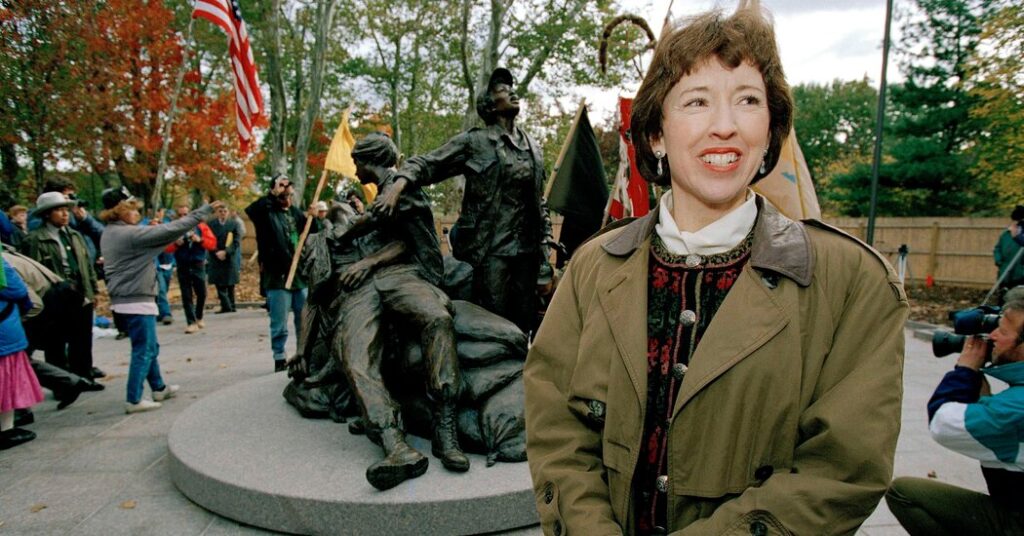
Diane Carlson Evans, who experienced the horrors of the Vietnam War firsthand as an Army nurse and then led a successful decade-long campaign to establish a monument on the National Mall to the thousands of women who served in that conflict, died on May 20 at her home in Helena, Mont. She was 79.
Her daughter, Carrie Evans, said the cause of death was urothelial cancer, a type of urinary tract or bladder cancer, which studies have linked to exposure to Agent Orange, a carcinogenic defoliant used in the war.
Ms. Carlson Evans was one of about 11,000 women who served as nurses in Vietnam — in her case, in combat medical units close to the front lines, where she cared for soldiers and Vietnamese civilians.
It was grueling work that left her with long-term trauma, but also with pride in having helped so many injured and sick people.
But when the Vietnam Veterans Memorial and the adjacent “Three Soldiers” statue were unveiled in the early 1980s, she was struck by the feeling that — although the names of eight women were included on the memorial wall — the overall message seemed to be about honoring men.
She saw the same thing repeated in the many state and local memorials to the war.
“If we don’t see women in our monuments,” she told The Los Angeles Times in 1986, “do we think of women who served?”
What was needed, she decided, was a memorial to honor not just the women who had served in Vietnam, but also the 265,000 who had served worldwide during the conflict.
In 1984, she started the Vietnam Women’s Memorial Project (later Foundation). Over the next nine years, she recruited thousands of volunteers, raised millions of dollars and struggled with the bureaucracy in Washington, navigating congressional hearings and the approval processes of three different arts and planning commissions.
“My driving force was that I was so proud of the women I served with,” she told Vietnam magazine in 2013. “My goal was to tell the truth: what they did and how they saved lives. The public needs to know that women, too, have issues and needs.”
The original design for the memorial centered on a seven-foot statue that the sculptor Rodger Brodin created based on a model wearing Ms. Carlson Evans’s bloodstained combat fatigues.
But one of the commissions insisted on having an open competition. Out of more than 300 submitted ideas, the winning entry belonged to Glenna Goodacre.
The memorial was dedicated on Nov. 11, 1993, with about 25,000 people in attendance. It was Veterans Day, and the day after Ms. Carlson Evans’s 47th birthday.
“This is our place for the healing process,” she said at the ceremony.
Diane Althea Carlson was born on Nov. 10, 1946, in Buffalo, Minn., one of six children of Newell Carlson, a farmer, and Dorothy (Andersen) Carlson, a nurse.
Watching her mother at work inspired Diane to follow in the same career. She studied nursing at St. Barnabas Hospital in Minneapolis and received her degree from the University of Minnesota in 1967, becoming a registered nurse.
She had joined the Army Nurse Corps student program in college, and soon after graduation entered the service, volunteering to be sent to South Vietnam.
After training, she arrived in the country in 1968, serving first in a burn unit in Vung Tau, on the southern coast, and then as head nurse at a hospital unit in Pleiku.
When she returned home the next year, she tried working in a civilian hospital but felt a lingering sense of survivor’s guilt, and rejoined the Army in 1970. She served three more years before being discharged as a captain.
While working at Fort Sam Houston in Texas, she met a military doctor, Michael Evans. They married in 1971.
In addition to their daughter, he survives her, along with their sons, Guy, Luke and Jon-Erik; six grandchildren; a sister, Nola Nilsson; and a brother, Maynard Carlson.
After her success with the memorial, Ms. Carlson Evans worked closely with veterans groups and V.A. centers. It was, she said, a way of both helping and healing.
“We wondered all those years if we did a good job, and they came out of the woodwork all across the country,” she said in an interview for the oral history project StoryCorps in 2022.
Veterans, she added, “wanted to find the nurse who took care of them because they wanted to say thank you. And that, in and of itself, is so healing. It’s just something that’s hard for anybody who wasn’t there to understand. It’s spiritual. It’s sacred. And we are sisters, and we are brothers.”
Clay Risen is a Times reporter on the Obituaries desk.
The post Diane Carlson Evans Dies at 79; Led Campaign for Vietnam Women’s Memorial appeared first on New York Times.