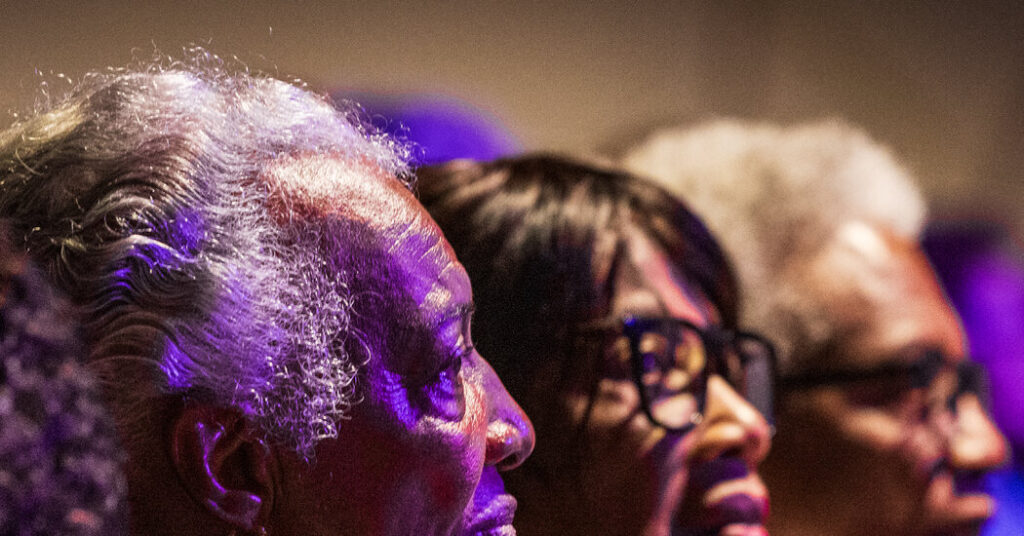
On a Thursday in April, a few hundred people, many of them older Black women, sat in the main hall at Impact Church, located in a converted warehouse near the airport in Atlanta. The windowless sanctuary was dark, but theater lights and the crowd’s energy illuminated the stage.
In his prayer, the Rev. Paul Thibodeaux, the church’s lead pastor, called upon God “to do some amazing things: We are expecting you, God, to bring down wisdom like never before. We are expecting you, God, to increase our knowledge like never before.”
For this wasn’t a typical sermon. Pastor Thibodeaux was opening the Alter Dementia Summit, a three-day conference aimed at educating the Black faith community about Alzheimer’s disease and other types of dementia.
The event was an unconventional mix of faith and science. Research posters on community-based caregiving and how physical health affects the brain lined one wall of the church. Shortly after Pastor Thibodeaux’s prayer, Vonetta Dotson, the chief of neuropsychology at Brigham and Women’s Hospital in Boston, took the stage to present strategies for improving cognitive health. When she said Bible study sessions could help by challenging the brain, the crowd murmured approvingly.
Roughly one in five Black Americans 65 and older has Alzheimer’s, compared with one in 10 white Americans. But it can take Black patients significantly longer to obtain a diagnosis, which limits treatment options and places an additional burden on caregivers.
Experts have identified several factors that contribute to these bleak statistics, including stigma and a lack of awareness about dementia in the Black community. There is also general distrust of the scientific and medical establishment, fueled by ongoing discrimination.
Fayron Epps, a professor of nursing at the University of Texas Health Science Center at San Antonio and the founder of Alter, is trying to address these disparities by tapping into places where trust runs deep: Black churches.
According to Pew Research Center, 73 percent of Black Americans identify as Christian. The church has traditionally been “that haven, that safe place that individuals can go to,” Dr. Epps said.
“That is part of the culture, that the church is there to help,” she added. “Why not make sure they have the resources?”
The Spiritual and the Tangible
According to data from the Alzheimer’s Association, more than half of Black Americans assume that significant memory loss is a normal part of aging, rather than a medical condition. “Many times in the Black community, it can be called several other things: ‘hardening of the arteries,’ ‘senile,’” Dr. Epps said. “Or it’s even just ‘crazy.’”
To help counter these misconceptions, Alter partners with Black faith communities around the country, providing education about dementia and brain health, as well as resources for caregivers.
To the Rev. jeff obafemi carr, Alter Summit’s M.C. and the founder and chief spiritual officer of the Infinity Fellowship in Nashville, science and faith are natural partners.
“If we’re going to address the spiritual needs of a human being, we also have to address their tangible needs,” he said. That includes preaching about science and the brain. (Mr. carr spells his name in lowercase as a “reminder to play his small role in the larger Creation.”)
Robert Reid, who previously served on Alter’s citizen advisory board, and his wife, Kim, are exactly the type of people Alter is hoping to help.
Mrs. Reid first began experiencing symptoms of cognitive decline when she was just 48. She went to her doctor with concerns that she was having difficulty with executive functioning at work, but was brushed off and told it was a symptom of perimenopause. It would take two years and many visits to the doctor before she finally received a cognitive test, a referral to a neurologist and a diagnosis of early onset Alzheimer’s.
Mr. Reid is now his wife’s full-time “care partner.” He prefers that term over caregiver or, even worse, caretaker.
“We married, we became one, so we partner in everything,” Mr. Reid said. “So when she was diagnosed, I was diagnosed.”
Before Mrs. Reid’s diagnosis, the couple “really didn’t know much about Alzheimer’s,” Mr. Reid said. And they didn’t think they knew anyone with the disease. They later discovered that Mrs. Reid’s grandparents most likely had dementia; her mother and father would also go on to develop different forms of the condition.
They “didn’t know that they needed to go get tested,” Mr. Reid said of his wife’s grandparents. “They didn’t know that they needed to get a diagnosis, and that from having a diagnosis you’re able to get better care.”
Chronic Stress and Disparities
There are several contributors to Black Americans’ increased dementia risk, Dr. Epps said. Higher rates of cardio-metabolic conditions, such as diabetes, stroke and hypertension, play a role, along with social determinants of health, including barriers to accessing health care and nutritious food.
And it’s not just about what life is like for Black Americans today, Dr. Dotson said; it’s also about what it was like growing up during the era of Jim Crow laws. When Dr. Dotson’s parents, now 69 and 72, were children in Birmingham, Ala., they weren’t allowed to go to certain playgrounds or drink from certain water fountains.
“When you talk about decades of accumulating chronic stress, I mean, my God,” she said.
Repeated exposure to life stressors like trauma and discrimination can cause systemic inflammation, which is associated with numerous health consequences, including dementia. Research has also shown that experiencing racism is associated with cognitive decline.
Many of these risk factors are out of an individual’s control. But one widely cited paper estimates that up to 45 percent of dementia cases can be attributed to modifiable risk factors, such as physical inactivity, social isolation and high cholesterol.
“Someone who has all these risks from before, so much working against them, can still get benefits” from healthy lifestyle changes like exercise and a nutritious diet, Dr. Dotson said. “Maybe not reversing the past, but certainly making the present and the future a bit better.”
Improving Health by Building Trust
Mary Parris, who leads a ministry at New Macedonia Baptist Church in Riverdale, Ga., draws on her background as a doctor of nursing practice to educate the congregation about healthy brain behaviors.
She has organized a dementia walk to raise awareness and get her congregation out and exercising, and distributed nutritious food at a health fair. She also partnered with a scientist from Emory University to talk to the church about the importance of sleep for brain health.
For Dr. Parris, the mission is personal. “I watched my grandmother develop dementia, and over a 10-year period I watched her light just dim,” she said. “And I walked that journey with her until she passed on Jan. 31, 2021.”
It was right around that time that Dr. Epps approached New Macedonia to start a partnership with Alter. That timing wasn’t a coincidence, Dr. Parris said: “That’s God.”
It hasn’t been easy work. Most of the parishioners at New Macedonia are “seasoned saints” in their 60s and 70s, Dr. Parris said. People that age are “kind of set in their ways, and here you are, coming and telling me what I should and should not be eating.”
But, she said, “the trust is beginning to develop.”
Clinical Trials in the Church
Scientific research is critical to improving dementia care for Black Americans. Attendees at the summit were encouraged to take part in studies, which routinely overrepresent white patients. According to one analysis, roughly 90 percent of participants in clinical trials testing drugs for Alzheimer’s disease were white and just 5 percent were Black.
Goldie Smith Byrd, a professor of social sciences and health policy at Wake Forest University, is working with Black churches in North Carolina in part to try to change that. In 2019, she set up the Triad Pastors Network, a partnership between Wake Forest and roughly 100 local faith leaders.
Dr. Byrd researches the genes that influence Alzheimer’s. But the partnership’s founding mission was to improve the community’s health at large, centering what they needed and prioritized.
To make inroads, she had to work to undo distrust of the scientific and medical establishment, which stemmed from a long legacy of discrimination and abuse. At Wake Forest, specifically, that included participation in a state-sponsored sterilization campaign in the mid-20th century.
Some of the pastors in the network remembered “when they could mop floors and cook” at the hospital “but they couldn’t be seen there,” Dr. Byrd said. “They remember when their loved ones experienced eugenics there. They remember when they felt like guinea pigs in research there.”
Over several years, Dr. Byrd and her team earned the pastors’ trust. In 2024, the network voted to turn its focus to Alzheimer’s. This included a recruitment push for Dr. Byrd’s research on the genetic contributors to Alzheimer’s in people with African and Hispanic ancestry, which ultimately helped enroll nearly 250 study participants.
Some pastors even preached about the importance of participating in research.
In an August service to raise Alzheimer’s awareness, one of the pastors in the network, the Rev. Dr. K. Lamonte Williams, spoke about the deep relationship between health and faith.
“Caring for our bodies is a form of worship,” he said. “It acknowledges the temple that God has entrusted us with.”
Dana G. Smith is a Times reporter covering personal health, particularly aging and brain health.
The post Raising Dementia Awareness, One Black Church at a Time appeared first on New York Times.