Though it wasn’t quite yet spring on the eastern end of Long Island, the artist Sanford Biggers had come out on a matter of business with its clouds and sky. Part of a littoral landscape that he connects to deeply, cloud forms have been a signature of his visual vocabulary since he first spray-painted graffiti onto nighttime Los Angeles as a teenager.
On this off-season day near his second home not far from Sag Harbor, air and clouds were combining into the kind of vistas that he identifies with East End. “They’re an obsession for me,” he said. “Each person sees something different. It’s a metaphor for life.”
Now clouds have helped inspire the title of Biggers’s first solo museum show on the East End, “Sanford Biggers: Drift,” at the Parrish Art Museum in Water Mill. As he arrived for an exhibition planning session, he pointed up at one of the gallery-length skylights. “I’ve loved that about this place since the first time I visited,” he said, “to look up and see the light and the sky.”
“Drift” continues the theme of Biggers’s Shimmer series — at its most monumental in “Unsui (Cloud Forest),” 2025, a cloud sculpture installation of LED-illuminated aluminum and acrylic commissioned by Brown University that last year hung from the neo-Romanesque rafters of its 19th-century Sayles Hall.
Biggers’s emphatic interjection of shapes faced off with portraits of past college dignitaries, all white men, associated with an institution once partly financed by the Atlantic slave trade and heightened a sense, Biggers said, “of who wasn’t there.”
The presence of absence likewise applies in “Drift,” which, from Biggers’s historical perspective, changes the long-established narrative of creative activity in the Hamptons. “It doesn’t just celebrate a lineage of artistic production on the East End,” he wrote in an email, “it also asks us to consider who has been included in that narrative and who has not.”
The Parrish includes eight of the “Unsui” clouds from Brown, along with two newer ones at the museum entrance. Below them smaller iterations ranging from fluffy to wavelike show Biggers, like the experienced DJ he is, sampling European, American and especially Japanese art traditions. This serves to convey the Buddhist idea of clouds as a metaphor for the awakened mind moving through the world toward enlightenment and transcendence. To Biggers, who spent three years in Japan following graduate school, clouds signal “infinite potential and un-fixedness,” he said.
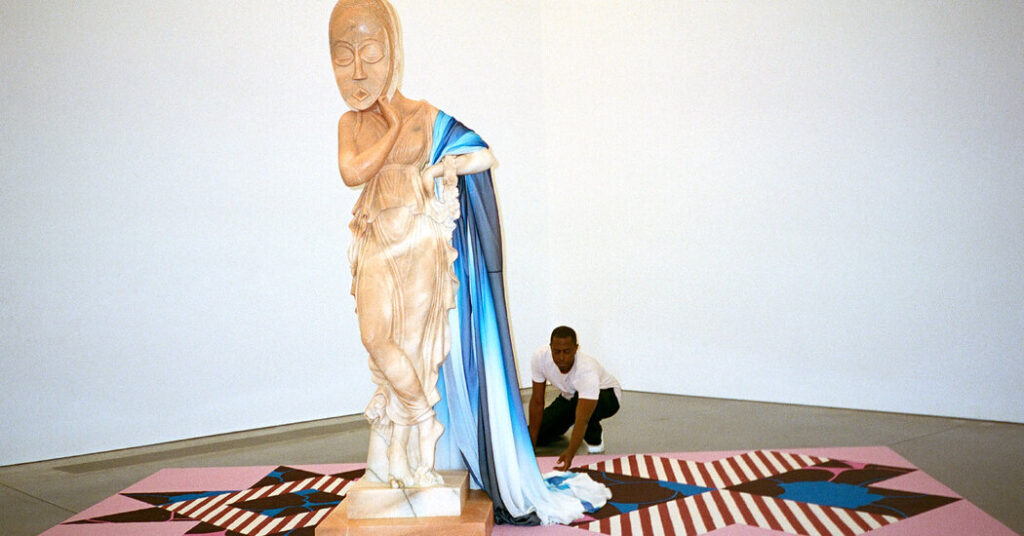
In charting changeability, Biggers has also painstakingly overlaid one gallery floor almost entirely with “Adrift,” an intricate sand painting in the Zen Buddhist vein, which, in a clouding process he calls “blur,” will be intentionally scattered apart at the end of the show.
Adjacent to it stands the sculpture “Mirror,” shaped from marble that in antiquity, Biggers said, “would have been painted, until its colors came off through the erosion of wind and sand and time.”
“Sanford’s dynamic and demanding work ultimately takes the ethereal and points in an elegant way to the power of hope,” said the artist Carrie Mae Weems, who recommended Biggers for the project at Brown.
In sending that message, “Drift” converses with Biggers’s longstanding engagement with African American history, which reaches back hundreds of years on Long Island, and to the trafficking of Africans as human cargo in slave ships that deposited them up and down the East Coast. The show is also a reminder that Biggers originally conjured clouds with piled up mounds of raw cotton, a lingering symbol of Black enslavement and sharecropping in the antebellum South.
Biggers’s re-envisioning of the American story factored strongly in the Parrish’s decision to dedicate a show to his work in its yearlong sesquicentennial series “Parrish 250: Life, Liberty and the Pursuit of Happiness.” “A lot of Sanford’s work comes from an awareness that, for a long time, constitutional rights weren’t extended to everyone,” said Corinne Erni, a co-curator of the show.
Biggers sees “Drift,” he said, “as less about illustrating the ideals of life, liberty and happiness, and more about opening up and complicating them, so that we can imagine new ways of inhabiting them.”
The artist Julie Mehretu, who first met Biggers through the artists-in-residence program at the Studio Museum in Harlem, said, “Sanford has been interested his whole career in making sense of attempts to dehumanize Black folks.” In that scrutiny, she added, lies Biggers’s “insistence on what life can be.”
Biggers’s multidisciplinary artmaking stands out in his unfolding Codex series and its intricate, conceptually complex repurposing of antique and vintage quilts garnered from all over the African-American map — turning them into semiabstract commentaries on the Black past, present and future.
He stores the majority of his quilt collection at his sprawling studio in a former factory building in the Mott Haven section of the Bronx, a subway ride from his home in Harlem. It bustles with a large team of young assistants working to help keep his multiple commissions and projects on track. (His show “Sanford Biggers: The Gift of Tongues” opened at the Marianne Boesky Gallery in Chelsea on April 30.)
The Codex selections in “Drift,” covering the span of the series from 2011 to 2026, reflect the significance Biggers attributes to the practice of intervention — reshaping trans-generational patchwork by means of spray-painting, dyeing, embroidery, stenciling, drawing and collaging, to become part of the present. Although he now recognizes as apocryphal the theory that quilts were used as coded signposts along the Underground Railroad, to him they remain symbols of perseverance and liberation, functioning as vernacular expressions of art as encoded communication. “I’m interested in the nuanced space between fact and belief,” Biggers said, “because that’s where our stories and identities are constructed.”
Biggers builds his quilts’ tantalizing labyrinths from sources as disparate as origami and botanical prints, minstrelsy and Op Art. Some ruminate on the movements of heavenly bodies and mystical stargazing, as in “7 Heavens,” or, in “Sirocco,” send feathery whirligigs scudding at an angle. In “Kind of Real,” miniaturized blur images appear in crisply alternating squares, while in “Otsukimi,” from the limited edition series “The Floating World,” a spinning shape suggestive of the Zen concept of the self as whirlpool rotates off toward infinity. The title of “Dagu,” which combines antique quilts and assorted textiles layered with spray paint and acrylic, derives from a nomadic descriptor for the exchange of news and information that Biggers absorbed as he traversed northern Ethiopia. “Also Known As” merges quilt and sculpture, cloud pattern and quilt, Shimmer and Codex.
Although Biggers was introduced to the Hamptons as a guest at one of the hip-hop mogul Russell Simmons’s star-studded charity bashes in 2011, he was increasingly drawn by his growing recognition of African Americans’ roles in the 19th -century whaling industry out of Sag Harbor and the farming nearby. He especially took to the alluring endurance of the town’s historically Black vacation communities, Azurest, Sag Harbor Hills and Ninevah Beach, established in the segregated 1930s and 1940s for upper-class professionals and leading cultural figures, who were nevertheless subjected to systemic real estate and housing discrimination.
The beachfront home associations, long desegregated, reminded Biggers of View Park, the prosperous Black enclave in Los Angeles where he grew up the second son of a well-known neurosurgeon and a socially active schoolteacher. They hosted elegant cocktail parties, collected Black art, were members of the Rev. James M. Lawson Jr.’s Holman United Methodist Church, and expected Biggers to leave home for the Ivy League. He opted instead for historically Black Morehouse College, “as a kind of political statement,” he said, “and because Spike Lee had just made ‘School Daze”— the 1988 film featuring a fictional Black college called Mission.
In 2016, Biggers married Arana Hankin, whose family had long been summer residents of Azurest, where they had built a white modernist beach house perforated by windows on all sides. “That’s where I really felt most intensely surrounded by clouds and sky and the incredible light,” Biggers said.
He is hard-pressed to miss the community’s annual Memorial Day and 4th of July celebrations, and sacrosanct sailboat races. He worries about encroachments on its tightknit world.
More recently he has lent his name and support to the Hamptons Black Arts Council, founded in 2023 by the gallerist and art dealer Storm Ascher to connect and advocate for local Black art organizations
Biggers is part of a closeknit group of Black artists out east — among them Rashid Johnson, Renee Cox, Hank Willis Thomas and often Carrie Mae Weems. The artist Eric Fischl, another good friend and co-founder of The Church cultural center in Sag Harbor, has on his fall schedule an exhibition based on the life and work of Amaza Lee Meredith, a founder of Azurest. At the Sag Harbor Cinema, Biggers can be spotted in the company of the architect Peter Marino and the writer Bob Colacello, both their names evocative of Andy Warhol’s.
“Sanford acts as a bridge between artist contemporaries and a heritage art world of people who’ve been around since the Warhol days,” said Casey Fremont, executive director of the Art Production Fund, which in 2021 helped produce a campuswide exhibition of Biggers’s work at Rockefeller Center.
Just up Main Street from the movie house is the Sag Harbor Variety Store, for over a century a purveyor of “everything I might need: craft supplies — beads and embroidery thread and fabric trim — and fabric, fabric glue, even an attendant who measures and cuts the bolts,” Biggers said. “There are still places with history like that out here, if you know where to look.”
The act of seeing, however, always begins for Biggers, “between my two temples,” he said. What happens next, conditions on the East End permitting, is showtime for clouds.
Sanford Biggers: Drift
Through Sept. 13, Parrish Art Museum, 279 Montauk Highway, Water Mill, N.Y.; 631-283-2118; parrishart.org.
The post Where Sky Meets Water, Sanford Biggers Sees Life’s ‘Drift’ appeared first on New York Times.