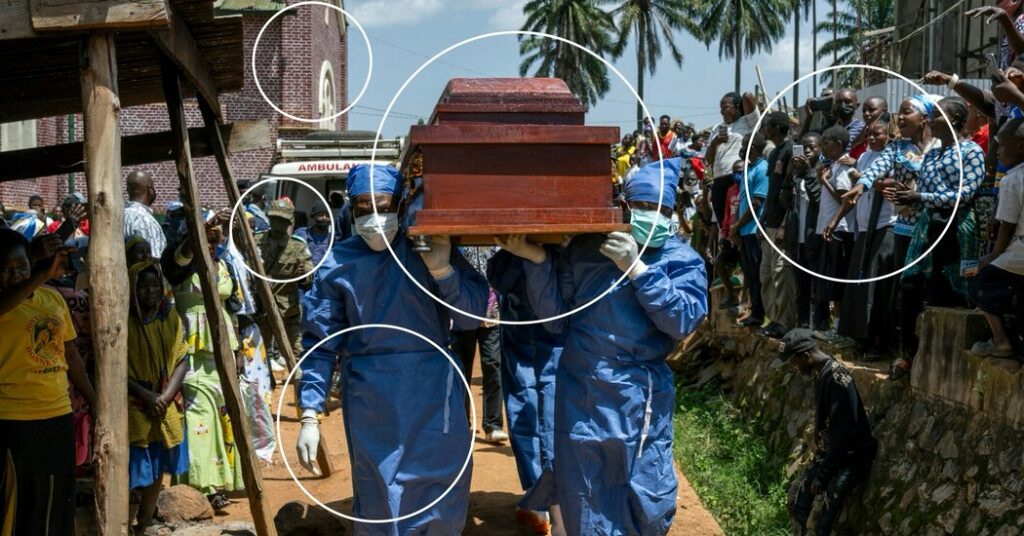
More than 400 cases of Ebola have already been reported in Mongbwalu, a town in the Democratic Republic of Congo, where fear of the highly contagious disease runs the streets. But many of Sylvestre Atama’s parishioners refused to believe that it was Ebola that had claimed the life of their “bergère.” Their shepherd.
When patients at Mongbwalu General Hospital die of the disease, workers disinfect their remains, place them in body bags and then seal the bags in coffins provided by families. They return the coffins with strict instructions: Do not open.
Mr. Atama’s followers had other ideas.
They wanted a traditional burial ritual, which involves touching the body — and could easily have infected other people. When they were refused, they converged on the hospital, some armed, and tried to seize the preacher’s remains. A five-hour battle with security forces ensued.
The funeral procession shown above took place on a Monday morning after careful negotiations. Health workers carried the coffin, and soldiers and police officers kept the impassioned crowd at bay.
Many believed that Mr. Atama had died of malaria, not Ebola. With distrust deeply held by many Congolese toward the government and hospitals, they wanted to look inside the coffin themselves.
As the procession passed, the air filled with the sounds of grief and imprecation. Some prayed for the preacher’s soul. Others hurled accusations at the health workers who had tried to save him.
The soldiers were able to protect the health workers as they made their war to the cemetery about a mile distant, but then word came that a mob was awaiting them at the gravesite.
Changing course, when they got near the cemetery, they turned the coffin over to church leaders who, they said, had agreed to leave the remains untouched.
The church leaders finished up the procession. The health workers went back to tending to the living, and the dead.
Written by Eric Nagourney.
The post Priest’s Ebola Death Stirs Fear an Doubt in Congolese Town appeared first on New York Times.