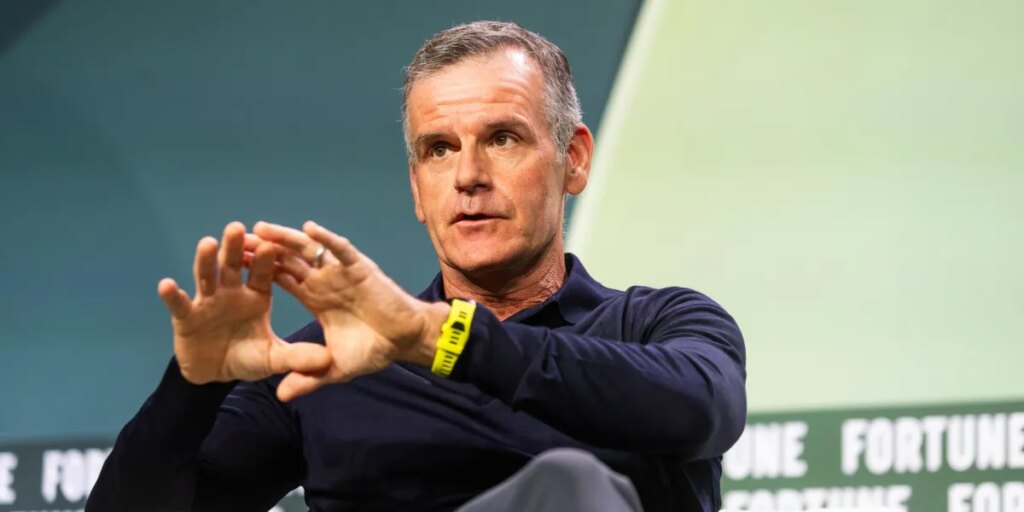
Dennis Woodside has one of the most eclectic résumés in Silicon Valley — a former M&A lawyer turned McKinsey consultant turned Google sales chief turned Motorola Mobility CEO turned Dropbox COO turned Impossible Foods president. (Whew.)
Now the chief executive of Freshworks, a Nasdaq-listed software company with 75,000 customers, Woodside sat down with Fortune‘s Diane Brady at the Fortune COO Summit in Scottsdale, Arizona, to reflect on a career built less on a master plan than on a willingness to follow big challenges — even when those challenges came with no roadmap.
It’s a philosophy he applies off the clock, too. Woodside has completed 18 Ironman races and is doing four more races this summer — not, he says, for the bragging rights, but because physical endurance gives him the one thing a packed CEO calendar rarely does: uninterrupted time to think. “Some people meditate. Some people do yoga,” he told Brady. “I go ride a bike or I go for a run.” It’s also, it turns out, a pretty good metaphor for the rest of his career.
“I’ve always thought of my career as a little bit of an adventure,” Woodside has said previously. That spirit of adventure, it turns out, has also produced some sharply honest lessons — about failure, about the limits of individual genius, and about the things that nobody in Silicon Valley actually tells you out loud.
‘I sold myself out of a job’
When Woodside became CEO of Motorola Mobility in 2012, following Google’s acquisition of the company, he inherited a $ 1 billion hardware operation in the middle of a brutal smartphone war. He launched the Moto X and Moto G — products that revitalized the brand — but when Google moved to sell Motorola Mobility to Lenovo in early 2014, Woodside engineered the deal.
“I was the CEO of Motorola Mobility,” he told the audience in Arizona. “We sold it — which meant I sold it — which meant I sold myself out of a job.” He landed at Dropbox as COO, helping take the cloud storage company public in 2018 before moving on again.
“I think the yin-yang of the role is very interesting,” he said, about his adventure going from CEO of a major Google subsidiary to COO of a major Silicon Valley firm. Woodside turned to the crowd and asked, “Who wants to be a CEO here?” Not many hands went up, and he called that “interesting.”
“If you have the title of COO, you have it for a reason,” he said, urging the crowd to think deeply about the question: “The board and your CEO decided that you are on a path to being ready potentially to be the CEO. Maybe they didn’t say that to you, but that’s what the title implies, and I think it’s important to recognize for yourself: Do you aspire to be the CEO or not? Some people don’t, and that’s fine, but if you do, you have to act a little bit differently.”
The problem, he acknowledged, is that this logic is rarely made explicit. When he was navigating his own path toward the top job, no mentor pulled him aside. “No one really told me that,” he said. “You kind of had to figure it out yourself.”
His prescription: make the ambition explicit, and make it early. “You have to have that conversation — ‘I want to be the CEO someday, help me get there.’ The board needs to understand that.” And before you can have that conversation credibly, he added, you have to be excellent at what you’re doing today. “You can’t just talk about what you want to do tomorrow.”
Taking over from a founder — and keeping the friendship
When Woodside formally became CEO of Freshworks in May 2024, replacing founder Girish Mathrubootham — who had led the company for 12 years — he had a head start most incoming CEOs don’t get. He’d spent nearly two years as president, quietly developing an independent view of where the company needed to go.
“Even in the best-run businesses, there are things that you can do differently and better,” he said. “When the time comes that maybe you do become the CEO, you are ready to go — you’re not spending six months figuring out what to do.”
In his first three months as CEO, Woodside made an acquisition, shut down several product lines and refocused the organization. But Mathrubootham didn’t disappear. He served as executive chair for 18 months, helping build the AI roadmap that now underpins Freshworks’ product strategy. “Girish was building AI products six years ago, when AI was not a thing yet,” Woodside said. “I valued that a lot.” Woodside said the two remain close — Mathrubootham, now running his own venture capital fund focused on Indian entrepreneurs, stays close. “We’re still friends. He literally bought a house down the street for me.”
‘I could never invent a company myself’
For all the success on his résumé, Woodside is unusually candid about the ceiling on his own abilities. When asked what draws him to big, hard problems — including his time at Impossible Foods, where founder Pat Brown’s mission was nothing less than replacing all animal meat with plant-based alternatives — Woodside didn’t reach for the standard Silicon Valley bravado.
There was an ambitious vision, to completely replace animal meat with plant-based eating. “That’s not always going to work,” Woodside said. “It’s going to be hard.” Even today, with considerable shifts in consumer behavior, “we’re a long way from fulfilling that mission.”
On his own role in Silicon Valley’s innovation ecosystem, Woodside was humble: “I could never invent a company myself, but I can help.”
The AI reckoning nobody can ignore
That AI pivot is now the central challenge of Woodside’s tenure. Freshworks sits in a peculiar position: it sells software to customer support and IT teams, the exact functions most exposed to AI-driven automation. Some of its customers have already moved to support teams of zero.
“It’s hard to fathom, we are going to invest $1 trillion in CapEx and systems and chips for AI,” Woodside told the audience. “The semiconductor industry has added a trillion in market cap in the last year. The software industry has gone down by $1.3 trillion.”
His advice to business leaders navigating the chaos: get hands-on and stay ruthlessly focused on real problems. “The ones that are seeing real value have a business leader who’s deeply engaged — who says, ‘We have a business problem. Let’s see if the technology can solve it.’” The ones that fail, he said, aren’t clear in their thinking.
The post This CEO has had 6 major jobs in Silicon Valley: How Dennis Woodside built a career on saying yes to hard problems appeared first on Fortune.