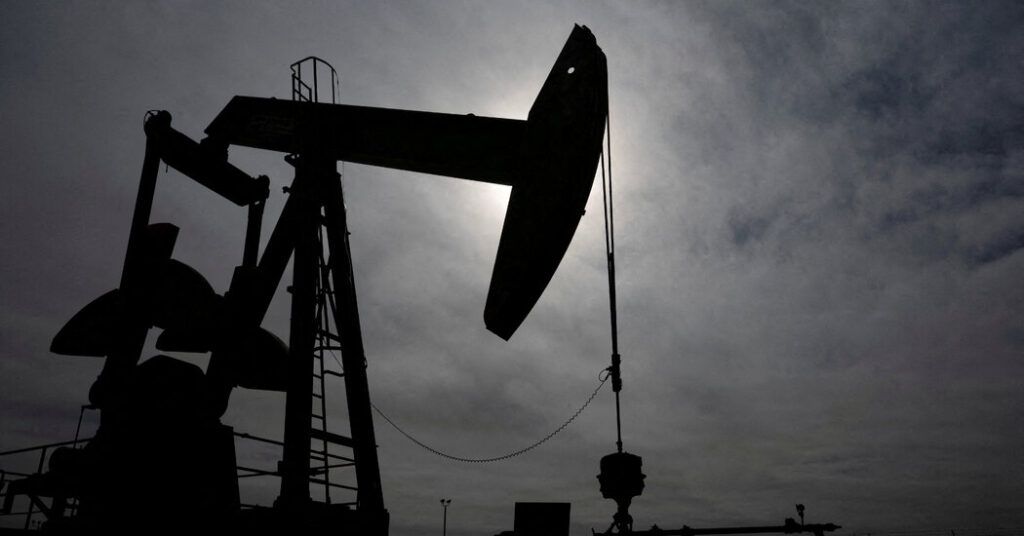
Oil prices rose on Wednesday when hostilities in the Middle East flared as Iranian drones struck Kuwait’s main international airport and the United States and Iran exchanged strikes.
Stocks wavered, rising across much of Asia but declining in Europe.
Energy markets have been on a hair trigger with the war in Iran dragging into a third month. Both the United States and Iran have continued to trade attacks while saying that a cease-fire is holding. The countries say that negotiations over a framework to settle the conflict are continuing.
Oil prices rise.
-
The price of Brent crude, the global benchmark for oil, was up more than 2 percent to about $98 a barrel.
-
West Texas Intermediate crude, the U.S. benchmark, was nearly 3 percent higher to around $96 a barrel.
-
Investors and analysts are focused on the continued disruption to shipping in the Strait of Hormuz, the narrow waterway between Iran and Oman that is a vital trading route for oil and natural gas that normally carries as much as one-fifth of the world’s oil supply.
Stocks waver.
-
Futures on the S&P 500 pointed to a modest decrease when stocks resume trading in the United States on Wednesday.
-
Stocks in Asia were mixed. The Nikkei 225 in Japan rose 2.5 percent and the Taiex index in Taiwan went up 2 percent, while the Hang Seng stock index fell 1.6 percent.
-
In Europe, stocks were down. The Stoxx 600, a broad-index that tracks the region’s largest companies, was 0.3 percent lower.
Gasoline prices dip.
-
Gas prices dropped on Wednesday to a national average of $4.26 a gallon, according to the AAA motor club. Still, prices have risen 43 percent since the war began.
-
Gas prices don’t move in lock step with crude, usually trailing increases or drops by a few days.
-
The average price of diesel also dipped to $5.41, up 44 percent since the start of the war.
The post Oil Rises as Hostilities Flare Overnight in the Persian Gulf appeared first on New York Times.