In California, Election Day often stretches into Election Week or even Election Month because of the time it takes to count the state’s high volume of mail ballots. That process, combined with the fact that many Democrats waited until the last minute to return their ballots this year, could lead to a long wait for a call in the state’s nonpartisan primaries.
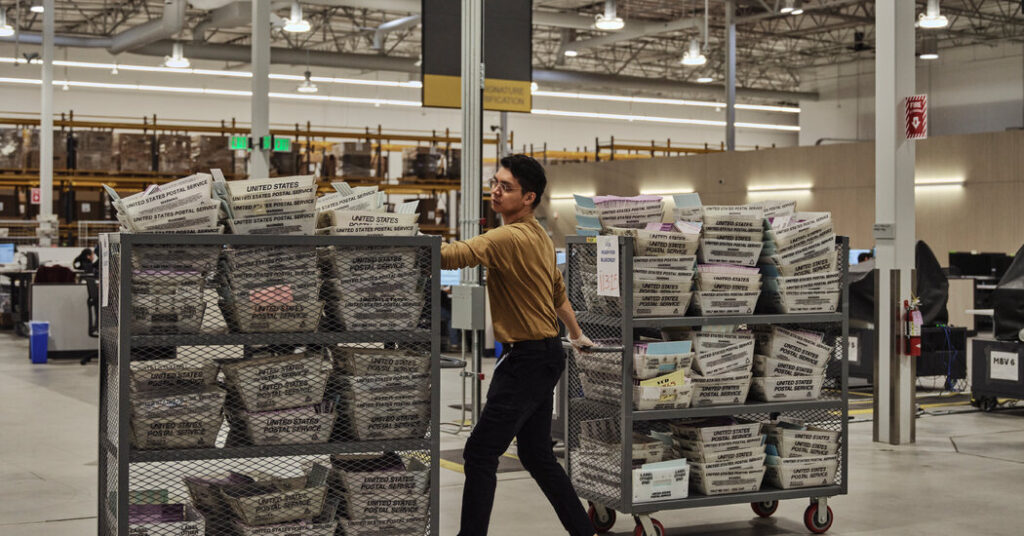
Typically, more than 80 percent of ballots in California are cast by mail. Counties process ballots that are returned well ahead of Election Day as they are received, and those votes are posted shortly after polls close on election night. But ballots received close to or on Election Day — as well as those postmarked by Election Day and received within seven days — can take up to 30 days to be counted.
Those later ballots, typically referred to as the “late mail” vote, often determine the outcome of the election. And this year’s primaries are further complicated by the fact that the share of ballots returned by registered Democrats has climbed in the lead-up to Election Day.
Four weeks ago, about 40 percent of the ballots cast by mail came from registered Democrats. In the past week, the Democratic share of returned ballots was over 50 percent.
In the 2022 primaries, by contrast, the partisan makeup of mail ballots remained relatively stable throughout the early voting period at about 53 percent. If this year’s trend continues, mail ballots counted in the days and weeks after Election Day could be significantly more Democratic than those reported on election night.
Even without a shift in partisanship over time, the counting still took a while in recent primaries: In 2022 and 2024, more than a quarter of the House races remained uncalled by the Monday morning the week after the primary. In 2024, only about half of the total vote had been counted by the end of election night.
The race to succeed Gov. Gavin Newsom, which has drawn national attention, has a crowded field, including two Democratic front-runners, Xavier Becerra and Tom Steyer, along with one Republican front-runner, Steve Hilton. They are vying for one of the top two spots in order to advance to the general election. Recent polling had more than 10 percent of voters still undecided in the weeks leading up to Election Day. A slight majority of those who have voted so far are 65 years or older, and just 7 percent are 30 or younger. In general, younger voters wait until later to cast their ballots.
If there is a lot of late mail vote outstanding after Tuesday, and especially if the margins between the second- and third-place candidates are close on election night, it could take days or weeks for the top two spots to be determined in that race. And downballot races could be in for a long wait as well.
Luke Vrotsos is an elections analyst at The New York Times who covers American elections and public opinion using a range of data sources.
The post Late-Arriving Ballots Could Lean Democratic in California appeared first on New York Times.